
Cue buying · 5 min read
Ten Pool Cue Buying Mistakes and How to Check for Them
Most cue buying mistakes happen before the cue reaches the table. The buyer compares appearance or one specification without defining the job, checking fit, confirming compatibility or recording what was actually tested. Use these ten checks to turn a product page or trial session into an evidence based decision.
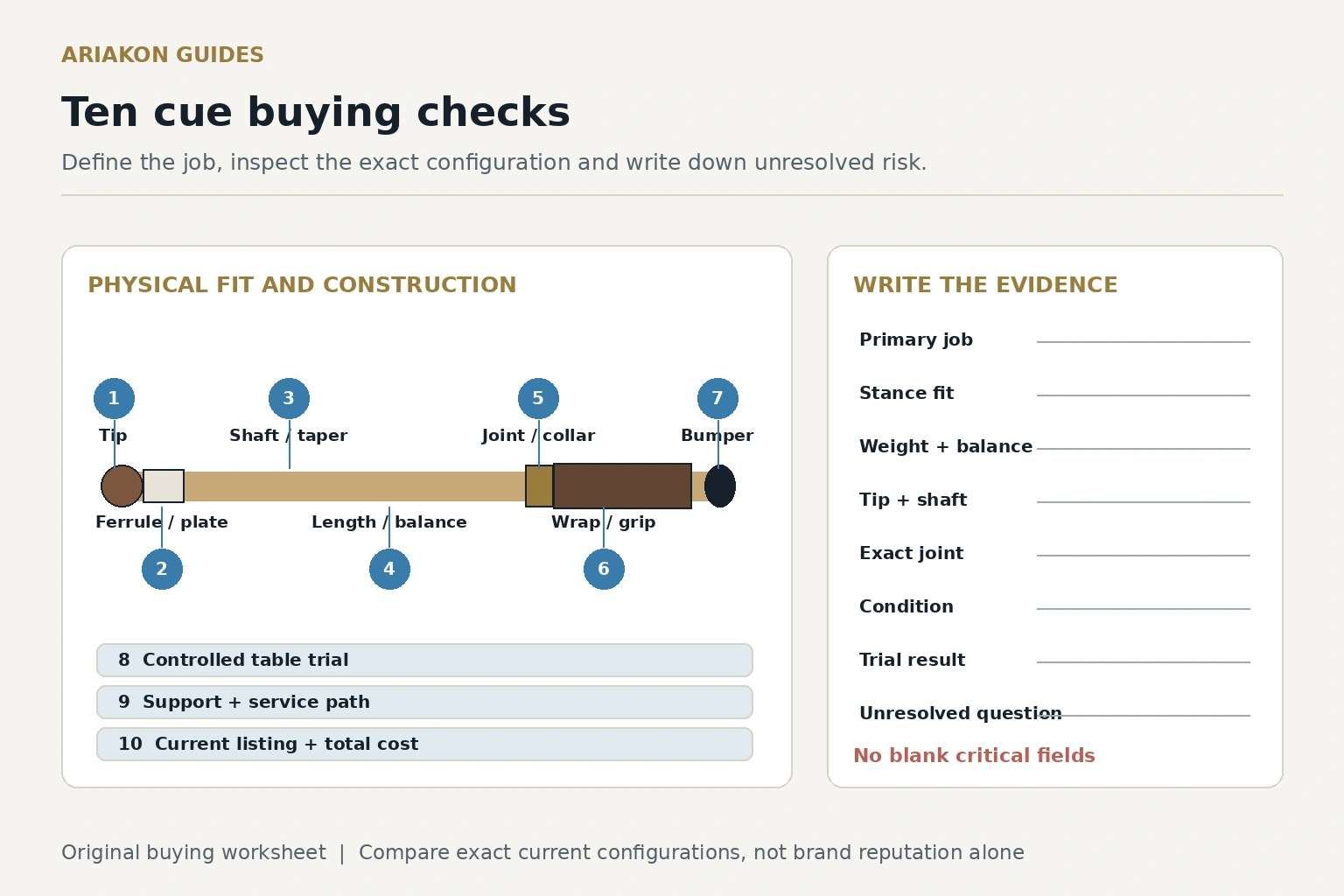
Mistakes one and two: undefined job and copied specifications
Mistake one is shopping for a playing, break, jump or short room cue without naming the job. Write the primary game, normal table size and whether the cue must share shafts or extensions. A cue built for a different task can be excellent equipment and still be the wrong purchase.
Mistake two is copying a professional player's weight, tip size or shaft without a fit test. Record your current cue, what you want to change and which result would show improvement. Preference and repeatability matter more than a borrowed number.
Start with the complete cue selection guide to define purpose, fit and a short comparison session.
Mistakes three and four: ignoring length and balance
Mistake three is treating nominal length as proof of fit. Get into your normal stance and check whether the grip hand stays on the intended wrap or handle area through the full stroke without crowding the bumper or forcing the shoulder. Room clearance also matters for a home table.
Mistake four is comparing total weight while ignoring balance. Two cues at the same weight can feel different because mass is distributed differently. Use the same grip location and ordinary warm up shots, then record whether the cue feels butt heavy, forward balanced or neutral to you.
Choose cue length for your stance and room when nominal length alone does not explain fit.
Test break cue weight as a controlled variable when the purchase is specifically for breaking.
Mistakes five and six: buying labels instead of construction
Mistake five is treating wood, carbon fiber, low deflection or pro taper as a complete behavior specification. Read the actual shaft material, taper, diameter, ferrule or plate, tip and care restrictions. Then test the cue with the aim compensation you normally use.
Mistake six is choosing a tip from soft, medium or hard wording alone. Those labels are not standardized across every maker. Confirm construction, diameter, installed height and replacement restrictions, then decide whether its maintenance fits your routine.
Decode named cue woods and their actual role before a material name becomes the whole buying decision.
Choose a cue tip from documented tradeoffs instead of relying on a hardness label alone.
Mistakes seven and eight: assuming compatibility and skipping condition
Mistake seven is accepting a family name as compatibility proof. Record pin geometry, thread, pilot or recess, collar diameter, mating faces and exact cue/shaft identities. A visually similar connection can still bind or leave a gap. Get written confirmation for the specific pairing; never force a trial fit.
Mistake eight is skipping a straightness and condition inspection. On a used or demo cue, inspect the tip, ferrule or plate, shaft surface, joint faces, wrap, finish and bumper. Roll tests can reveal some movement but do not replace sighting each component and checking assembled fit.
Identify the exact cue joint before ordering when a replacement shaft is part of the purchase.
Check cue straightness without overreading one roll during receiving or used cue inspection.
Mistakes nine and ten: weak trials and stale listing facts
Mistake nine is calling a few power shots a controlled trial. For a playing cue, use the twenty-attempt observation card below with the same layout and conditions. Record comfort and errors without claiming a durability test. A break or jump purchase instead needs its own permitted, job-specific trial; do not grade it by the playing-cue card.
Mistake ten is relying on a screenshot, review or old price instead of the current seller and manufacturer listing. Confirm the exact model, included shaft, tip, joint, length, weight options, warranty or service path, return terms and total delivered cost at purchase time. Do not assume availability or included accessories from a similar configuration.
Make twenty playing-cue observations reproducible
On a measured 100 × 50-inch playing surface with 2.25-inch balls, let x run 0–8 along the long cushions and y run 0–4 across the table; one unit is 12.5 inches in either direction. Use the real corner pocket P=(8,4). Place object-ball center O=(6,2) and cue-ball center C=(5,1). The centers and pocket are collinear. Ball radius is 0.09 unit; the contact-center position is G=(5.8727,1.8727), rounded from O−(0.18/√2)(1,1). All ball positions are centers, not diamond sights behind a rail.
Reset the same centers for five stop attempts, five modest follow attempts, five modest draw attempts and five ordinary rolling attempts. Choose comfortable legal contact offsets, record them, and do not chase maximum power. The first fifteen attempts use the targets below; the rolling block records potting and comfort only.
- For each target block, count a hit only when the object ball is potted and the cue-ball center rests inside or on the target boundary without a scratch.
- The target tally is at most 15 and the pot tally at most 20; report them separately, never as 35 successful shots.
- Repeat the current cue first and rotate candidate order on another day. These are personal observations, not a causal material comparison or an equipment ranking.
| Block | Cue-ball finish target | Record |
|---|---|---|
| Stop — 5 | Within 0.125 unit of G | Pots, target hits, miscues, grip comfort |
| Follow — 5 | Within 0.25 unit of (6.5,2.5) | Same fields; no scratch counts as a hit |
| Draw — 5 | Within 0.25 unit of (5.5,1.5) | Same fields; distinguish speed adaptation |
| Roll — 5 | No target; ordinary controlled roll | Pots, miscues and comfort; record the finish |
Use one comparison worksheet
| Check | Current cue | Candidate A | Candidate B | Evidence or unresolved question |
|---|---|---|---|---|
| Primary job | Fill in | Fill in | Fill in | Playing, break, jump or space constraint |
| Length and stance fit | Fill in | Fill in | Fill in | Normal grip location and clearance |
| Weight and balance feel | Fill in | Fill in | Fill in | Same shots and grip location |
| Shaft, taper and diameter | Fill in | Fill in | Fill in | Published specification |
| Tip construction and care | Fill in | Fill in | Fill in | Published specification |
| Joint and collar compatibility | Fill in | Fill in | Fill in | Written confirmation |
| Condition inspection | Fill in | Fill in | Fill in | Tip, shaft, joint, wrap and bumper |
| Controlled table trial | Fill in | Fill in | Fill in | Twenty named shots |
| Support and service path | Fill in | Fill in | Fill in | Current written terms |
| Exact configuration and cost | Fill in | Fill in | Fill in | Current seller checkout facts |
Inspect a current Ariakon cue listing to verify the exact delivered configuration rather than infer specifications from this guide.
Make the final decision from unresolved risk
Circle every blank in the last column. A candidate with impressive marketing but unresolved joint fit, condition or return terms is not ready to compare. Ask the seller or manufacturer a precise question and save the answer with the receipt.
Choose the cue that meets the job, fits your body and has the fewest important unknowns. Keep the worksheet for receiving inspection. If the delivered configuration differs from the written evidence, stop using it and follow the seller's current resolution process before modifying anything.
Sources and further reading
References support the specific factual information above. The practical checklists are Ariakon editorial guidance.