
Cue materials · 4 min read
Pool Cue Woods: Maple, Ash and Decorative Butt Materials
A wood name can describe a playing shaft, a structural splice, an outer sleeve, a thin veneer or a decorative inlay. It does not automatically identify the rest of the cue or predict performance. Use the ROLE–EVIDENCE–CONSTRUCTION worksheet to translate a listing into known facts, unknowns and follow-up questions before comparing complete cues or shafts.
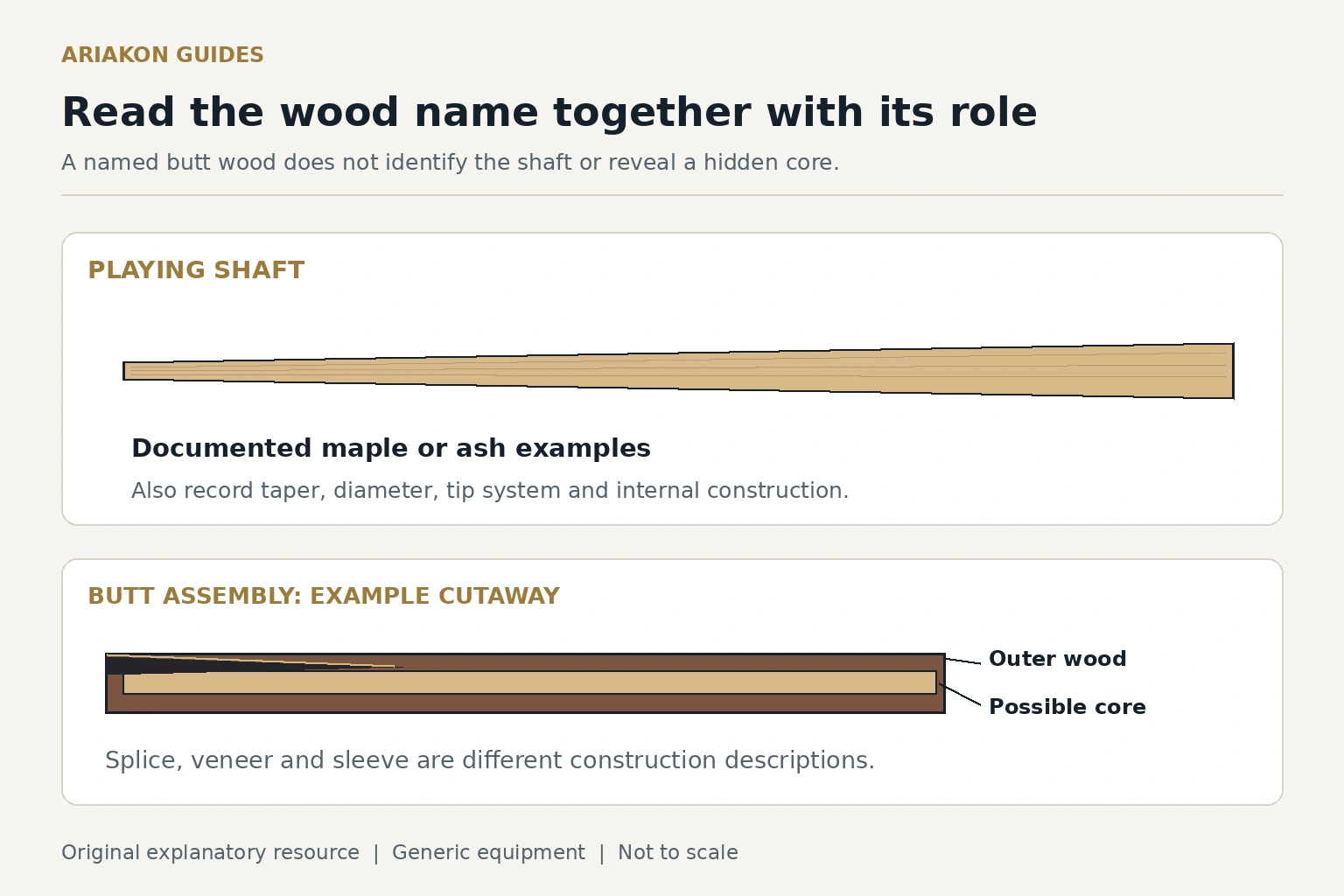
Map the named material to one cue role
A listing that names dark butt points does not identify the shaft. A pale shaft does not prove a particular maple species, a solid blank or one internal design. Keep location, role and evidence in separate columns.
| Cue area | Possible role | Evidence to seek | Do not infer |
|---|---|---|---|
| Playing shaft | solid wood, laminated wood or mixed construction | exact shaft documentation and visible condition | species from color alone |
| Forearm or splice | structural outer section or joined points | maker construction description | hidden core from visible points |
| Butt sleeve | outer shell over another structure | cross-section or exact maker record | solid construction |
| Veneer or inlay | thin or localized decorative element | listed placement and material | playing effect from rarity |
| Core | hidden stabilizing or weighting structure | exact model documentation | presence from exterior grain |
Trace cue construction stage by stage when the question is how parts become an assembly.
Name every cue part and fit boundary when the task is replacement compatibility.
Read maple and ash as species groups, not promises
The USDA Wood Handbook explains that properties vary among species and with physical characteristics; species selection alone can be insufficient for a specific use. Apply that general materials principle conservatively. The handbook does not grade cue blanks or certify any cue.
Ash may show prominent grain and maple may appear quieter in common examples, but finish, stain, cut, lighting and the individual piece change the view. Use visible grain to describe the surface, not to issue an identity or quality certificate.
| Claim | What it can support | What remains unknown |
|---|---|---|
| Maple shaft documented | named material in the shaft | exact species, grading, moisture history, taper and hidden construction unless stated |
| Ash shaft documented | named material in the shaft | individual grain, stiffness, taper, tip system and intended game unless stated |
| Visible straight grain | surface observation | internal defects, seasoning, straightness stability or species certificate |
| Decorative butt wood documented | named material at a stated location | core, sleeve thickness and performance effect unless stated |
Separate wood from geometry and front-end construction
Bridge feel, cue-ball response and service limits arise from the complete shaft, not the species line alone. Never attribute a difference to wood when taper, diameter, tip or internal construction also changed.
| Field | Candidate A | Candidate B | Evidence |
|---|---|---|---|
| Named material and species detail | ___ | ___ | exact documentation |
| Solid, laminated, cored or unknown | ___ | ___ | model construction record |
| Length and joint | ___ | ___ | measured and documented fit |
| Diameter at tip and bridge | ___ | ___ | same measuring method |
| Taper profile | ___ | ___ | diameter stations |
| Tip, pad, ferrule or plate | ___ | ___ | visible and documented front end |
| Condition and finish | ___ | ___ | light, touch and care record |
Measure shaft taper and bridge feel when geometry is the real comparison.
Decode a mixed-material listing
Example listing: maple shaft, dark-wood forearm points, colored veneers and a cored butt. Enter maple only in the shaft-material row. Enter the dark wood in the forearm or splice row, veneers in the decorative row and cored in the hidden-construction row. Then ask for the actual core, shaft model, joint and finish instructions.
Do not rewrite the listing as an all-maple cue or a solid dark-wood butt. If the seller cannot document a hidden field, write unknown. That answer protects the comparison from a photograph-based guess.
Compare complete shafts without claiming a species test
Use compatible shafts on the same butt only when the joint and seating are documented. Mark object-ball center at the foot spot, call the right foot corner and place the cue-ball center exactly two diamonds behind the object ball on the pocket-center line. Shoot five stop attempts and five gentle follow attempts with Shaft A, then Shaft B. Reverse the order on another day.
Award one point for the called pot and one for cue-ball finish inside the marked target: 20 maximum per shaft per day. Also record bridge comfort and any service concern without turning preference into points. The result compares those complete configurations. It does not isolate maple, ash or any other species.
| Observed result | Safe wording | Unsupported wording |
|---|---|---|
| A repeats higher control score | Shaft A fit this task better in two sessions | its wood species is more accurate |
| B feels smoother in bridge | B's complete surface and profile felt smoother | ash or maple always feels smoother |
| Tie with different preference | scores tied; preference differed | rare wood adds performance |
Use material- and finish-specific care
Record the exact shaft, finish and construction before choosing a cleaner or burnishing method. A finished butt, unfinished or low-finish wood shaft, laminated shaft and composite shaft can have different boundaries. Furniture polish, oil, wax, abrasive paper and moisture are not generic cue-care tools.
Store the assembled or cased cue away from impacts and prolonged temperature or humidity extremes. The USDA handbook explains wood–moisture relationships generally, but the exact cue documentation must control service. Unknown means dry cloth, protective storage and qualified guidance—not experimentation.
Use material-appropriate shaft care after the exact construction and finish are recorded.
Sources and further reading
References support the specific factual information above. The practical checklists are Ariakon editorial guidance.