
Equipment care · 4 min read
Keep a Pool Cue Shaft Clean Without Hiding Damage
A shaft can feel rough or sticky because of hand oil, chalk, moisture, raised wood fiber, a damaged finish or a contaminated case. Those causes do not share one remedy. Use the IDENTIFY–DRY–DOCUMENT–RECHECK process to remove ordinary residue without treating damage as dirt or copying instructions from a different material.
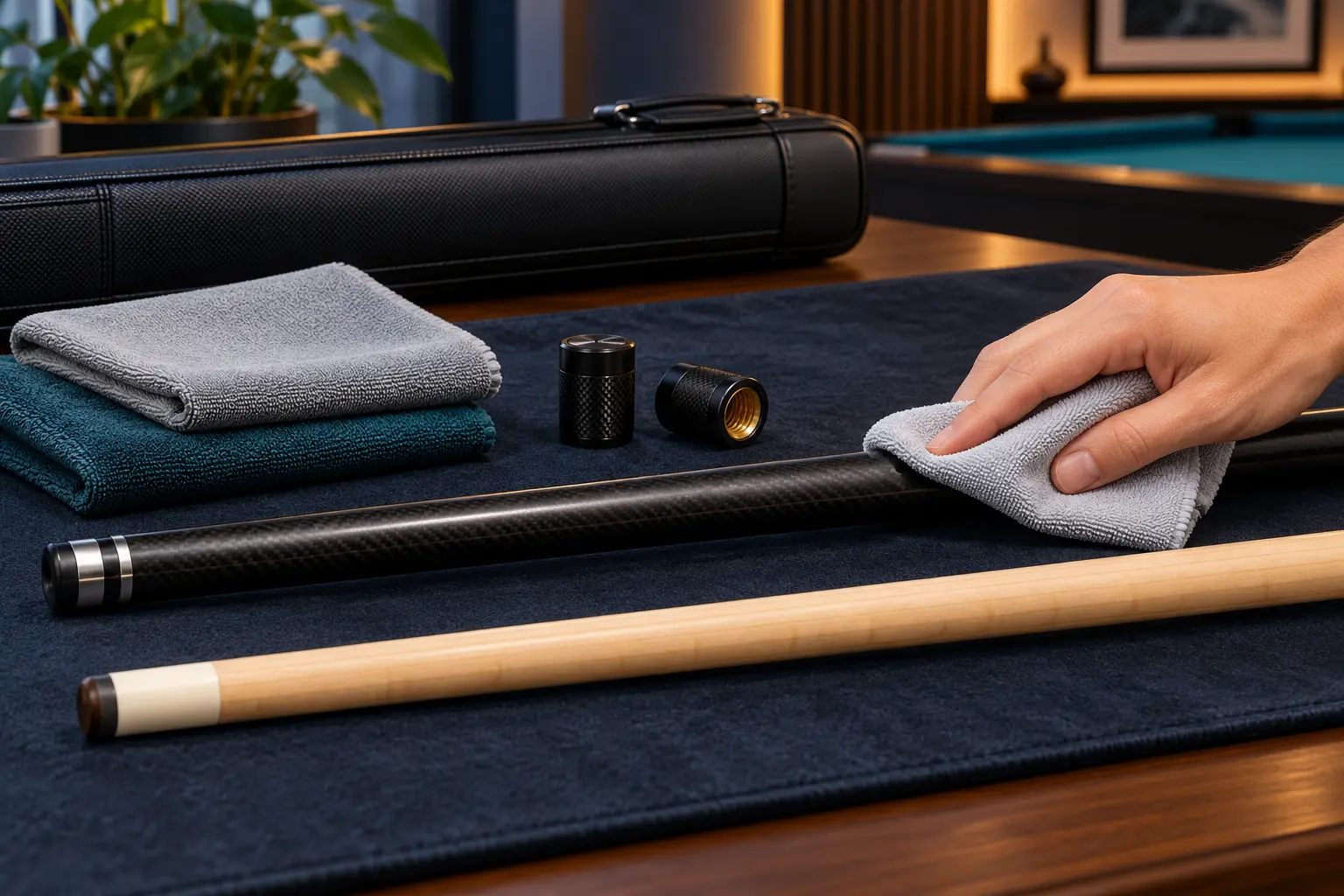
IDENTIFY the shaft before touching the surface
When material or finish is unknown, stop at a clean dry soft cloth and contact the maker or a qualified technician. Color is not an identification method: a dark shaft is not automatically carbon fiber, and a wood-colored surface may include a finish or laminate.
Photograph dents, raised areas, cracks, finish lifting, corrosion near a joint or an opening at the ferrule before cleaning. Those observations belong in a condition record, not under a residue label.
| Field | Record | Why it changes the decision |
|---|---|---|
| Maker and exact model | ___ | Locates the applicable care instructions |
| Material | wood / composite / carbon fiber / unknown | Methods are not interchangeable |
| Finish or coating | documented / unknown | A cleaner may affect the surface |
| Date and condition | ___ | Separates new residue from existing wear |
| Care source checked | page and date | Prevents memory from becoming a policy |
Prevent buildup during play
A glove may make bridge friction more consistent, but it does not clean the shaft. A smoother sensation after putting on a glove is not evidence that residue or surface damage has been removed.
- Wash and dry the bridge hand before the session.
- Keep chalk away from the shaft and return it to a defined holder.
- Reserve one clean soft cloth for the cue; do not reuse a table or spill cloth.
- Wipe the shaft in straight, light passes when friction changes.
- Let a damp bridge hand dry before handling the shaft.
- Keep open drinks and spray products outside the cue-care area.
Use the least aggressive documented step
Ariakon’s current FAQ directs owners of its carbon-fiber equipment to use a clean soft cloth, avoid abrasive cleaners and excessive heat, and contact Ariakon before using an unfamiliar care product. That is documented Ariakon guidance; it is not a universal instruction for every shaft.
Do not sand, burnish, polish or apply a household chemical merely because a dry cloth did not solve the feel. Those actions can change dimensions, finish, graphics or service eligibility. Apply any specifically permitted liquid to the cloth rather than spraying toward the cue or table.
| Step | Use only when | Stop when |
|---|---|---|
| 1. Dry soft cloth | Identity known or unknown; loose residue | Texture or color changes |
| 2. Maker-approved method | Current instructions match exact shaft | Unexpected transfer, drag or finish change |
| 3. Maker support | Residue remains or instructions are unclear | Await a documented answer |
| 4. Qualified service | Dent, raised fiber, finish failure or structural concern | Do not continue home treatment |
Separate residue from wear with a four-zone RECHECK
Use the same light, hand condition and bridge cloth for the before-and-after check. If visible residue decreases and the surface remains unchanged, the bounded care step did its job. If a mark or rough area remains in exactly the same place, document it as a possible condition issue rather than escalating automatically.
A table-roll observation can be affected by taper, joint collar, table flatness and viewing angle. Use it as a prompt for a qualified inspection, not a verdict that the shaft is warped.
| Zone | Look and feel for | Next action |
|---|---|---|
| Tip and ferrule | gap, crack, looseness or residue line | Service structural concerns |
| Front 12 inches | friction band, dent, raised fiber or finish change | Compare with pre-clean photo |
| Mid-shaft | uniform feel and straight visual reference | Do not diagnose straightness from one roll |
| Joint and collar | debris, damage or incomplete seating | Clean only as documented; verify assembly |
Control heat, moisture and storage
- Dry the shaft and cloth before closing the case.
- Keep the cue away from a hot vehicle, direct sun and standing moisture.
- Store sections supported in a clean case rather than leaning under load.
- Keep chalk and abrasive tools in separate closed compartments.
- Let a closed case acclimate after a large temperature change before opening it.
- Repeat the identity and condition check after travel or service.
Choose a cleaner for wood or carbon fiber after the material and current instructions are documented.
Remove residue without treating wear as dirt for a focused residue-versus-condition decision.
Sources and further reading
References support the specific factual information above. The practical checklists are Ariakon editorial guidance.