
Cue care · 3 min read
Choose a Shaft Cleaner for Wood or Carbon Fiber
Wood, coated wood and carbon-composite shafts can share a color while requiring different care. A safe cleaner choice begins with identity, not a generic recipe. Use the MATERIAL–INSTRUCTION–LABEL–PATCH worksheet. If any field is unknown, limit the action to dry wiping and qualified identification; do not infer permission from another shaft.
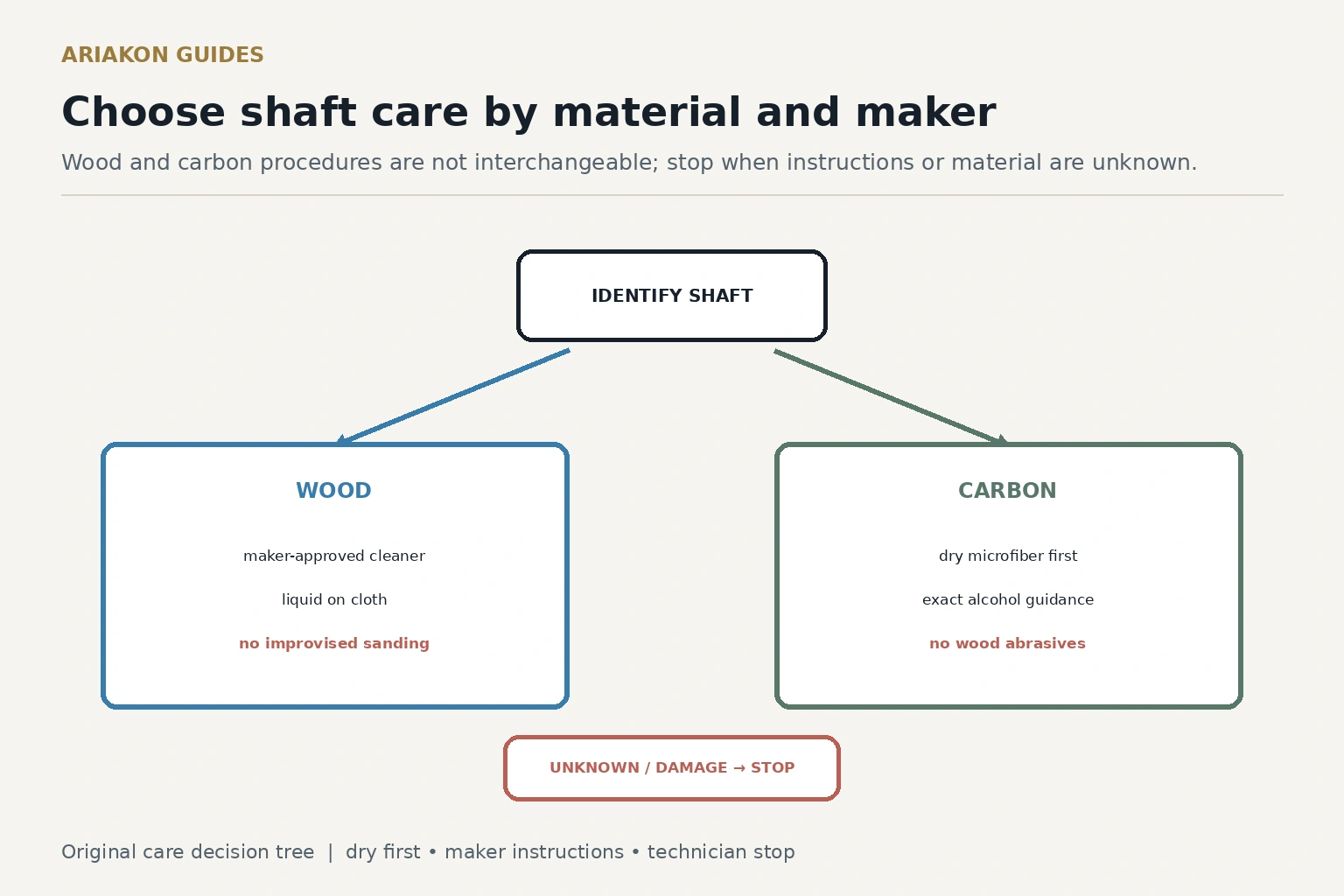
Build a material and finish record
| Field | Record | Stop when |
|---|---|---|
| Maker and exact model | ___ | identity cannot be supported |
| Material | wood / coated wood / carbon composite / other ___ | only appearance is available |
| Surface finish | unfinished / sealed / coated / unknown | finish state is unknown |
| Condition | residue / discoloration / raised fiber / scratch / chip | damage is mistaken for dirt |
| Current care instructions | document title/date ___ | no instructions or conflict |
| Service boundary | owner-safe / qualified service | warranty or safety requires service |
Separate wood and composite care routines for storage, prevention and periodic inspection.
Distinguish residue from wear before selecting any liquid.
Screen the proposed cleaner
A material category does not grant blanket permission. Different finishes and composite systems may impose different chemical and abrasive limits. Preserve the exact instruction date in the record because a product label, warranty or service method can change.
| Question | Accept only when | Reject when |
|---|---|---|
| Named material | Cleaner label and shaft instructions both permit it | Either excludes or omits the material |
| Concentration | Exact range matches the instructions | A generic stronger-is-better assumption |
| Application | Cloth, amount and drying method agree | Direct spray, soaking or heat is proposed |
| Abrasive content | Explicitly permitted for this finish | Unknown grit, pad or polishing compound |
| Damage boundary | Only transferable residue is present | Chip, split, soft spot, lifted finish or unusual noise |
Use a dry-first patch sequence
- Wash and dry hands; protect the tip, joint and any opening from debris or liquid.
- Photograph the shaft under the same light and mark one nonplaying test zone in the record, not on the shaft.
- Wipe with a clean dry lint-free cloth; stop if a structural change becomes visible.
- Only when exact instructions permit, place the documented amount on the cloth—never improvise direct spray.
- Make the documented number of light passes in the patch, then dry for the full stated interval.
- Compare feel, sheen, color transfer and surface integrity before extending the method.
Score evidence, not cosmetic perfection
Any zero stops extension regardless of total. A dark wood mark that does not transfer may be wear or discoloration, not remaining dirt. A composite chip, split, deep scratch, lifted coating or unusual sound stops play and goes to the documented service path.
| Check | 0 | 1 | 2 |
|---|---|---|---|
| Surface integrity | new damage | uncertain | unchanged |
| Residue transfer | none or worse | some | clear reduction |
| Feel | rougher, sticky or soft | mixed | returns to documented normal |
| Finish | uneven sheen or color | uncertain | uniform and dry |
Worked decision
A player has two dark shafts. One identity card confirms sealed wood; the other lacks any reliable model record. The proposed cleaner is permitted only for the identified sealed finish. The player runs a documented patch there and uses dry wiping only on the unknown shaft while seeking identification. Similar appearance never becomes compatibility evidence.
Inspect an unknown shaft before comparison when labels and records are missing.