
Cue care · 3 min read
Shaft Polishers and Abrasives: Material Compatibility Comes First
Polishing, burnishing and abrasion are different amounts and kinds of surface change. A product accepted for one identified wood finish can remove material or coating from another; an unknown composite should never become the experiment. Use MATERIAL–FINISH–PERMISSION–LIMIT and keep cleaning separate from material removal.
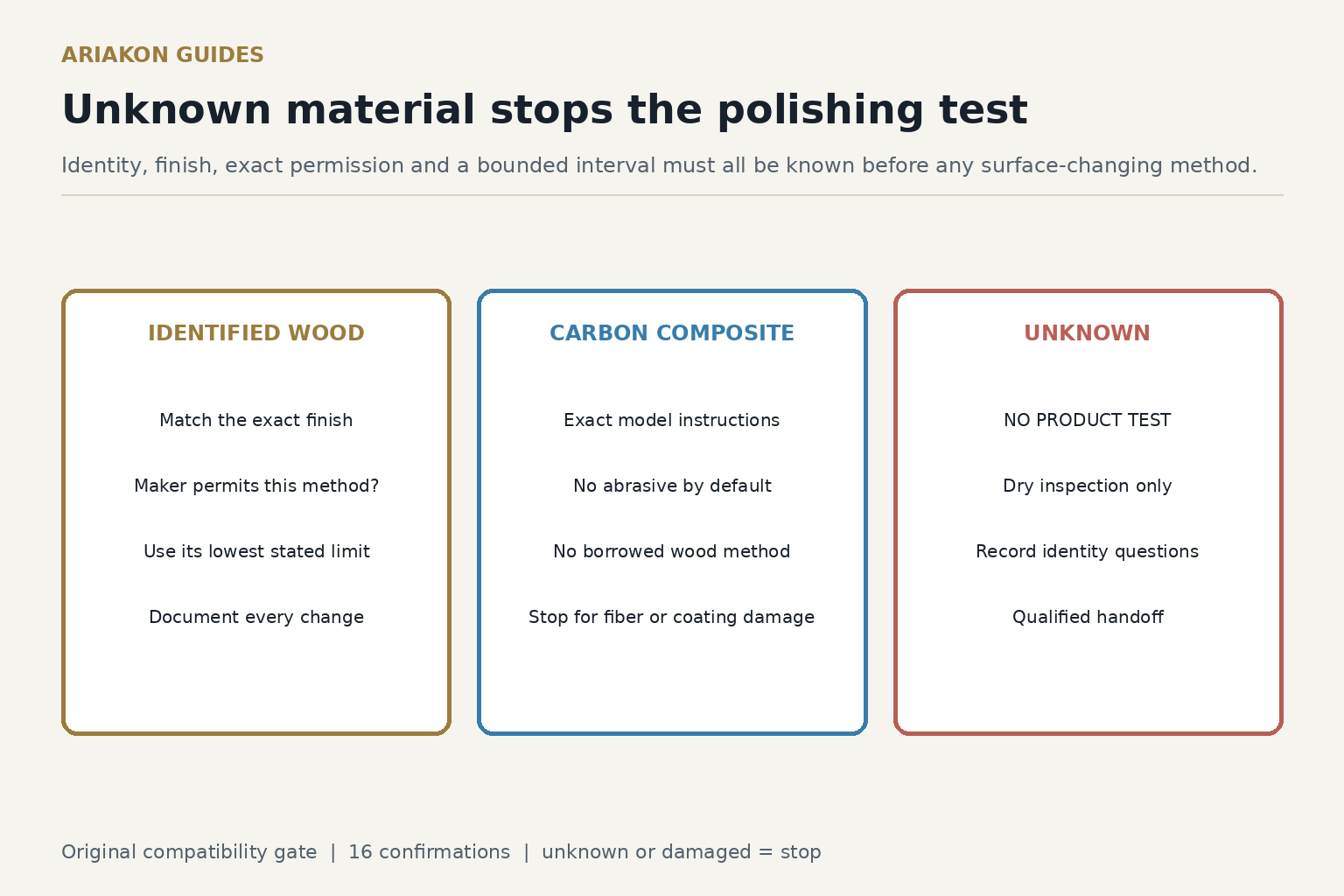
Classify the surface before the product
| Shaft record | Fact to verify | Default while unknown |
|---|---|---|
| Sealed or finished wood | Named finish and permitted pad, liquid or paper | Dry lint-free cloth only |
| Unfinished wood | Exact cleaner, burnisher and any abrasive limit | Do not assume bare wood permits sanding |
| Carbon composite | Model-specific cleaning method and prohibited actions | No abrasive or conventional burnisher |
| Painted, coated or wrapped surface | Coating-specific care | No visible-area test |
| Unknown material or prior repair | Identity and service history | Stop and hand off |
Classify residue, stain, wear and damage first before treating appearance as a polishing problem.
Choose the cleaner separately when the task is removable residue rather than surface finish.
Complete sixteen confirmations
Proceed only at 16/16. Completion defines a bounded trial, not a guarantee against damage. Inspect the tool and control its slip path; use the exact shaft instructions to determine material and finish compatibility.
| Area | Four confirmations |
|---|---|
| Identity | Maker; exact model; material; finish |
| Condition | No crack; no splinter; no lifted coating; no deep dent |
| Method | Exact product; permission; current instructions; clean undamaged tool |
| Control | Hidden band; light pressure; cycle ceiling; written stop point |
Run one least-change test
- Photograph a dry 50-millimeter band near the joint under fixed side light.
- Protect the tip, joint opening, wrap and table surface.
- Apply only the documented product and motion to the recorded test band.
- Limit the first cycle to the instruction's amount or two light lengthwise passes, whichever is lower.
- Allow the full drying interval before comparing feel, sheen, transfer and surface integrity.
- Do not expand beyond the test band unless every recorded field remains acceptable.
Stop before polishing becomes removal
| Observation | Decision |
|---|---|
| Transfer stops and dry feel is even | Stop successfully |
| Finish becomes dull, patchy, tacky or lighter | Stop and request service guidance |
| Fibers rise or cloth catches | Stop; do not escalate grit |
| Colored or black material transfers from the shaft | Stop play and isolate the cloth |
| Diameter, roundness or coating thickness is in question | Qualified measurement, not hand sanding |
| Crack, splinter, chip or lifted coating appears | No play until inspected |
Worked compatibility decisions
An identified wood shaft with an intact finish has a current document permitting one named conditioning method. The card reaches 16/16, the bounded test removes residue and the dry sheen stays even. The owner stops and records the cycle; the result does not authorize the method on another shaft.
An unlabelled black shaft has a dull band and no service history. Identity, finish and permission are missing, so the card stops before any abrasive is opened. The evidence packet goes to a qualified technician.