
Cue care · 4 min read
Protect a Favorite Pool Cue During Travel and Storage
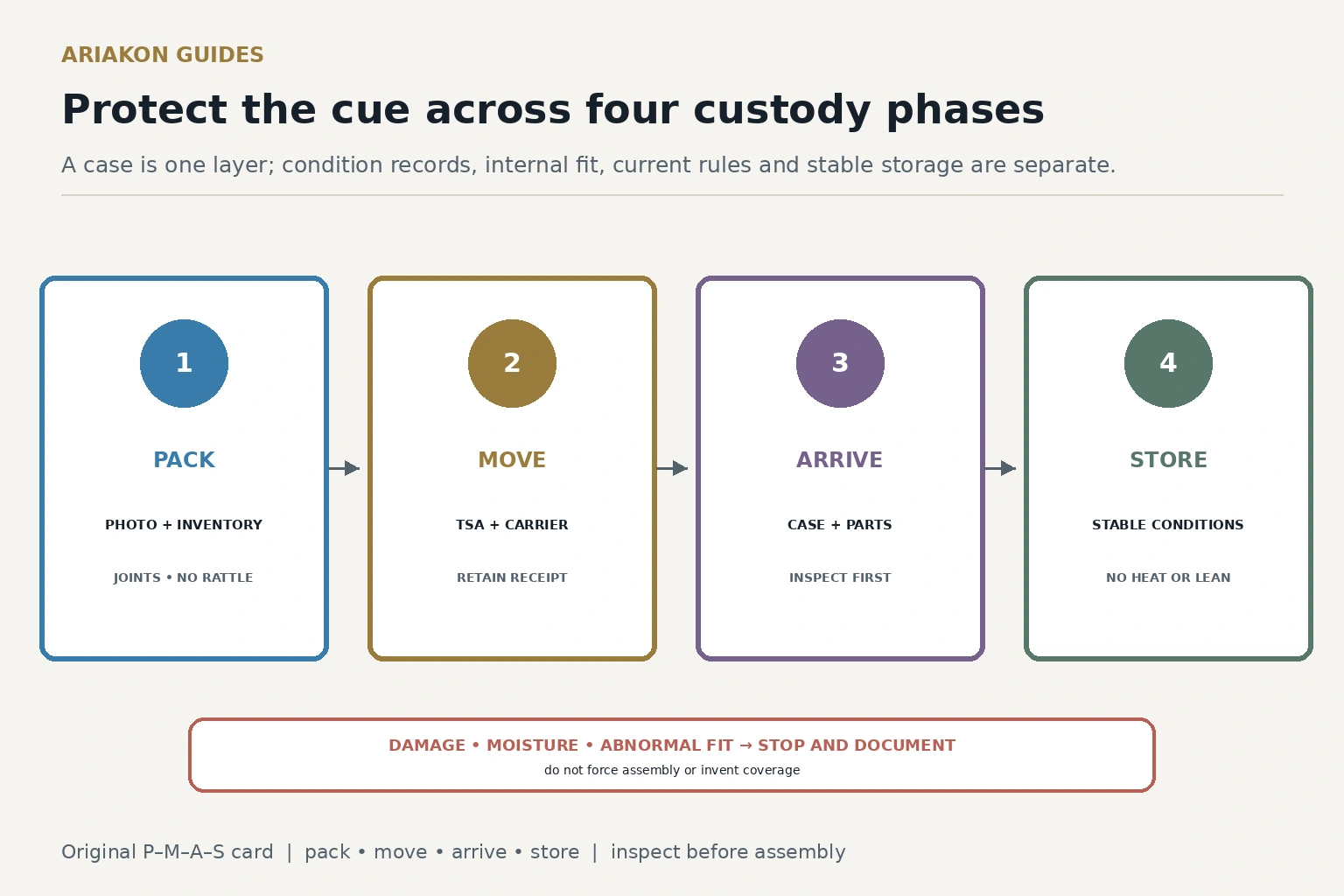
A favorite cue needs a condition trail as well as physical support. This custody worksheet follows the same equipment through packing, movement, arrival and storage. It is separate from choosing a travel case or filling it for a tournament. The record helps you notice and report a change; it promises neither damage prevention nor reimbursement.
Create six paired condition records
Use your own photographs of your actual equipment on a stable surface. Keep date and filenames with the inventory, not personal details in publicly shared photos. Leave an unknown field unknown. A casual roll or photograph does not certify shaft straightness. Use the same safe inspection method and ask qualified service to evaluate a suspected change.
| Area | Departure baseline | Arrival comparison |
|---|---|---|
| Identity | Section descriptions, receipt or serial evidence and date | Same pieces accounted for; uncertainty recorded |
| Joint | Clean visible mating surfaces, threads and permitted protector fit | No new crack, impact, thread change or forced fit |
| Shaft | Overview and close views of the surface under consistent light | New scratch, residue, wetness or deformation recorded |
| Tip and support | Leather edge, bond and ferrule or plate in close views | No newly opened bond or support damage |
| Butt and finish | Full-length view and existing wear details | New finish damage or changed wrap edge |
| Case and contents | Exterior, closures, packing map and full inventory | Impact, moisture, missing item or shifted load |
Confirm joint identity before assigning or forcing a protector.
Give each phase three independent confirmations
The maximum is 12 confirmations. Use VERIFIED, UNKNOWN or FAILED; only VERIFIED earns a confirmation. Any defect, missing part, unexplained moisture or abnormal fit blocks use even if the other eleven fields are complete. Keep evidence for each field rather than replacing the log with a total.
| Phase | Three required confirmations |
|---|---|
| PACK | Baseline and inventory saved; dry sections properly separated; closure/restraints and permitted joint protection checked |
| MOVE | Actual route and rules verified; case handled without unrestrained movement or prolonged exposure; custody handoff/receipt saved if applicable |
| ARRIVE | Inventory matched; six paired condition areas inspected; safe-use decision recorded before assembly |
| STORE | Exact equipment care/storage instructions saved; supported stable location chosen; next dated inspection scheduled in the log |
Separate baggage screening from acceptance and liability
As checked October 13, 2026, the official U.S. TSA indexed pool-cue listing says no for carry-on and yes for checked baggage, with the checkpoint officer making the final decision. Direct page retrieval was unavailable during this check. Reopen the government listing before the actual trip; the indexed classification does not establish airline acceptance.
Save the operating carrier’s current rules for every segment, packed dimensions/mass, required packing, fees and any coverage terms you elect to use. A tag, lock or photograph does not itself prove entitlement to compensation. For other countries or modes, use their current authorities. For a car trip, restrain the case safely and do not leave the cue in a parked vehicle as storage.
Verify route-specific case acceptance before relying on a hard shell or familiar baggage routine.
Inspect changes before trying to correct them
At arrival, photograph exterior damage before opening. On a stable surface, match the inventory and all six condition areas. If equipment is wet, unusually hot or cold, damaged or resistant to normal assembly, stop. Save the observation and obtain guidance for that actual material; do not use force, heat, chemicals or sanding to make it appear normal.
If no concerning change appears, follow the equipment instructions for acclimation and assembly. Keep shaft, wrap and finish care separate. Time to acclimate and permissible temperature or humidity ranges are model-specific; this worksheet supplies no universal number or recipe.
Use separate care records instead of sharing an unverified cleaner.
Close the custody loop with a worked stop decision
Hypothetical trip: PACK is 3/3 and MOVE is 3/3. All pieces arrive, but a new line appears at the shaft joint. The ARRIVE inspection is documented, yet safe use cannot be confirmed, so ARRIVE is 2/3. STORE is 3/3 after a protected hold location and service contact are recorded. Total 11/12 does not permit play; the cue remains unused pending qualified assessment.
Store the cue supported as its instructions require, away from direct sun, heat sources, damp exposure and lateral loading. Record location, date and next inspection, repeating the six condition views at that check. Preserve the trip evidence if a claim or service request is needed, while keeping the current carrier or coverage process separate from the physical condition log.
Build the event load after the cue and case are safe to use.
Sources and further reading
References support the specific factual information above. The practical checklists are Ariakon editorial guidance.