
Cue care · 3 min read
Build a Pre-Shot Chalking Habit You Can Audit
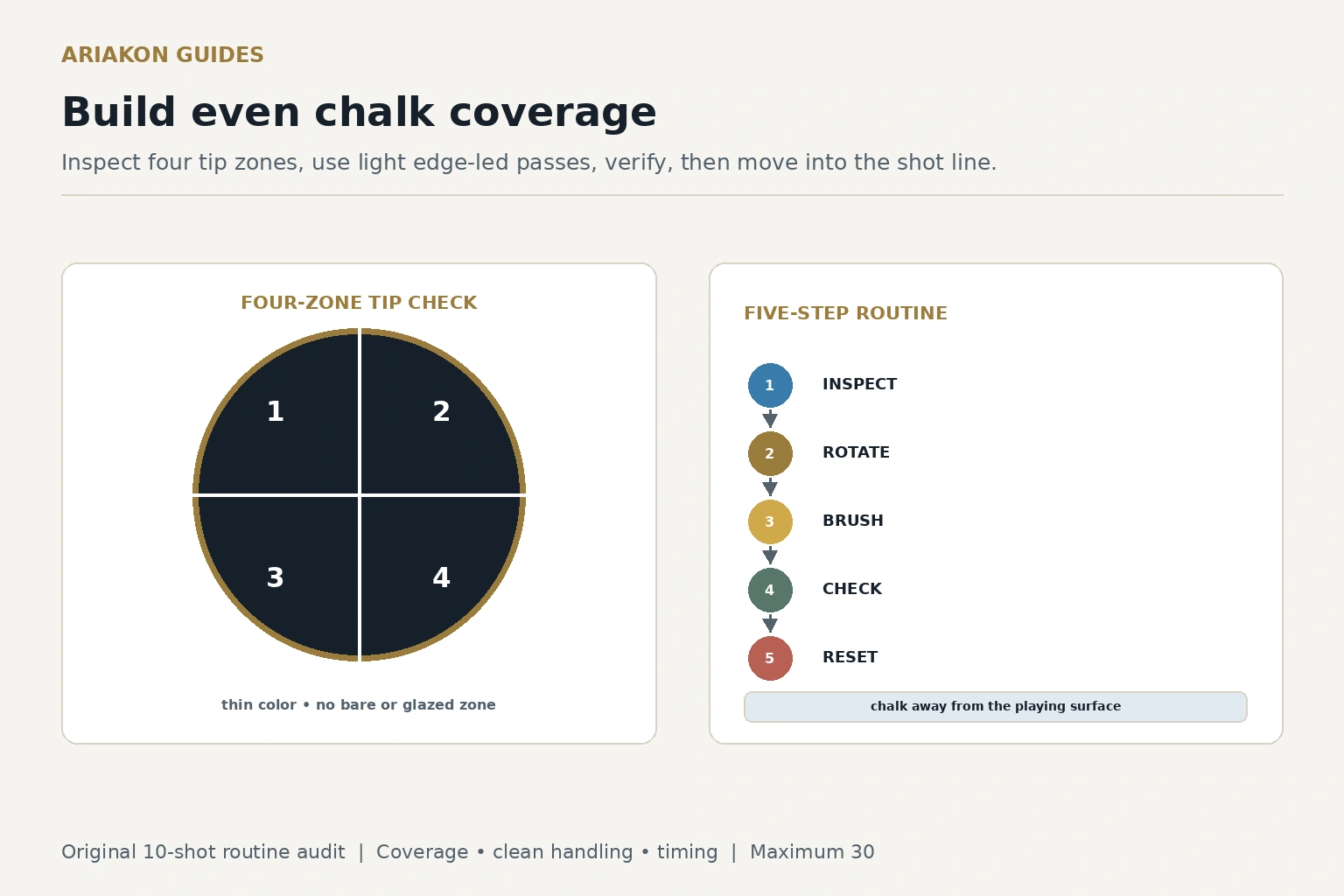
Knowing how to brush chalk across a tip does not guarantee the step happens at the right time. This guide turns application into a standing habit: INSPECT while upright, COVER before aiming, CHECK the four zones, RESET the cube away from the playing surface, then enter the shot line. Score adherence across ordinary shots; do not treat pocketing or one miscue as proof about the chalk.
Learn the technique before auditing the habit
Use the separate application guide to practice light edge-led passes and an eight-sector dome check. This page begins after that motion is understood. Its reader task is timing and repeatability inside a pre-shot routine, not detailed tool technique or chalk-product comparison.
Inspect the tip under even light. A loose, torn, delaminated or badly glazed surface is a maintenance stop. More pressure and more chalk do not repair structural condition.
Learn the detailed chalking motion before scoring habit adherence.
Use the cue-tip care decision routine when the surface is damaged or will not accept chalk.
Anchor five actions to the standing routine
The current international equipment guidance treats cloth cleaning and permitted chalk colors as equipment concerns for covered competition conditions. Keeping loose particles away from the playing surface is a conservative room-care practice; it is not a claim that one chalk formula performs better.
| Action | When | Visible evidence | Restart signal |
|---|---|---|---|
| Inspect | standing before aim | tip condition and four zones visible | damage or glossy patch |
| Cover | before selecting final line | light pass reaches all four zones | grinding or ferrule contact |
| Check | cue rotated once under light | thin color with no bare zone | bare quadrant remains |
| Reset | still away from shot line | cube returned; dust kept off bed and rails | chalk on rail or over table |
| Enter | after cube is put away | both hands available for normal routine | chalking from final stance |
Score ten ordinary shots for thirty points
Use ten normal practice shots, not a special maximum-spin drill. Three observable habits per shot produce a maximum of 30 points. Pass at 27 or higher with no ignored tip-condition stop and no chalk placed on the rail. Pocketing does not add points; the audit measures behavior.
Write the shot number for every zero. A cluster in one column identifies the next action: move the habit earlier, relearn coverage or change the storage location.
| Point per shot | Pass evidence | Zero evidence |
|---|---|---|
| 1. Timing | complete before entering final stance | step occurs in stance or after aiming |
| 2. Coverage | all four zones appear thinly covered | bare zone, grinding or tip-condition stop ignored |
| 3. Reset | cube stored; no chalking over cloth | cube on rail, dust over bed or chalk still in hand |
Use the two-session retention check
Repeat on a different day with the same chalk storage location. Two passes support a stable habit for those conditions. A score drop shows where the routine broke; it does not prove that the tip, cube or table changed.
| Session | Timing /10 | Coverage /10 | Reset /10 | Total /30 |
|---|---|---|---|---|
| Day 1 | ___ | ___ | ___ | ___ |
| Day 2 | ___ | ___ | ___ | ___ |
| Difference | ___ | ___ | ___ | ___ |
Diagnose failures without changing products
| Repeated failure | First adjustment | Do not conclude |
|---|---|---|
| Chalk occurs in final stance | move cube beside the planning position | faster chalk is required |
| Same zone stays bare | return to eight-sector technique practice | cube caused the miss |
| Dust reaches cloth | change location and reduce pressure | more residue means more grip |
| Cube remains on rail | assign a fixed holder or pocket | rail storage is harmless |
| Tip will not accept chalk | stop for condition review | harder grinding is the repair |
Compare chalk only after the habit passes
A product comparison needs the same tip, application procedure, shot set, cleaning method and observation fields. Run that separate task only after the routine passes twice, or application differences will be confused with product differences.
This habit audit makes no brand recommendation, inventory claim or performance promise. It creates a repeatable input so later observations have a cleaner baseline.
Run a controlled cue-chalk comparison after the habit passes in two sessions.
Sources and further reading
References support the specific factual information above. The practical checklists are Ariakon editorial guidance.