
Cue care · 3 min read
Remove Shaft Dirt Without Treating Wear as Dirt
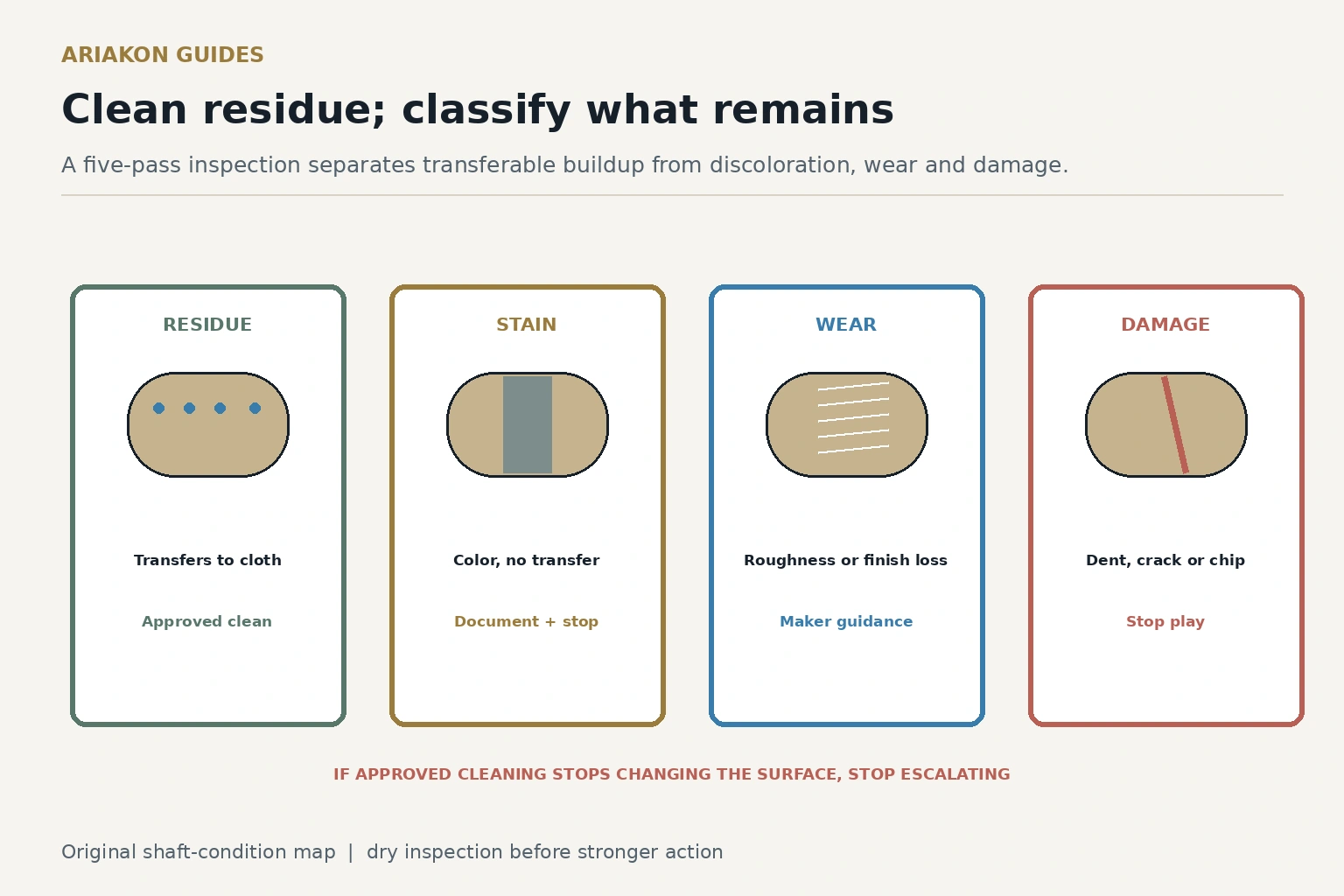
Darker is not the same as dirtier. Residue can transfer to a cloth; a stain may remain after the surface is clean; wear changes the material or finish; damage changes structure. Use the LIGHT–DRY–TRANSFER–DOCUMENT–RECHECK sequence before any liquid or abrasive. Exact instructions for the identified shaft always control.
Build an identity and condition record
| Field | Record | Stop when |
|---|---|---|
| Maker and exact model | ___ | Identity is unsupported |
| Material | wood / coated wood / carbon composite / other ___ | Appearance is the only evidence |
| Finish | unfinished / sealed / coated / unknown | Finish state is unknown |
| Service history | cleaning, repair and date ___ | Prior treatment is unexplained |
| Current instruction | document and date ___ | No matching instruction is available |
| Observed condition | residue / stain / wear / damage / unknown | A structural sign appears |
Choose a shaft cleaner only after identification when a current instruction permits a specific method.
Separate material-specific care routines for prevention and periodic inspection.
Run five dry-first passes
Keep the light, camera distance and dry interval consistent. Never compare a damp patch with the dry baseline. Color alone cannot distinguish residue from stain, wear or a previous treatment.
| Pass | Action | Evidence |
|---|---|---|
| 1 — Light | Rotate under fixed side lighting | Dent, raised fiber, coating break, scratch or crack |
| 2 — Dry cloth | Wipe lengthwise with a clean lint-free cloth | Loose chalk, dust or surface transfer |
| 3 — White-cloth check | Repeat on a fresh white section | Whether residue is still transferring |
| 4 — Document | Photograph the same dry area and mark it on a paper map | Repeatable location and appearance |
| 5 — Recheck | Compare feel, sheen and transfer after the maker-approved method, if any | What remains when fully dry |
Classify what remains
| Class | Observable evidence | Next action |
|---|---|---|
| Residue | Material transfers and diminishes without surface change | Stop when transfer ends |
| Stable discoloration | Color remains; no transfer; surface is sound | Document and stop chasing color |
| Wear | Finish loss, raised fiber or persistent roughness | Use exact service guidance; no stronger cleaning |
| Dent | Local depression remains without transfer | Treat as damage evidence |
| Structural damage | Crack, splinter, chip, soft area or movement | Stop play and seek inspection |
| Unknown | Evidence conflicts or identity is incomplete | Isolate and identify |
Use a six-point acceptance card
Six of six closes the cleaning record. Any structural zero removes the shaft from play. A cosmetic stain does not reduce the score when transfer has stopped and the identified surface remains sound.
| Check | 0 | 1 |
|---|---|---|
| Transfer | Still active or unknown | Stopped |
| Feel | New roughness, tack or softness | No adverse change |
| Sheen | New patch or coating loss | Consistent with baseline |
| Structure | Crack, chip or movement | Sound |
| Identity | Unresolved | Documented |
| Instruction | Unmatched | Exact and current |
Worked classifications
A wood shaft leaves blue residue on the first dry cloth. After its documented method, the fresh cloth stays clean but a pale band remains. The record classifies stable discoloration and stops without sanding for appearance.
An identified composite shaft leaves no residue but shows a narrow dull line that catches fixed side light. Because cleaning did not change it, the line is recorded as possible finish wear and sent for model-specific guidance rather than polishing.