
Equipment care · 4 min read
Build Separate Wood and Carbon Fiber Shaft Care Checklists
The risky crossover is often in the kit, not the label on the shaft: a used cloth, an unmarked bottle or an instruction remembered from another cue. Create one care card per identified shaft. Keep material and finish separate, and leave the method field blank until the exact current instructions support it. This paired-kit workflow differs from diagnosing dirt or choosing a cleaner.
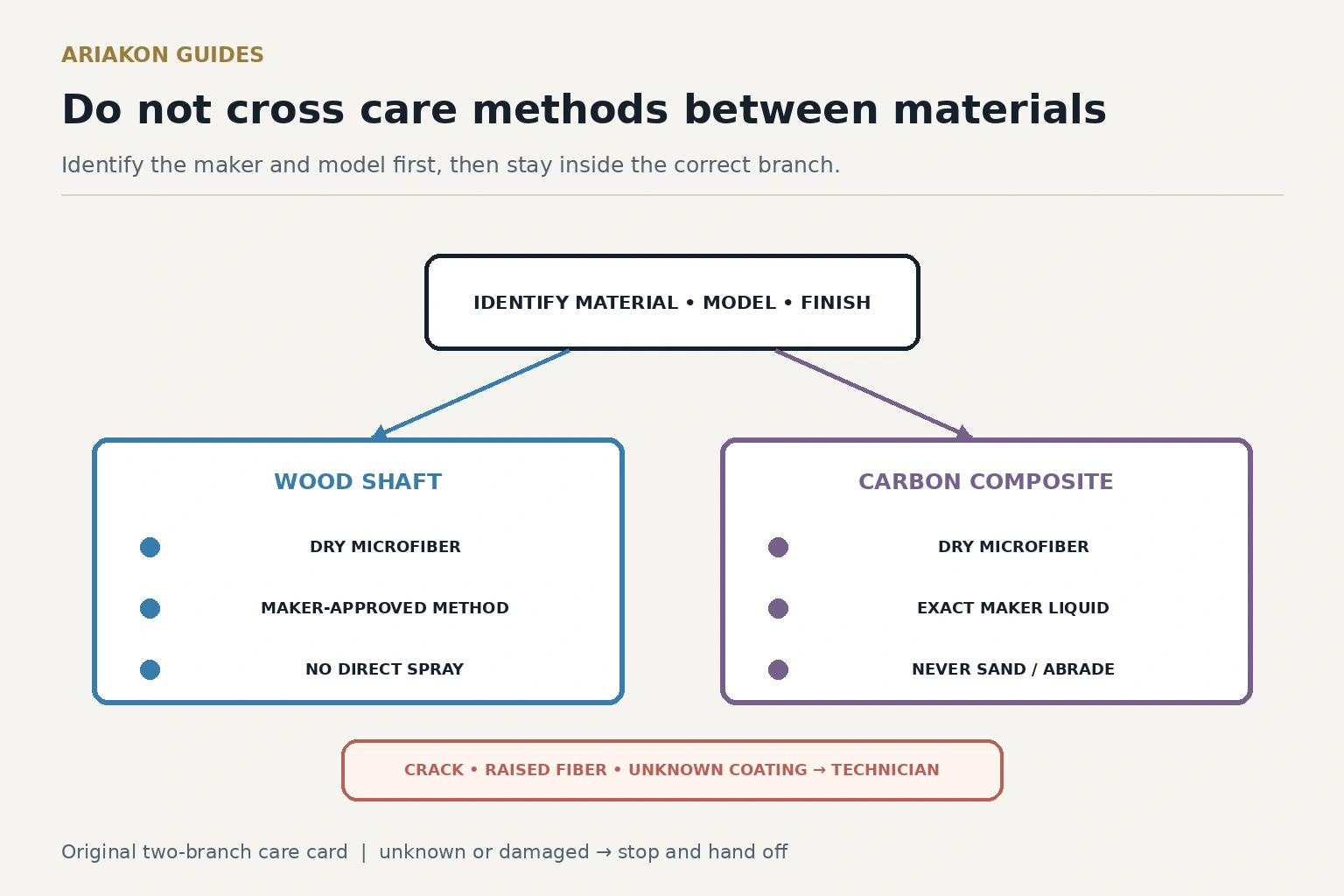
Open a separate identity card for each shaft
If material, finish, residue or instructions are unknown, do not apply a liquid or abrasive. A damaged or potentially splintered surface is an inspection task, not a wiping experiment. Keep it out of play and seek model-qualified guidance.
| Field | Wood card | Carbon-composite card |
|---|---|---|
| Identity | Exact model, section and service history | Exact model, section and service history |
| Surface | Sealed, finished, unfinished or unknown | Documented coating or surface system; not inferred from black color |
| Instruction | Document date and permitted method | Document date and permitted method |
| Condition | Four-view photos; residue and structural concerns | Four-view photos; residue and structural concerns |
| Kit | Labelled clean cloth; only documented supplies | Different labelled clean cloth; only documented supplies |
Diagnose residue versus wear before treating a mark as dirt.
Start with preventive shaft handling for between-session habits.
Keep the two care branches physically separate
There is no universal alcohol percentage, cleaner recipe, humidity target or abrasive grade in this card. Do not sand or abrade a carbon-composite shaft under this owner-care workflow. A different model’s permission does not travel with the bottle or tool.
| Stage | Wood branch | Carbon-composite branch |
|---|---|---|
| Inspect | Locate grain, finish and raised areas without scraping | Locate coating change, cracks or exposed fibers without scraping |
| Dry step | Only on a sound surface, use the documented clean-cloth motion | Only on a sound surface, use the documented clean-cloth motion |
| Further method | Copy the exact permitted product, quantity and limits | Copy the exact permitted product, concentration and limits |
| Apply | Follow the documented application route; no improvised direct spray | Follow the documented application route; no improvised direct spray |
| Dry and recheck | Use the stated interval; compare under the baseline light | Use the stated interval; compare under the baseline light |
| Store | Only clean, dry materials return to this labelled kit | Only clean, dry materials return to this labelled kit |
Audit ten confirmations per completed cycle
Maximum: 10 per shaft. Before requires 4/4; any uncertainty means no treatment. A completed cycle requires 10/10. For two shafts the record contains 20 possible confirmations, but 20 is not one transferable approval: each shaft must independently pass its ten checks.
| Stage | Required confirmations |
|---|---|
| Before — 4 | Exact identity; current instructions; sound surface; correct separate kit |
| During — 3 | Only permitted method; specified quantity and contact interval; no crossover |
| After — 3 | Fully dry as instructed; no adverse change; next action recorded |
Prevent contamination when changing shafts
- Close the first card and return its labelled supplies to its own kit.
- Wash or otherwise clean hands appropriately before touching the second cue.
- Use a different debris-free cloth; do not transfer cleaner residue between cloths.
- Read the second card from identity, not from the first card’s method.
- Quarantine an unmarked bottle or a cloth with unknown treatment; do not identify chemicals by smell.
Screen a proposed shaft cleaner when the permitted product is not yet documented.
Check abrasive compatibility as a separate decision, not a routine cleaning step.
Worked paired-kit decisions
An identified finished wood shaft has a sound surface and current instructions supporting a dry-cloth step. Its separate card completes 4 Before, 3 During and 3 After confirmations. The second, unlabelled composite shaft has no reliable coating record: it fails identity before cleaning. The combined outcome is one completed 10/10 cycle and one stopped card, not a 20/20 approval.
A second session reveals raised grain on the wood shaft and a deep scratch on the composite. Neither receives a stronger cleaner. Keep both away from play, photograph the exact locations and ask a qualified technician to identify damage and model-specific service options.
Send a useful handoff
Supply exact identities, condition photos, the instruction version, products already used and the last known sound condition. State whether the issue is residue, possible finish wear or structural uncertainty. Do not sand, glue or conceal the mark before evaluation. General caution cannot establish chemical compatibility; the identified model’s current care instructions control.