
Equipment reference · 3 min read
Identify an Unknown Pool Cue Before Ordering Components
Color, decoration and a seller's family name can narrow a search, but they cannot safely choose a component. Build an identity packet for the physical cue in hand. Keep candidate names provisional, and let unresolved fields remain visible before any order or modification.
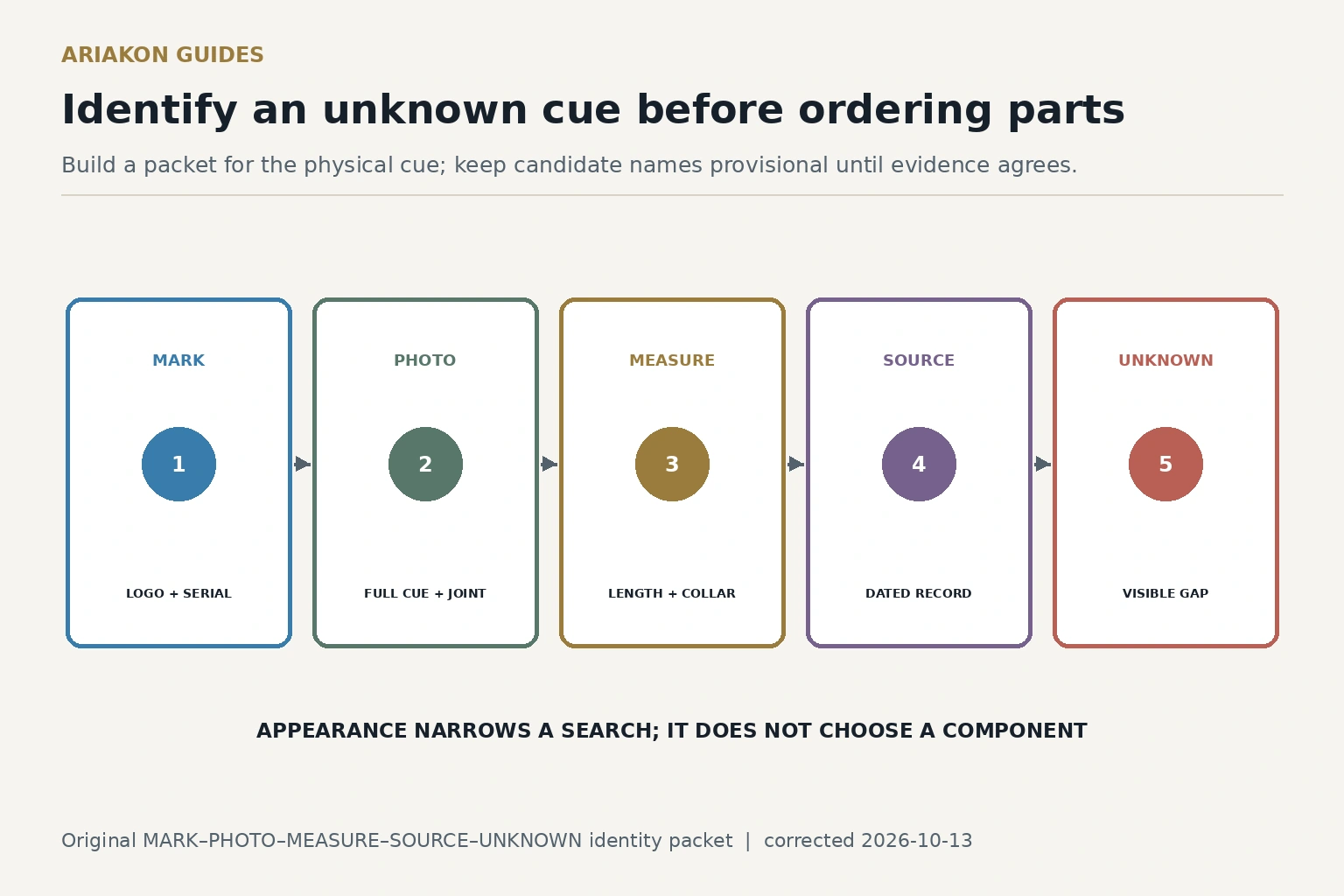
Capture the cue before taking it apart further
| Field | Capture | Why it matters |
|---|---|---|
| MARK | Logos, stamps, serials, decals and handwritten service marks | Creates searchable evidence without assuming authenticity |
| PHOTO | Full cue, forearm, wrap, sleeve, butt plate, bumper, pin, insert, faces and collar | Preserves relationships among parts |
| MEASURE | Each section's length and mass; collar and accessible joint dimensions | Separates present geometry from appearance |
| SOURCE | Receipt, dated catalog, archive, service invoice or maker response | Ties an identity claim to time and scope |
| UNKNOWN | Every missing or contradictory field | Prevents a guess from becoming an order specification |
Identify the cue joint before buying a shaft after the identity packet reaches the interface.
Build a cue service record when alteration or professional inspection is needed.
Use a candidate table, not a single guess
Do not disassemble glued or press-fit parts to identify hidden construction. Photograph accessible features and seek a qualified technician when identification requires destructive work.
A patent search can help locate disclosed joint or component designs. It cannot authenticate the cue by itself; connect any document to a model, date and physical field.
| Evidence | Candidate A | Candidate B | Decision rule |
|---|---|---|---|
| Visible mark | Exact match, partial or absent | Exact match, partial or absent | A mark is one field, not proof |
| Decorative pattern | List matching and conflicting details | List matching and conflicting details | Repairs and similar designs remain possible |
| Joint geometry | Documented and measured fields | Documented and measured fields | Conflict defeats the candidate |
| Dated source | Exact page, year and model | Exact page, year and model | Undated resale text remains weak |
| Service history | Original or modified fields | Original or modified fields | Current cue may differ from factory record |
Turn the packet into an order specification
Only fields needed for the component move into the order record. A shaft request may need role, pin or insert, pilot, face, collar diameter, ring position, shaft length and intended tip diameter. A bumper or weight request needs different dimensions and attachment details.
Attach photographs and measurement units. If a vendor or technician asks for the cue, send the complete relevant assembly rather than translating an uncertain family label into a part number.
Worked example: two similar black cues
Two cues share black forearms and similar ringwork. Cue A has a readable under-bumper mark, a dated receipt and a documented piloted joint. Cue B has no mark, a flat face and evidence of a replaced collar. Appearance suggests a relationship, but the packets do not support one common replacement shaft.
Cue A advances to a component request tied to its record. Cue B remains unidentified and goes to a qualified inspection with its dimensions and photographs. The second packet is successful because it prevents a confident wrong order.
Preserve the packet with the cue
Store the final photos, source copies, measurement date, tool resolution, technician invoice and removed parts together. If a replacement is fitted, label it as later service rather than silently changing the cue's identity record.
This task identifies one physical cue. It is distinct from comparing shaft performance, authenticating every cue from a maker or deciding whether a candidate physically fits after purchase.
Sources and further reading
References support the specific factual information above. The practical checklists are Ariakon editorial guidance.