
Equipment reference · 3 min read
Verify a Discontinued Cue Shaft Before Buying Used
A discontinued shaft can be worth considering, but a familiar shape or seller description does not establish its identity. Build the record from dated documents and the actual specimen. Newer product pages may suggest questions to ask, but their dimensions, materials and performance claims do not transfer backward without evidence.
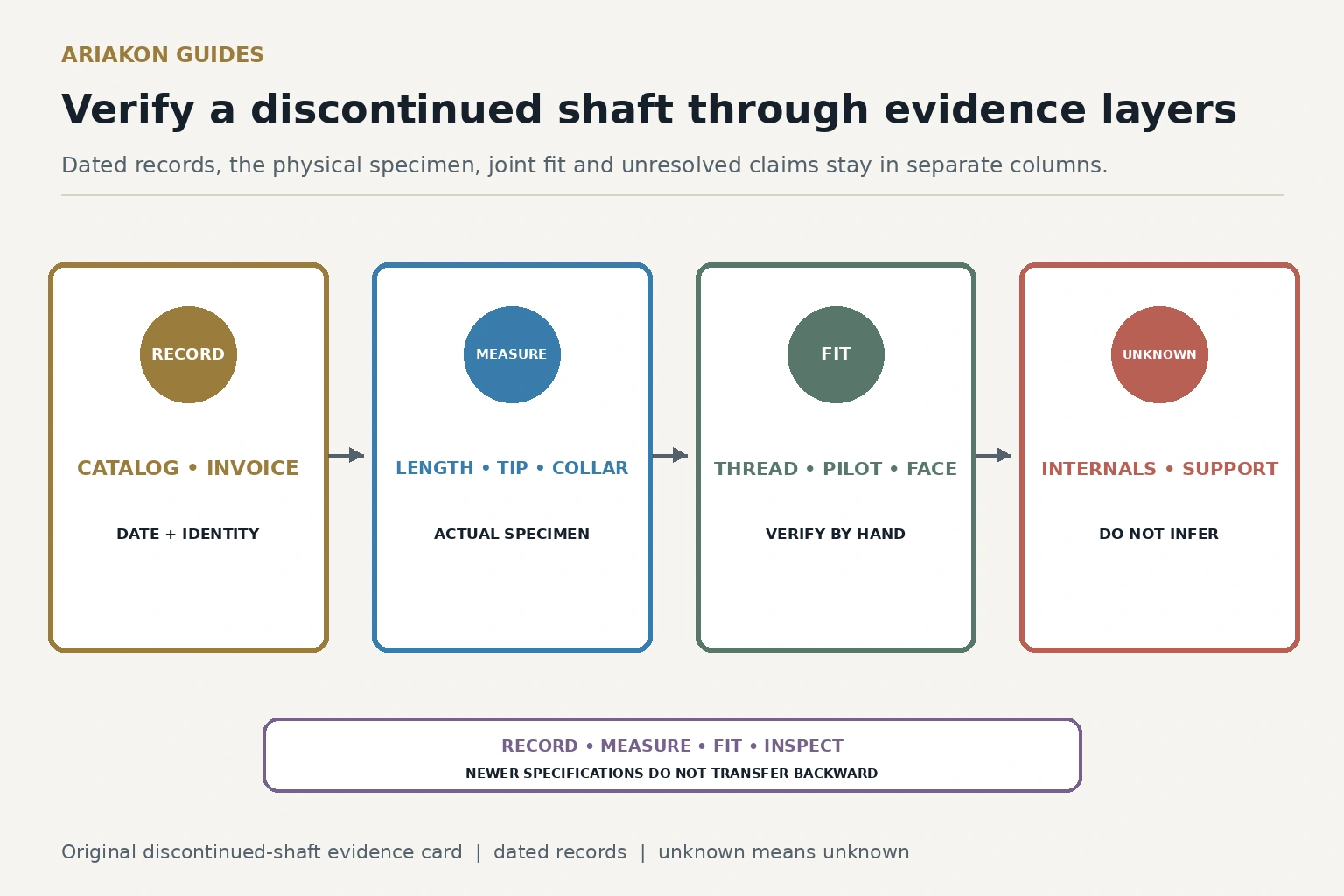
Build a dated evidence ledger
| Question | Acceptable evidence | Safe conclusion |
|---|---|---|
| Did this model exist? | Dated catalog, archived instruction sheet, invoice or packaging | Record only the model name and date the evidence supports |
| Is the specimen that model? | Matching mark, ring work, dimensions and purchase record | Label unverified when the chain is incomplete |
| What was original? | A dated specification tied to that exact generation | Do not transfer a newer tip, ferrule, taper or internal design |
| Will it fit this butt? | Verified thread, pilot, joint face and collar dimensions | A joint nickname alone is insufficient |
| Is it safe to play? | Current inspection of straightness, ferrule, tip, finish and joint | Damage or looseness requires qualified service |
See how pool cues are designed and made for the general shaft, ferrule and joint system.
Identify a pool-cue joint before buying before treating a joint name as verified fit.
Measure the specimen in a repeatable order
Photograph the shaft before cleaning or altering it. Record overall length from joint face to tip, tip diameter in millimeters, collar diameter, joint-face geometry, pilot depth where applicable and ring position. Use the same units and measuring method for every candidate so comparisons do not depend on rounded seller descriptions.
Do not remove a tip, ferrule or joint insert to discover internal construction. Destructive inspection can erase condition evidence and create a repair problem without proving the model. A public patent or drawing can show one documented construction, but it does not identify an unmarked specimen.
Separate compatibility from identity
| Check | Pass condition | Stop condition |
|---|---|---|
| Thread start | Engages by hand without cross-threading | Starts crooked, binds or needs force |
| Joint face | Faces meet evenly without an unexplained gap | Bottoms early or rocks |
| Pilot and insert | Pilot seats without interference | Pilot depth or diameter is uncertain |
| Collar | Diameter and ring alignment are acceptable to the owner | Sharp mismatch suggests wrong fit or needed service |
| Condition | No crack, loose part or abnormal sound | Any structural concern |
Run a bounded personal comparison
After fit and condition are cleared, alternate twelve shots with a known compatible shaft: four center-ball stop shots, four medium-speed position shots and four familiar off-center shots. Keep the butt, balls, table, start marks and order balance the same. Record start line, cue-ball finish zone and confidence separately. Run twelve attempts per shaft, twenty-four total: alternate shafts within each shot family so each shaft receives four stop, four position and four off-center attempts. Save each shaft’s twelve observations separately.
The result describes one player with two specimens under one set of conditions. It is not a universal ranking, an Ariakon performance test or proof of the discontinued model's internal construction.
Worked decision: evidence is incomplete
A used shaft has no legible model mark and no original paperwork. Its measured tip, length and joint resemble a seller's description, but those features are shared by many products. Record the model as unknown, keep the measured dimensions, verify fit independently and value the shaft by condition rather than an unsupported identity.
A second shaft has dated packaging, a matching invoice and physical details consistent with the same record. Its identity can be recorded with the evidence date. Original tip condition, undocumented internal changes and present manufacturer support still remain separate unknowns.
Sources and further reading
References support the specific factual information above. The practical checklists are Ariakon editorial guidance.