
Equipment reference · 3 min read
Verify a Specialty Cue Before Replacing Its Shaft
A playing shaft, break shaft and jump shaft may share a familiar thread description while serving different jobs and using different contact ends, collars or assembled lengths. Verify the physical cue in hand. A family label is not a compatibility test.
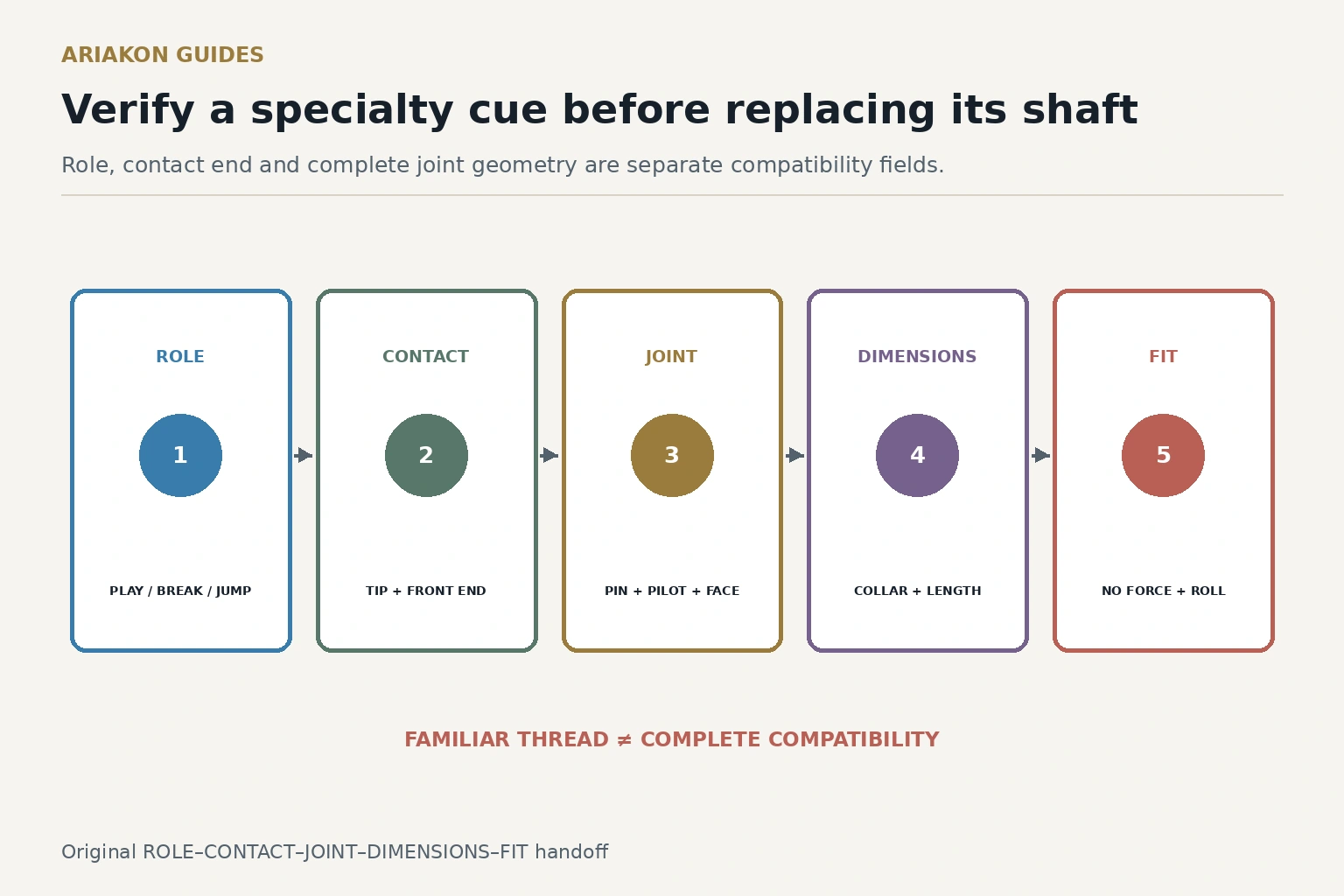
Start with role, not appearance
| Field | Record from the cue | Do not assume |
|---|---|---|
| Role | Playing, break, jump or combined configuration | A hard tip proves a break role |
| Contact end | Tip material, ferrule or plate and present diameter | One role requires one material |
| Joint | Pin, insert, pilot, face and collar | A thread nickname proves full fit |
| Length and mass | Each section and assembled cue | A replacement preserves balance |
| Evidence | Marks, receipt, service record and dated photographs | Color or decoration identifies the model |
Compare playing, break and jump configurations when selecting the job before the exact replacement.
Identify a cue joint before buying for a joint-identification workflow.
Run a six-minute physical handoff
Minute one: photograph the full cue and all separable sections. Minute two: label each section by its demonstrated role. Minute three: photograph pin, insert, pilot and joint face square-on. Minute four: measure collar diameter and joint-face-to-tip length. Minute five: record weight and contact-end condition. Minute six: write unknowns and the intended use of the replacement.
Do not assemble a candidate until the handoff is complete. If identity or role is uncertain, keep the label neutral and let the physical record drive the fit request.
Before any normal assembly, obtain exact-pair compatibility confirmation from the maker or a qualified cue technician. Do not use a candidate shaft as a thread or pilot gauge. An unknown geometry remains a hold; the gentle seating checks below apply only to an already cleared pair.
Check the whole interface
| Check | Pass | Stop |
|---|---|---|
| Thread start | Begins straight by hand | Crooked start, bind or force required |
| Pilot and insert | Pilot enters freely to intended depth | Interference or unknown depth |
| Joint faces | Meet evenly | Early bottoming, rocking or unexplained gap |
| Collar | Diameter and ring transition are acceptable | Sharp edge or unapproved reduction needed |
| Assembled roll | No new lift, click or visible misalignment | Abnormal movement or sound |
Confirm the replacement still matches the job
After compatibility and condition are cleared, test the cue only in its intended role. For a playing cue, use six center-ball shots at soft and medium speed. For a break cue, use six legal controlled breaks under the active rule set and record cue-ball control separately from balls made. For a jump cue, confirm event and room permission before any test.
The result belongs to this assembled cue and player. It does not prove a universal material advantage or authorize a configuration under every event's rules.
Worked decision: familiar thread, incomplete fit
A break-cue butt and a candidate shaft share a seller's thread label. The candidate begins smoothly, but its pilot bottoms before the faces meet and the collar stands proud. Stop and record the gap; matching thread engagement did not establish compatibility.
A second candidate matches thread, pilot, faces and collar, and the assembled cue rolls without a new lift. Its role and contact end are documented. Only then does the owner proceed to the bounded break-cue test.
Sources and further reading
References support the specific factual information above. The practical checklists are Ariakon editorial guidance.