
Equipment reference · 3 min read
Audit a Used Cue-Shaft Listing With a SPEC–SOURCE–GAP Ledger
A detailed listing can still combine three different things: what the seller says, what a dated document supports and what the specimen can prove. Build one row per claim before comparing price or performance. A blank cell is useful—it names the evidence still needed.
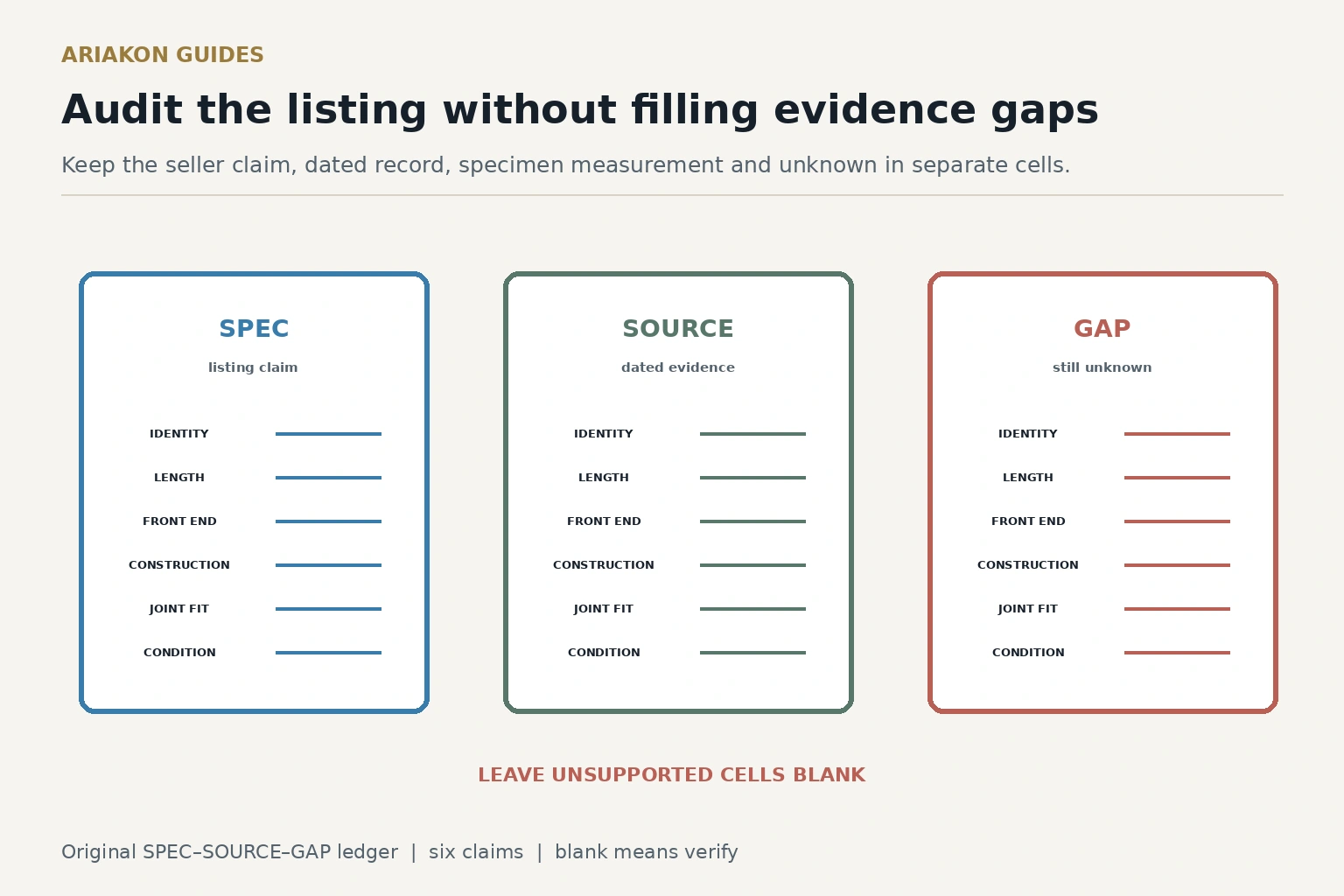
Copy claims before interpreting them
| Field | Listing claim | Evidence to request | Gap if absent |
|---|---|---|---|
| Identity | Model or generation label | Marking, dated invoice, packaging or catalog record | Exact identity unknown |
| Length | Nominal or measured length | Joint-face-to-tip measurement and tool resolution | Method or present value unknown |
| Tip and front end | Diameter, tip or ferrule description | Current close photo and millimeter measurement | Wear or replacement history unknown |
| Construction | Material or internal-design statement | Exact-model dated record, patent or repair documentation | Do not infer hidden construction |
| Joint fit | Thread or compatibility name | Pin, insert, pilot, face and collar dimensions | Fit not established |
| Condition | Straight, clean or lightly used | Rolling-light video, face/ferrule photos and service record | Present condition unverified |
Verify a discontinued shaft before buying used when one claimed identity needs a deeper provenance check.
Identify your cue joint before buying a shaft before treating a thread nickname as complete fit evidence.
Give every source a date and scope
Record the URL or document name, publication or access date, exact claim supported and model or generation named. A current page can document a current item without describing an older specimen. A patent search can locate a disclosed design, but a drawing does not prove that an unmarked shaft uses it.
Keep seller photos and measurements attached to the listing date. If a tip, ferrule, collar or insert has been serviced, the present measurement belongs beside—not in place of—the nominal dated specification.
Use three decision bands
| Band | Minimum record | Permitted conclusion |
|---|---|---|
| Documented | Dated source tied to the exact identity | Repeat only the supported claim and date |
| Observed | Clear current photo or repeatable measurement of this specimen | Describe present exterior or dimension |
| Unknown | Claim lacks exact-model or specimen evidence | Ask, inspect or price the uncertainty; do not fill the cell |
Worked listing audit
A listing names a generation, gives a 12.5-millimeter tip and says the shaft fits a familiar pin. The photos show a readable mark, but the seller supplies no dated document, measuring method, pilot depth or collar diameter. Record the mark as observed, the generation as claimed, 12.5 millimeters as unverified and fit as incomplete.
The seller then supplies a dated invoice, caliper photo, joint-face image and slow rolling-light video. Identity and present diameter move into supported rows. Compatibility and internal construction remain open until their specific evidence arrives. The purchase decision can now price known condition separately from unresolved fit.
Stop before a listing becomes a promise
Do not translate words such as rare, original, low deflection or professional into measurable performance. Do not force an assembly to test a seller's fit claim. Ask for the missing field or arrange qualified inspection with the intended butt.
This ledger audits one listing. It does not authenticate every discontinued model, rank shaft constructions or replace an in-person condition check.
Sources and further reading
References support the specific factual information above. The practical checklists are Ariakon editorial guidance.