
Equipment reference · 3 min read
Document a Hybrid Cue Shaft Before Comparing Performance
A shaft may combine a wood exterior with a composite core, use laminated wood, or use heat-treated wood. Those descriptions answer what a document says about construction; they do not by themselves establish the identity of a used specimen, its compatibility with a butt or how a particular player will perform.
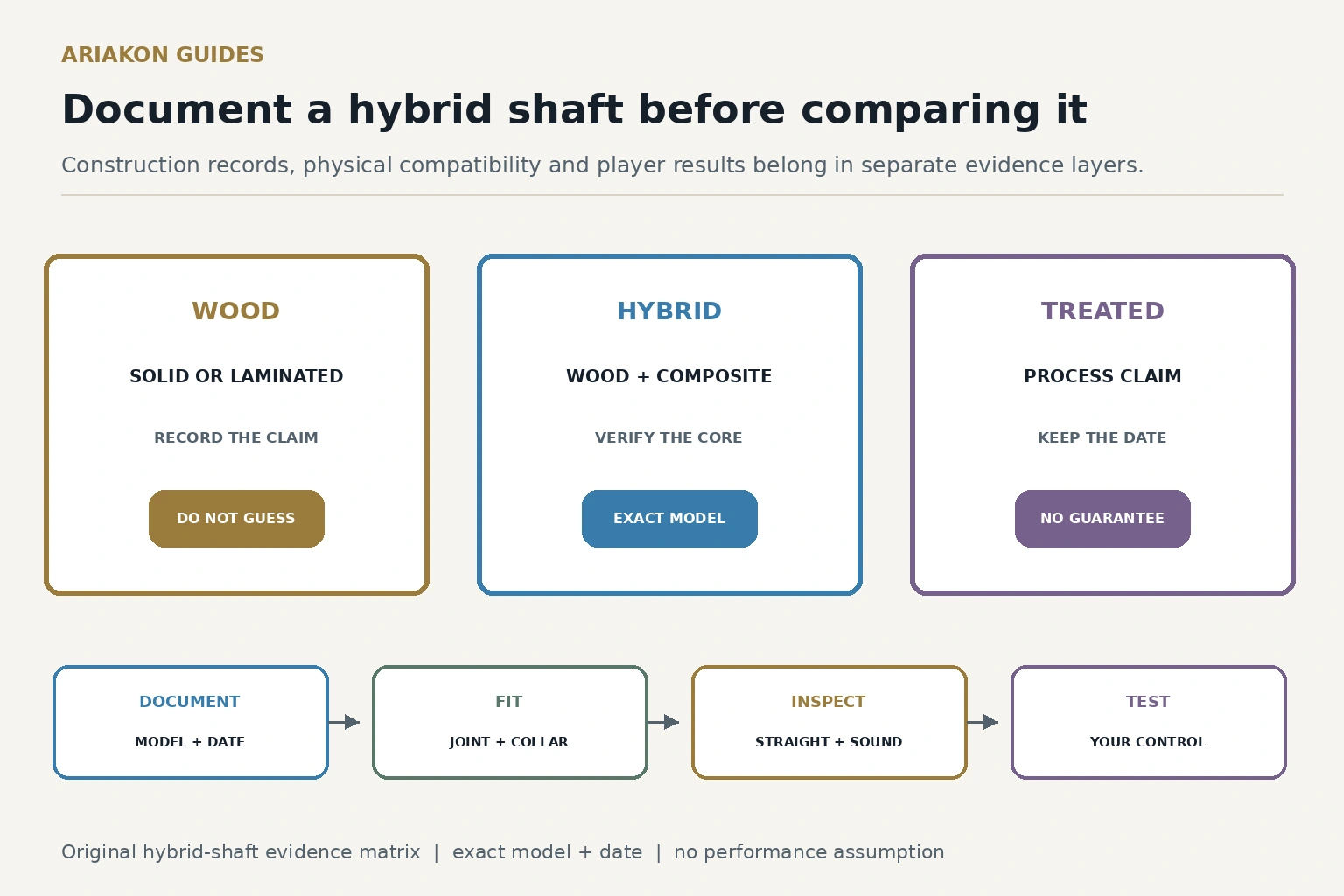
Classify the claim before measuring
| Claim type | Evidence to retain | Do not infer |
|---|---|---|
| Solid or laminated wood | Dated specification and visible grain or seam pattern | Exact species, grade or internal mass from appearance alone |
| Wood over composite | Cross-section drawing, patent, repair record or exact-model specification | That every similar-looking shaft has the same core |
| Heat-treated wood | Exact-model material statement and evidence date | That treatment guarantees straightness, feel or durability |
| Modified front end | Documented ferrule, plate, bore or insert description | A universal cue-ball deflection result |
| Used specimen | Markings, measurements, service history and current condition | That nominal original specifications remain unchanged |
See how pool cues are designed and made for broad shaft, ferrule and joint concepts.
Identify your cue joint before buying a shaft because construction does not prove fit.
Record dimensions without overstating precision
Measure overall shaft length from joint face to tip, tip diameter in millimeters, collar diameter and visible joint geometry. Record the tool and resolution used. A nominal catalog value and one current measurement belong in separate columns because tips wear, shafts may be serviced and sellers may round values.
Wood is an engineered natural material whose properties vary with species, grain, moisture and processing. Composite components add another design layer. Describe only the construction supported by a dated record tied to the exact model.
Verify fit and condition before a play test
Stop when a joint starts crooked, binds, bottoms early or leaves an unexplained gap. Do not force the assembly or remove material to make it fit. A qualified cue technician or documented manufacturer fit guidance is the next step.
| Field | Evidence | Unknown when |
|---|---|---|
| Identity | Marking, invoice or original packaging | Only color or diameter is known |
| Construction | Exact-model document or qualified repair record | A seller repeats an unsourced description |
| Joint fit | Thread, pilot, face and collar checked on the intended butt | Only a joint nickname is supplied |
| Condition | Straightness, ferrule, tip, finish and service history | Repairs or damage are undocumented |
| Alteration | Owner-authorized service record | The shaft has been sanded, bored or fitted without records |
Use a matched twelve-shot comparison
On two cleared compatible shafts, keep one butt, table, ball set and marked layout. Alternate four center-ball stop shots, four medium-speed position shots and four familiar off-center shots. Record the starting line, broad cue-ball zone, pocket result and confidence in the decision. Run twelve attempts per shaft, twenty-four total: alternate shafts within each shot family so each shaft receives four stop, four position and four off-center attempts. Save each shaft’s twelve observations separately.
Do not turn twelve attempts into a universal material ranking. Tip, taper, front mass, joint, condition, table and delivery all contribute to the result. The worksheet answers whether one player can make a useful choice between two specific specimens.
Worked decision: the core claim is unverified
A used shaft is advertised as wood over a composite tube. The seller supplies a diameter and a dark end surface but no model record, repair history or cross-section evidence. Record exterior material as observed, internal construction as unverified and fit as a separate check.
A second specimen has matching dated documentation and an intact identity mark. Its documented construction can be recorded, while present condition and the player's test results stay in their own rows.
Sources and further reading
References support the specific factual information above. The practical checklists are Ariakon editorial guidance.