
Equipment reference · 3 min read
Inspect a Segmented-Wood Cue Shaft Without Assuming Performance
A segmented-wood shaft uses multiple wood pieces in a documented assembly rather than one visually continuous blank. That description can help organize inspection, but it does not identify an unknown shaft or predict a player's result. Keep the construction claim, the actual specimen and the play test in separate evidence rows.
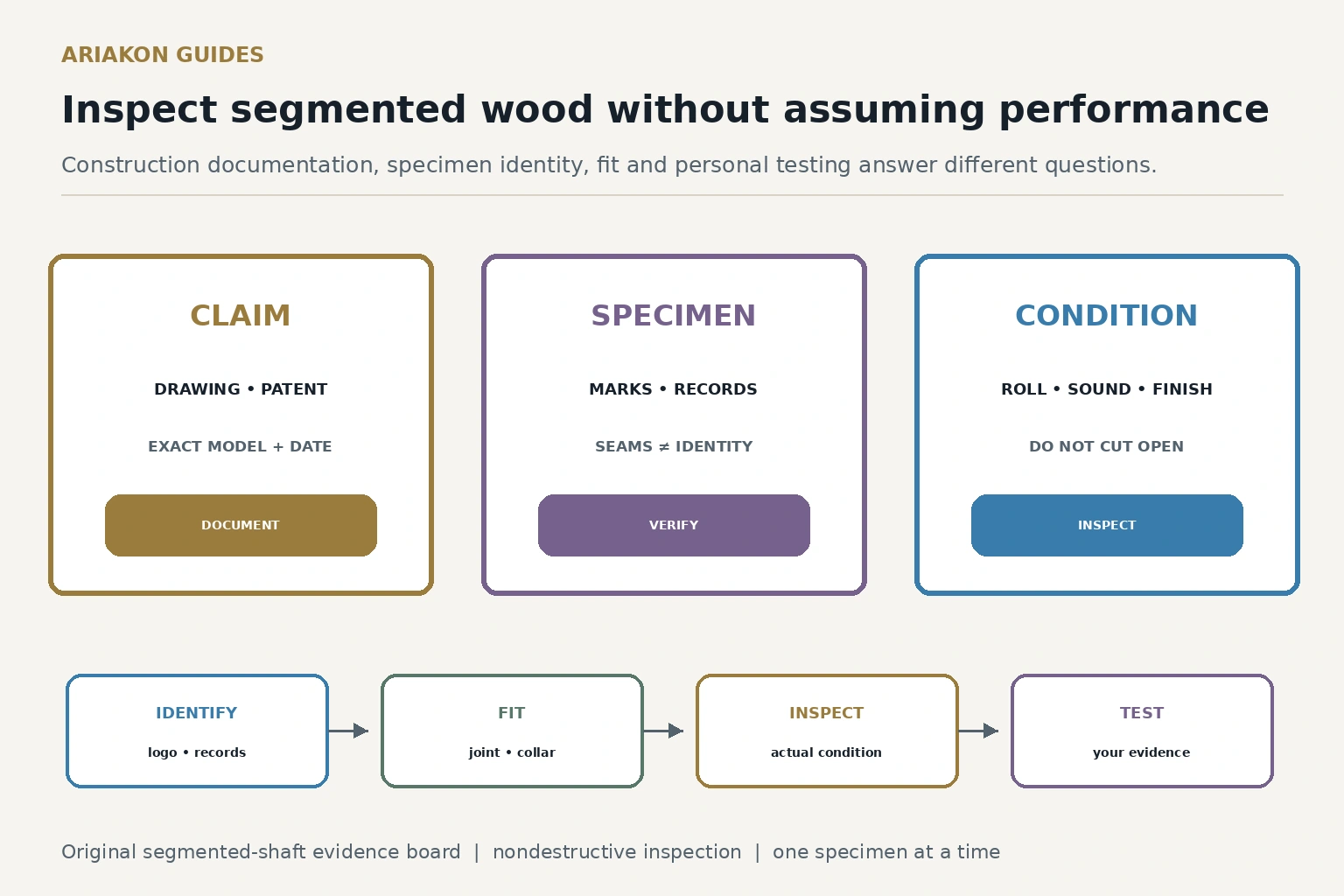
Separate construction evidence from model identity
| Question | Useful evidence | Stop point |
|---|---|---|
| Is the design segmented? | Exact-model drawing, patent, manufacturing description or qualified repair record | A surface line or logo is not enough |
| Is this that model? | Matching marks, dated paperwork, ring work and dimensions | Record unknown when the chain is incomplete |
| Are the sections sound? | Nondestructive visual, roll and sound inspection | Do not cut, bore or strip finish to investigate |
| Will it fit? | Verified thread, pilot, face and collar geometry | Never force a binding or crooked start |
| Does it suit the player? | Matched alternating shots on cleared equipment | One session is personal evidence, not a universal ranking |
See how pool cues are made for broad shaft, joint and finishing concepts.
Compare cue-shaft materials by practical evidence when material family, rather than a construction claim, is the main question.
Inspect without destroying the evidence
Under bright rolling light, inspect the finish, ferrule or front plate, joint face and any visible seams. Listen for an abnormal click during a gentle roll and check for a loose tip or component. Stop for a crack, lifted seam, loose part or uncertain repair. A qualified cue technician can investigate without turning an article exercise into destructive testing.
A patent drawing can establish that a construction was documented; it cannot prove that an unmarked used shaft implements it or that every generation uses the same dimensions. Preserve the document date and the specimen observations separately.
Measure the whole interface
| Check | Record |
|---|---|
| Joint | Thread or insert, pilot, joint-face diameter and seating depth |
| Collar | Diameter, ring position, material and visible gap |
| Length and front end | Joint-face-to-tip length, tip diameter and remaining tip |
| Condition | Roll behavior, finish, ferrule or plate and service history |
| Evidence date | When each document, photo and measurement was obtained |
Run a matched test after fit is cleared
Use the same compatible butt, ball set, table and marked layouts. Alternate twelve attempts: four center-ball stop shots, four medium-speed position shots and four familiar off-center shots. Record pocket result, starting line, cue-ball finish zone and confidence before looking at totals. Run twelve attempts per shaft, twenty-four total: alternate shafts within each shot family so each shaft receives four stop, four position and four off-center attempts. Save each shaft’s twelve observations separately.
Do not attribute every difference to segmentation. Tip condition, taper, front mass, joint, total cue balance and delivery remain possible contributors. The test is a decision aid for two specimens, not a material certification.
Worked decision: a seam is not an identity
A used shaft shows faint longitudinal lines but has no readable mark or paperwork. The buyer records a possible segmented construction, not a confirmed model, then measures the joint and collar and requests service history before assembly.
A second shaft has a dated construction drawing, matching invoice and consistent physical details. The construction claim can be recorded. Condition, fit and the player's comparison still require independent checks.
Sources and further reading
References support the specific factual information above. The practical checklists are Ariakon editorial guidance.