
Equipment testing · 3 min read
Compare Wood, Composite and Carbon Cue Shafts With a Controlled Trial
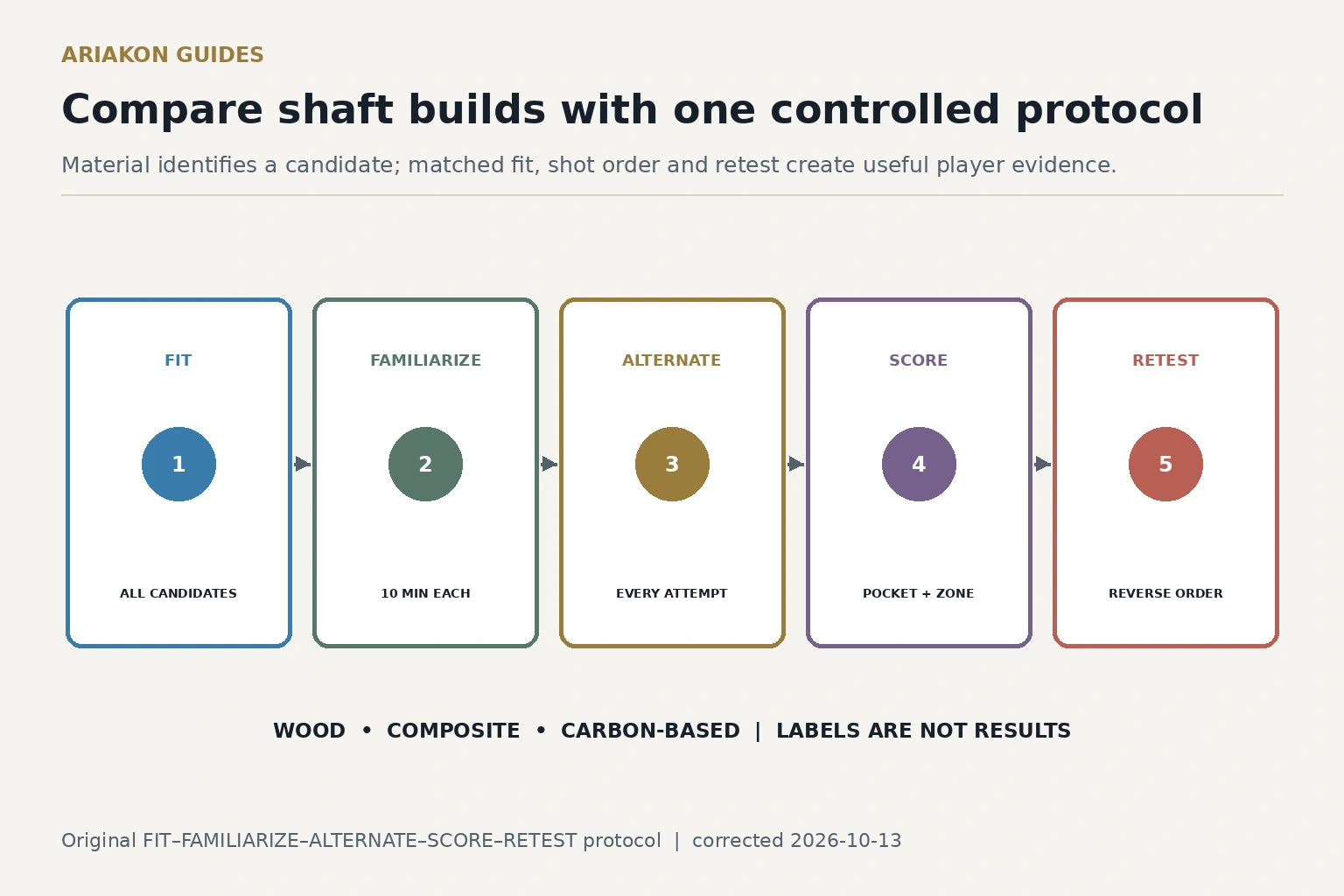
Wood, bonded or reinforced composite, and carbon-based shafts can differ in taper, mass, surface, front-end construction and care. A material label does not rank them. Clear physical fit first, then compare complete configurations with the same butt and shot order.
Create three neutral candidate cards
| Field | Candidate A | Candidate B | Candidate C |
|---|---|---|---|
| Material record | Wood or exact documented build | Composite or exact documented build | Carbon-based or exact documented build |
| Geometry | Length, tip diameter and taper description | Length, tip diameter and taper description | Length, tip diameter and taper description |
| Mass and balance | Shaft mass and assembled balance reference | Shaft mass and assembled balance reference | Shaft mass and assembled balance reference |
| Fit | Thread, pilot, faces, collar and roll | Thread, pilot, faces, collar and roll | Thread, pilot, faces, collar and roll |
| Care | Exact cleaning and tip-service limits | Exact cleaning and tip-service limits | Exact cleaning and tip-service limits |
Confirm replacement-shaft fit across seven fields before any candidate enters play.
Read the low-squirt shaft guide for the aiming-adjustment concept without a material ranking.
Familiarize without scoring
Use ten minutes per candidate with the same butt. Shoot center-ball stop, follow and draw shots at comfortable distances, then a familiar off-center position shot. The purpose is to reduce novelty, not to tune aim separately for one candidate.
Use only candidates whose interface and condition have already passed. Keep tip condition comparable where practical, and record unavoidable differences rather than pretending the only variable is material.
Alternate a twelve-attempt scored block
Alternate candidates after every attempt and rotate which one starts each station. Maximum: 22 points per candidate because the lag station awards one point per attempt. Record confidence from one to five beside the score, but do not add confidence to the performance total.
| Station | Attempts per candidate | Pocket point | Position point |
|---|---|---|---|
| Straight stop | 2 | Called pocket | Cue-ball center in stop zone |
| Medium follow | 2 | Called pocket | Cue-ball center in forward zone |
| Medium draw | 2 | Called pocket | Cue-ball center in return zone |
| Off-center route | 2 | Called pocket | Cue-ball center in route zone |
| Thin cut | 2 | Called pocket | Cue ball avoids marked scratch lane |
| Speed-only lag | 2 | Cue ball reaches called zone | No second point; note miss direction |
Retest before naming a preference
Repeat the block on another day with the starting order reversed. A candidate becomes the practical preference only when its fit, care burden, score pattern and player confidence make sense together. A one-point lead that reverses on day two is not a stable ranking.
The trial cannot isolate which internal feature caused a result, and it does not predict another player's outcome. It compares three complete, documented configurations for one player.
Worked comparison: score and care disagree
Candidate B leads the first session by two points but requires a care method the owner cannot support during travel. Candidate A trails by one point after the reversed-order retest and has the most consistent confidence notes. The worksheet supports A as the practical choice without claiming its material is universally superior.
Candidate C fits but produces a repeated confidence drop on the thin-cut station. Keep the station notes for practice or a later retest; do not convert them into a defect diagnosis.
Sources and further reading
References support the specific factual information above. The practical checklists are Ariakon editorial guidance.