
Buying guidance · 3 min read
Compare Playing, Break and Jump Cue Configurations by Job
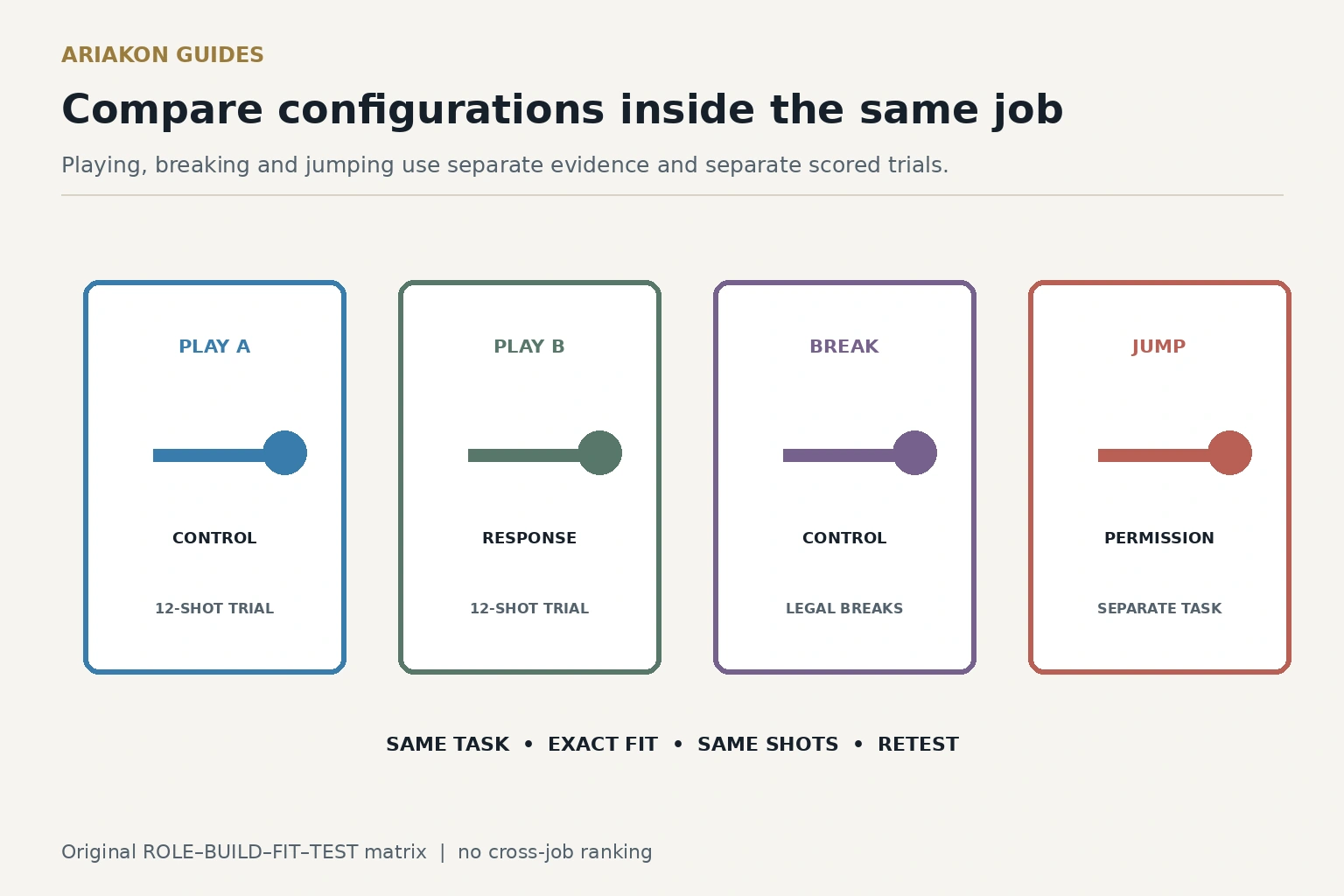
A cue configuration should be evaluated for the job it must do. Playing, breaking and jumping create different decisions, and two playing configurations can still differ in front-end design, taper, balance and feedback. Compare role first, verify fit second and test only like tasks.
Define the job in one sentence
| Lane | Reader task | Record | Do not combine |
|---|---|---|---|
| Playing control | Pocket and move the cue ball predictably | Tip, taper, front end, balance, length and fit | Break-speed outcomes |
| Playing response | Compare a second compatible playing build | Same physical fields and same shot set | Material label as a result |
| Break control | Deliver a legal opening shot with cue-ball control | Contact end, weight, length, grip and rule permission | Balls made as the only score |
| Jump permission | Use a legal, permitted specialty configuration | Event rules, room permission, length and contact end | A jump test without authorization |
Choose a break-cue weight with a matched test when break-cue mass is the specific decision.
Compare cue-shaft materials by evidence when the playing-shaft material family is the narrower question.
Complete the fit row before play
For every two-piece candidate, record pin or insert, pilot, joint face, collar diameter, shaft length, assembled length and weight. A configuration that binds, bottoms early or creates a new collar edge does not enter the trial. Keep tip and contact-end condition in their own row.
For a one-piece or dedicated specialty cue, mark joint fields not applicable instead of inventing compatibility. The matrix compares complete usable configurations, not isolated labels.
Run a twelve-shot playing trial
Choose two cleared playing configurations. Mark one straight stop shot, one medium follow shot and one familiar off-center position shot. Alternate configurations after every attempt: two cycles per shot with each cue, for six attempts per cue and twelve total.
Award one point for the called pocket and one for finishing in the marked cue-ball zone. Maximum: 12 points per cue. Also record start-line miss and confidence. Reverse the starting cue on a second day before treating a small difference as useful.
Run a separate legal-break test
Use one rack format and the active rules. Alternate six breaks per cleared break configuration. Score one point for a legal break, one for cue ball remaining on the table and one for cue ball finishing inside a premarked center-table zone. Maximum: 18 points per configuration.
Record balls made but do not add them to this control score. Rack quality, cloth, balls and contact variation can dominate a short result. Never mix the playing-shot total and break-control total into one ranking.
Worked comparison: choose by job
Playing configuration A scores 10 of 12 and B scores 9, with B producing the tighter cue-ball group on off-center shots. The decision remains open until the reversed-order retest because one point is smaller than the observed day-to-day variation.
A break configuration scores 15 of 18 with five center-zone finishes. That evidence supports the player's break-control choice only. It does not make the same configuration preferable for normal position play, and it says nothing about a jump configuration without permission and a separate task.
Sources and further reading
References support the specific factual information above. The practical checklists are Ariakon editorial guidance.