
Cue care · 3 min read
Build a Cue Service Record Before Modifying or Replacing Parts
A repair can solve a problem and erase the evidence needed to understand it. Before sanding, facing, drilling, refinishing or replacing a part, make a service record that identifies the cue, records present condition and states exactly what work is authorized.
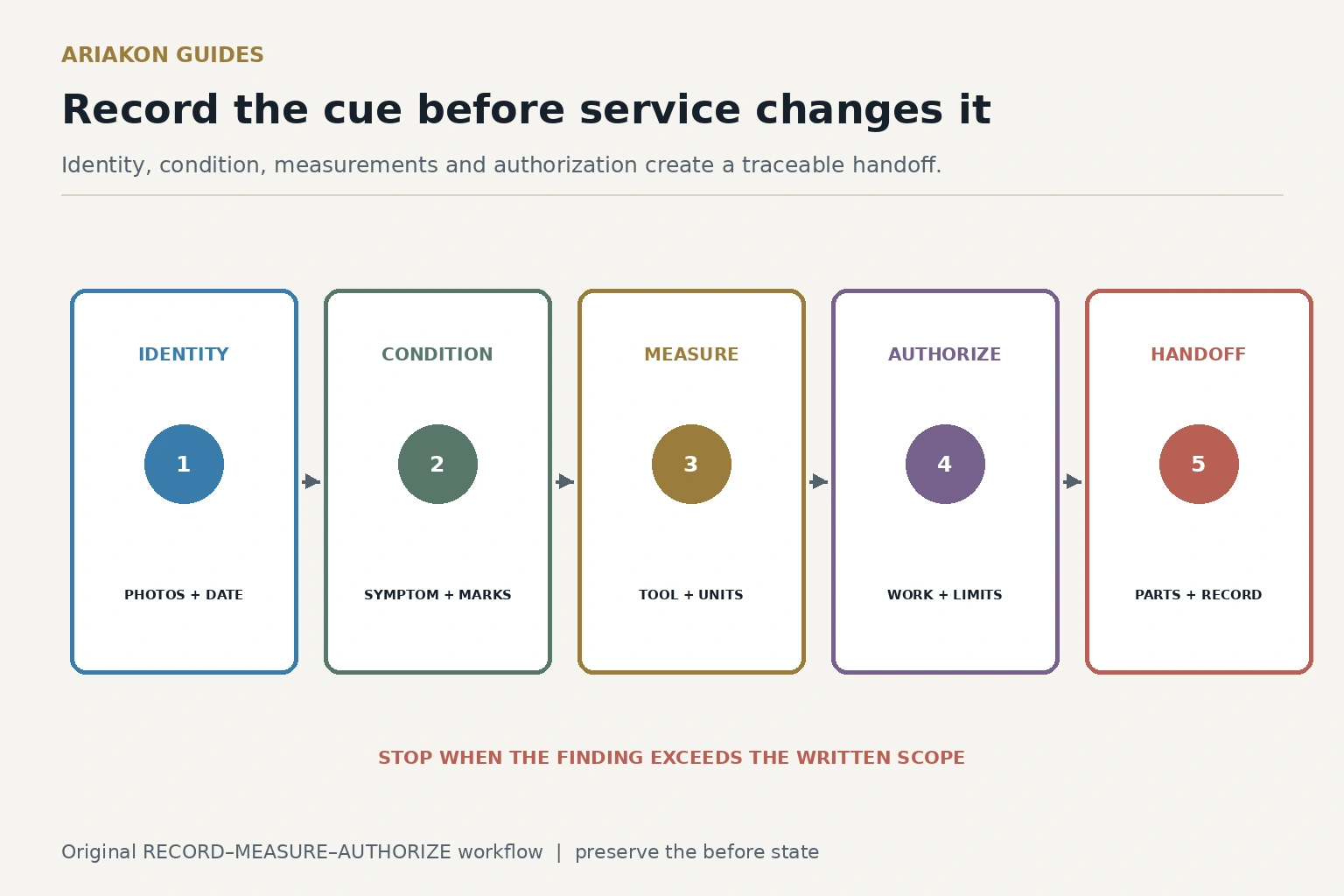
Open a six-field service record
| Field | Record | Why it matters |
|---|---|---|
| Cue identity | Owner label, visible marks, photos and acquisition record | Prevents component mix-ups |
| Ownership and date | Current owner, intake date and return contact | Keeps authorization traceable |
| Component history | Known tips, ferrules, shafts, weights, joints and prior work | Separates original from later changes |
| Current symptom | When, where and how the issue appears | Avoids treating a vague adjective as diagnosis |
| Measurements | Length, diameter, weight and joint geometry with tool resolution | Creates a before state |
| Terms and authorization | Approved work, limits, estimate, replaced-part disposition and stop conditions | Defines the handoff |
Review shaft care and cleaning limits for routine care that does not require structural work.
Identify a joint before ordering parts when service includes a new shaft.
Photograph and measure before cleaning
Photograph the full cue, joint faces, collar alignment, tip, ferrule, wrap and each visible defect under even light. Place a scale in close images when practical. Record measurements in one unit system; millimeters are useful for diameters and interface dimensions.
Do not clean away chalk, finish residue, witness marks or loose fibers before the intake record is complete. Surface evidence may help a qualified technician distinguish wear, contamination, impact or prior work.
Separate symptom, observation and diagnosis
| Type | Example | Record rule |
|---|---|---|
| Symptom | Cue clicks during some shots | Quote the condition and frequency |
| Observation | Tip edge lifts at one location | Photograph and locate it |
| Measurement | Collar diameters differ by 0.3 millimeter | Name the tool and resolution |
| Diagnosis | A component bond has failed | Reserve for qualified inspection |
| Authorization | Replace tip only; stop if ferrule damage appears | Use explicit scope and stop point |
Write the modification boundary
List reversible inspection separately from irreversible work. Cleaning a joint face, removing material, changing weight, cutting a tip, drilling a bore and refinishing a butt are different authorizations. Record whether removed parts should be returned and whether a fit trial may use the owner's butt.
If written coverage or service terms may apply, preserve the dated document and seek the named service channel before altering the cue. Do not infer current coverage from age, ownership or appearance.
Worked handoff: a replacement shaft request
A cue arrives with a damaged shaft and an intact butt. The record includes full-cue photos, butt and shaft weights, pin and insert photos, pilot and face measurements, collar diameter, assembled length and the owner's instruction to retain the original shaft. No sanding or collar reduction is authorized.
The candidate replacement starts crooked and stops before the faces meet. The service record directs a stop: do not force, chase threads or remove material. The next action is a fit diagnosis and revised authorization, not an improvised modification.
Sources and further reading
References support the specific factual information above. The practical checklists are Ariakon editorial guidance.