
Equipment guides · 4 min read
Choose Pool Cue Length With a Fit, Reach and Clearance Worksheet
Complete cue length affects ordinary handling, room clearance and occasional reach. It is not determined by player height alone. This worksheet compares two documented configurations with safe stations and a rear-clearance calculation; it is separate from shaft taper, bridge length and extension compatibility identification.
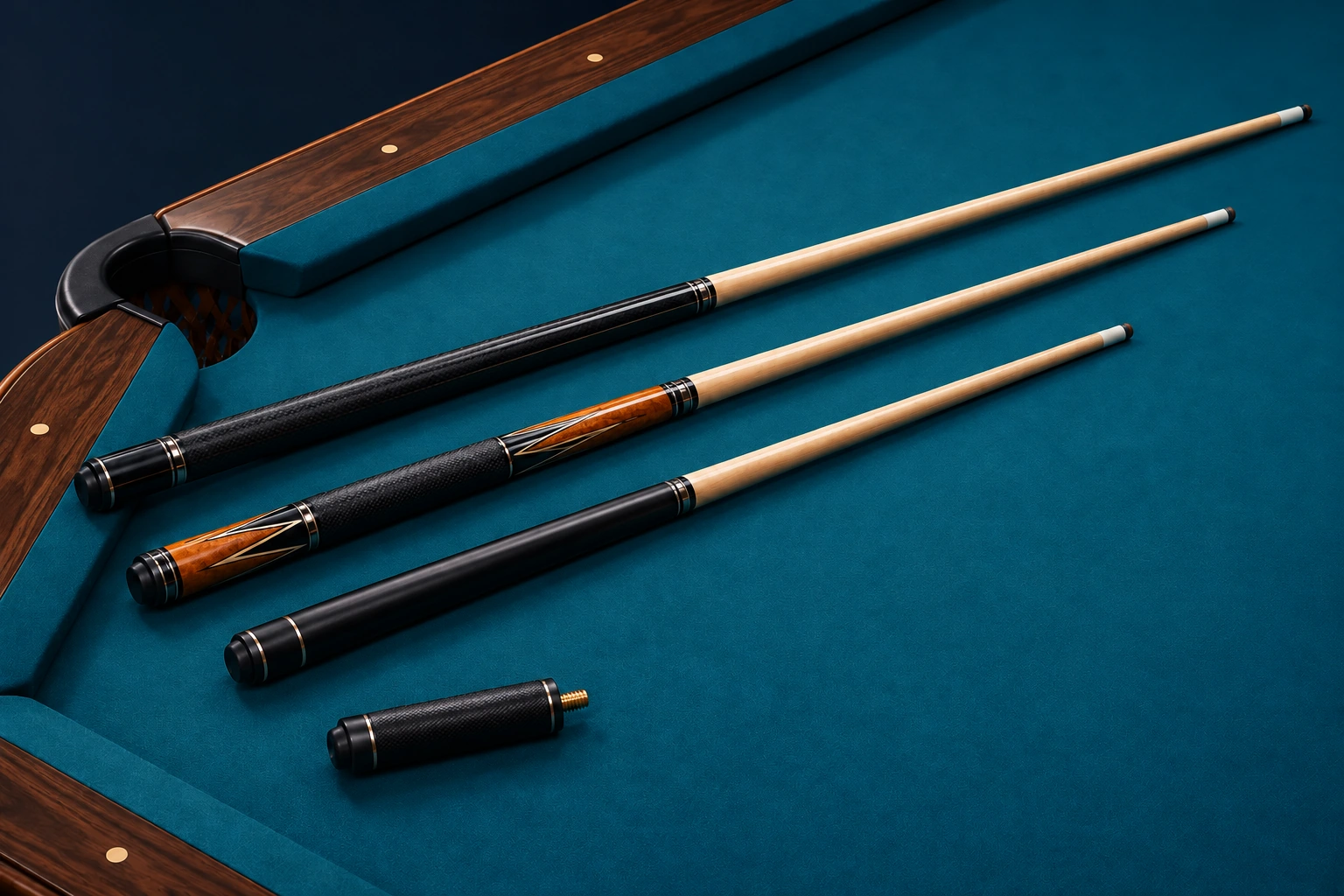
Measure the assembled system before choosing a size
The WPA specification’s 40-inch minimum and absence of a maximum length describe its equipment boundary, not personal fit. Confirm the actual venue and event requirements. A listed component length is not an assembled measurement, and a different shaft or extension can alter balance, mass and handling as well as reach.
Do not assume a universal perpendicular forearm, fixed bridge length or height threshold. An uncomfortable or obstructed address is a hold condition, not a sign to stretch farther. Inspect secure components before taking a stroke.
| Field | Measure or verify |
|---|---|
| Assembled length | Bumper to tip with the exact intended parts attached |
| Rear addition | Actual net added length; nominal extension length can overlap hardware |
| Mass and balance | Measured complete configuration, not shaft length alone |
| Compatibility | Maker-approved connection and secure assembly |
| Ordinary fit | Free cue movement through a comfortable bridge and grip |
| Room and carry | Backward clearance along the shot line; actual case fit |
Identify the connection before combining parts rather than forcing a similar-looking thread.
Evaluate shaft taper separately if the cue binds through the bridge.
Calculate clearance for a near-level ordinary stroke
At a near-level address, measure available distance from the tip’s address point backward along the cue axis to the first obstruction. The simple sufficient check is C≥L+b+m. In this example A has 2 inches spare and B lacks 1 inch, so B is held at that station. The 2-inch allowance is an example chosen before testing, not a universal safety standard.
Do not raise the cue or shorten the backswing after the fact simply to turn a clearance failure into a pass; that changes the task. Real hand, face, clothing and furniture clearance still needs observation. The formula does not certify comfort or allow an unsafe stance.
| Quantity | A | B |
|---|---|---|
| Measured assembled length L | 58 | 61 |
| Planned backward tip travel b | 4 | 4 |
| Chosen clearance allowance m | 2 | 2 |
| Needed distance L+b+m | 64 | 67 |
| Available cue-tip-to-wall distance C | 66 | 66 |
| Spare C−(L+b+m) | 2 | −1 |
Separate everyday fit from an occasional long reach
Use an illustrative 100×50-inch bed represented by x=0 to 8, y=0 to 4, measured between cushion noses from the lower-left corner. Equal 2.25-inch balls have radius 0.09 and diameter 0.18 units. Intact-cushion center bounds are x=0.09 or 7.91 and y=0.09 or 3.91. Real pockets interrupt those boundaries at the corners and side midpoints (4, 0),(4, 4). Scale to your measured bed and ball size; actual jaws and shelf require inspection. Coordinates are ball centers, not edges or universal diamond values.
The central and reach stations are not promises of a straight stop or prescribed finish. Aim at the tangent center for the chosen object-to-pocket line, and use one familiar controlled pace without intentional sidespin. There are no other balls. Inspect whether the physical cue can clear the rail at the near-rail station; do not force a level stroke through a cushion.
Try A and B only at stations that pass safety and compatibility checks. Two configurations×three stations×four strikes=24 planned attempts, 12 per configuration. Alternate which configuration goes first by station; reverse on a later repeat. Record actual denominators when a station is held.
| Station | Exact ordinary shot | Observe |
|---|---|---|
| Central | Cue (4, 2), object (6, 3), pocket (8, 4) | Free bridge/grip motion and chosen normal pace |
| Near rail | Cue (3, 0.25), object (6, 0.25), pocket (8, 0) | Safe rail clearance; adapt bridge before striking |
| Reach | Cue (5, 2), object (6.5, 2.75), pocket (8, 4) | Secure supported reach; hold if unsafe |
Use a mechanical bridge for occasional reach when changing every ordinary stroke is unnecessary.
Test bridge spacing separately rather than changing both variables during this comparison.
Keep essential holds beside the pocket outcome
For every struck attempt record configuration, station, actual clearance, free cue movement and called pot without foul. An equipment or comfort hold is not averaged away by more pocketed balls. A candidate that passes only the reach station has not demonstrated better everyday fit.
Hypothetical A: central 4/4 and rail 3/4 pots, reach held; B: central 3/4 and rail held, reach 3/4. Each has eight struck attempts, not twelve; available percentages cannot determine a winner because the missing stations differ. Resolve holds or retain a safe normal cue with a separate reach aid. This is not a length-only causal experiment when mass or balance changed.
Verify Ariakon extension facts at the current destination
The Ariakon Atlas extension listing checked October 13, 2026 offers nominal 4, 6, 8, 10 and 12-inch choices and identifies Atlas-cue compatibility. Those inch and millimeter selector labels are nominal product choices, not exact conversions or guaranteed net added assembled length. Measure your actual configuration and confirm the connection before ordering.
Do not infer stock, case fit, delivered cost or a performance advantage from this worksheet. Keep the smallest number of configuration changes that solves the observed task; a longer option is not automatically more useful or less useful.
Check current Ariakon Atlas extension options and confirm compatibility and actual supplied configuration.
Use the complete cue-buying worksheet when more than length is unsettled.
Sources and further reading
References support the specific factual information above. The practical checklists are Ariakon editorial guidance.