
Fundamentals · 4 min read
How to Use a Mechanical Bridge in Pool
A mechanical bridge supplies cue support when an ordinary hand bridge would require an unstable reach. Learn its placement and clearance before requesting extra speed or spin. This guide is a support-and-delivery worksheet, distinct from choosing a hand bridge, changing bridge length or buying a cue extension.
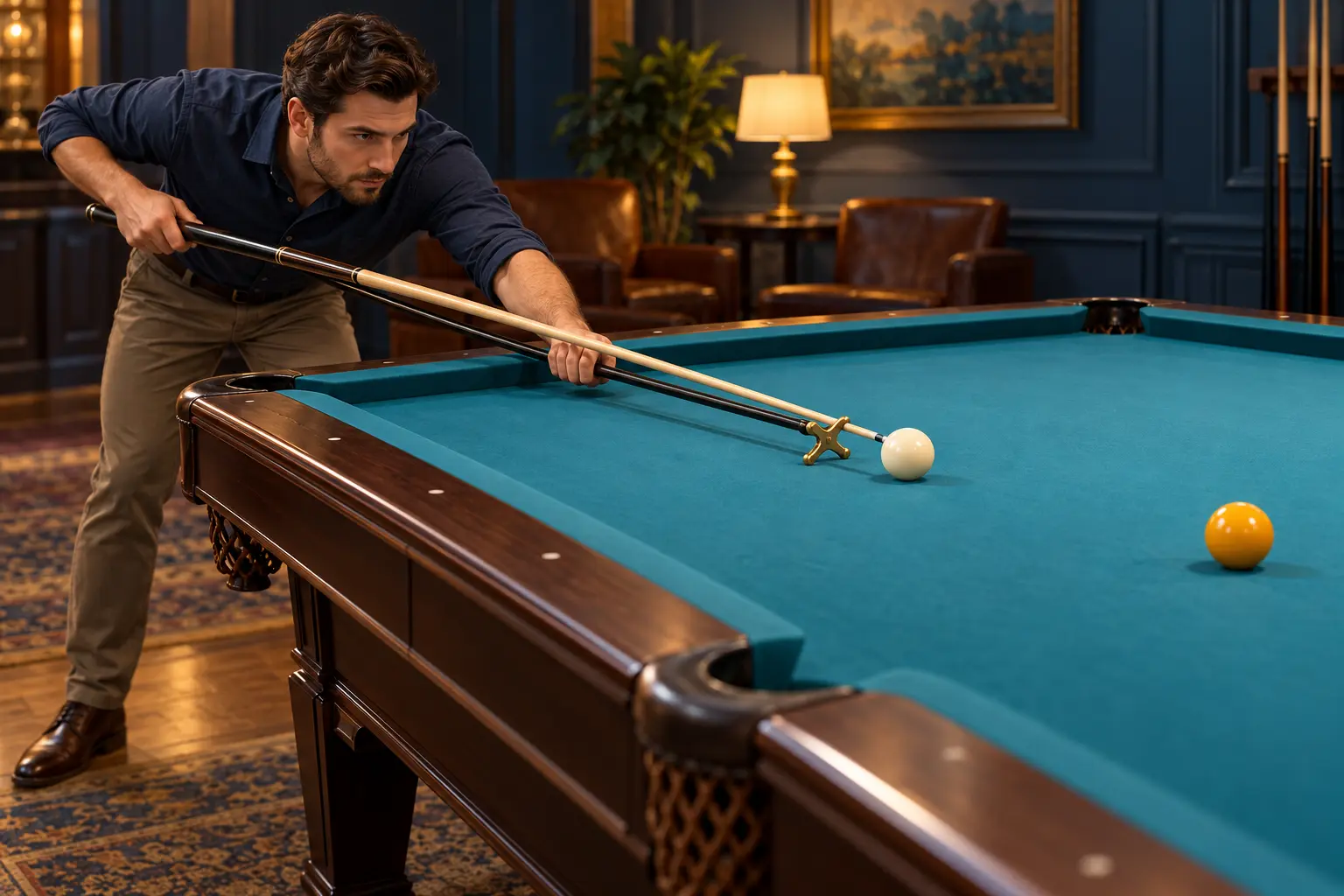
Inspect the support before addressing a ball
Ask for a sound bridge if condition is uncertain. Do not wrap sharp hardware, add improvised blocks or press hard into cloth to stabilize a rocking head. A bridge is cue support, not a support for body weight.
Current WPA rules permit up to two standard-like mechanical bridges: the cue is supported by a bridge head, and a second bridge, when used, is supported by the first bridge’s head. This lesson uses one bridge only. Confirm actual event and room procedures; do not improvise a stack.
| Check | Proceed when | Hold when |
|---|---|---|
| Head and handle | Secure, smooth and intact | Loose, sharp or damaged |
| Base | Stable on permitted cloth without contact with a ball | Rocking, dragging or obstructing a ball |
| Cue groove | Cue slides freely and stays supported | Binding, slipping or unsuitable height |
| Stroke clearance | Cue, bumper, hand and face have room for an ordinary stroke | Any risk of striking a person, furniture or another ball |
Build the line around a stable head
Choose a comfortable address and a groove that clears the shot without unnecessary elevation. Set the head behind the cue ball with space for your intended stroke, stabilize its handle, then place the playing cue in the groove. Inspect tip clearance and an ordinary rehearsal motion before committing.
If alignment is wrong, rebuild the placement while no balls are moving. Do not lever the shaft sideways through the groove or use a fixed head distance, wrist angle, dominant-eye rule or grip pose as a universal requirement. A compact comfortable motion is preferable to an unsafe reach. Keep the simplest tip contact and pace that solve the shot.
Choose an ordinary hand bridge separately when reach is comfortably available.
Compare occasional reach with complete cue length when considering an extension instead.
Use two exact straight-shot starts
Use an illustrative 100×50-inch bed represented by x=0 to 8, y=0 to 4, measured between cushion noses from the lower-left corner. Equal 2.25-inch balls have radius 0.09 and diameter 0.18 units. Intact-cushion center bounds are x=0.09 or 7.91 and y=0.09 or 3.91. Real pockets interrupt those boundaries at the corners and side midpoints (4, 0),(4, 4). Scale to your measured bed and ball size; actual jaws and shelf require inspection. Coordinates are ball centers, not edges or universal diamond values.
The tangent cue center is (5.839003, 2.919502), one diameter behind the object along its pocket line. The starts are 1.2 and 2 units behind that center on the same incoming line. Place only one active pair. The bridge head sits behind the active cue center on the chosen cue line, never between cue ball and object; choose its spacing for safe clearance, not from the decorative photo.
Take four struck attempts at each start, eight total, with a familiar no-intentional-sidespin pace. This task scores support and a called pot, not a guaranteed stop finish. If a safe supported address cannot be established, hold that station rather than counting unplayed attempts as misses.
| Start | Cue center | Fixed object and pocket |
|---|---|---|
| Near | (4.76569, 2.382845) | O(6, 3); real corner P(8, 4) |
| Far | (4.050149, 2.025074) | Same O and P |
Keep support evidence separate from the ball result
Hypothetical near block: 4/4 support, 3/4 pockets; far: 3/4 support, 2/4 pockets. Totals 7/8 and 5/8 are independent, not 12/16 ability. A pocketed ball does not excuse a support failure. A struck foul remains an attempt.
Retest the same starts on a later occasion before adding obstacles, elevation or spin. A repeated support problem calls for placement or equipment inspection, not a stronger hit. Remove and return the bridge only after balls stop and while clear of the opponent’s path.
| Field | One when |
|---|---|
| Support retained | Head/base stayed stable and cue remained freely supported through the stroke |
| Pocket outcome | Called object entered its pocket without foul |
| Notes | Head moved, binding, contact uncertainty, discomfort or miss direction |
Inspect ordinary delivery fields if stable support still produces unclear misses.
Register a safe video view for a concrete movement question, not a prescribed pose.
Sources and further reading
References support the specific factual information above. The practical checklists are Ariakon editorial guidance.