
Fundamentals · 4 min read
Build a Pool Stance Checklist for Balance and Cue Clearance
Stance review asks whether you can support and clear the cue comfortably while repeating the shot picture. It is not a competition to lower the head or copy a professional’s foot angle. Use an observable card, one controlled change and a separate transfer to decide what helps your delivery.
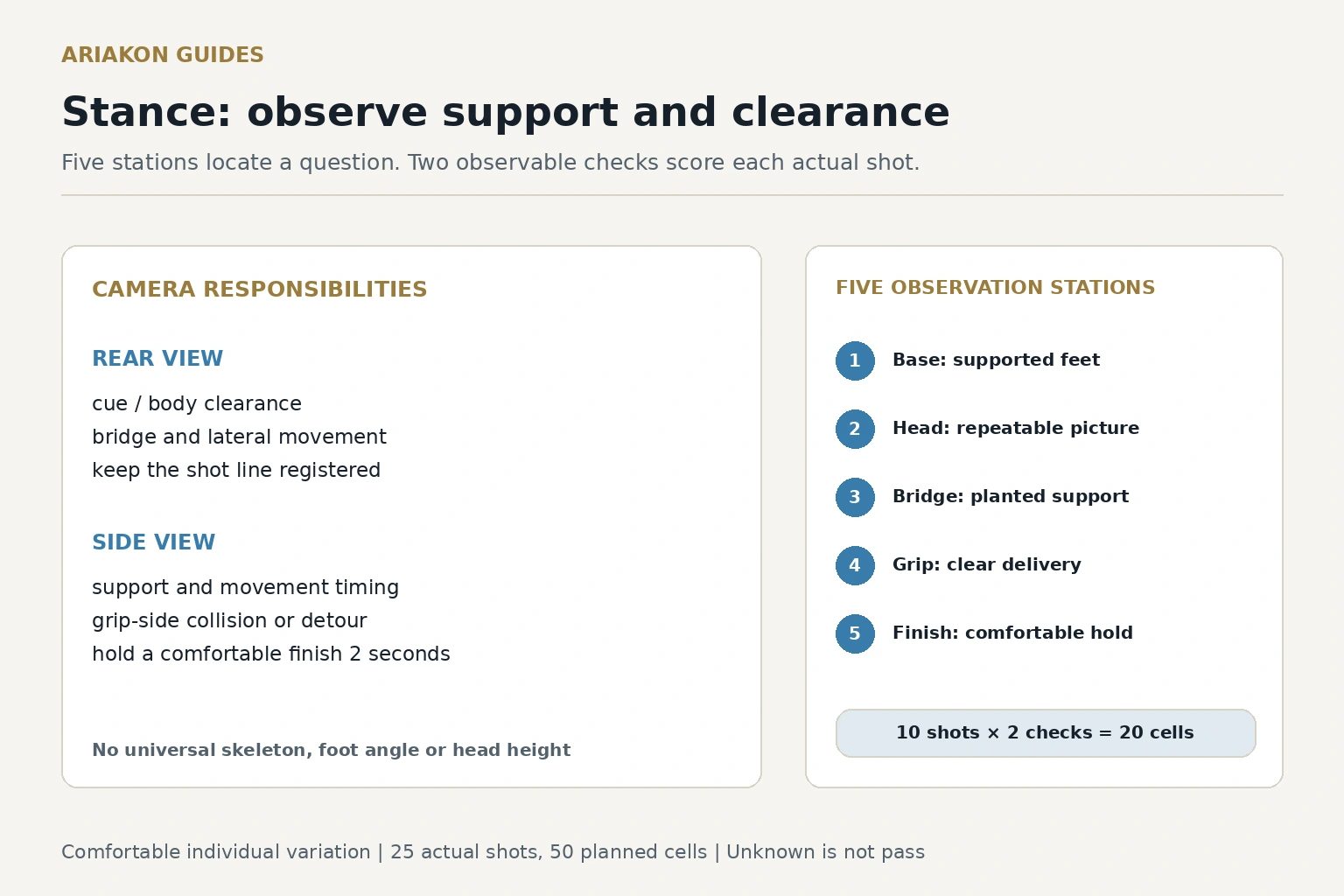
Choose a reconstructible shot and two permitted views
Use ball-center coordinates on an illustrative 100×50-inch bed: x=0..8 along the length, y=0..4 across it, origin at the lower-left cushion-nose corner. Equal 2.25-inch balls have radius 0.09 and diameter 0.18 units. Intact-cushion center limits are 0.09..7.91 and 0.09..3.91; real pockets interrupt the boundary at four corners and (4,0),(4,4). Measure your actual bed, mouths and balls before scaling this example. Remove all measuring aids before shooting; do not mark a competition table.
Use O(6,3), P(8,4), contact G(5.839003, 2.919502) and straight cue start (4.944576, 2.472288), one unit behind G on the pocket line. Use an ordinary controlled stop request. Register a rear-line view for lateral cue/body clearance and a side view for support and motion timing. Phones remain off the playing surface and outside walkways.
Get permission from anyone identifiable in a clip. Use simultaneous views if available; otherwise score only what each view actually reveals. Do not award hidden-side clearance because the other camera looks tidy. Stop for discomfort; this is not a medical assessment.
Give five stations concrete jobs
Use the five stations to locate a question, not five separate commands in the stroke. A low head can be uncomfortable, and a wide base can restrict some players. Select only comfortable adjustments you can repeat.
| Station | Observation | What it does not establish |
|---|---|---|
| Base | Stable supported feet without a recovery step | A mandatory foot angle |
| Head picture | Chosen comfortable sight picture repeats before contact | A universal head height |
| Bridge side | Planted support without crowding the cue | Exact grip force |
| Grip side | Hand and cue clear torso through delivery | One required elbow pose |
| Finish | Comfortable supported position held for two seconds | A made ball or correct aim |
Keep stance inside the full fundamentals check when the first visible failure is elsewhere.
Review forearm timing as a separate task instead of forcing the stance to imitate an arm model.
Score two outcomes, not ten unseen assumptions
Shoot ten baseline attempts. For each, record balance as pass only when support remains stable and the two-second finish is observed; record clearance as pass only when the relevant views show no body collision or forced detour. Use fail for an observed failure and unknown for inadequate evidence. Twenty planned cells are ten shots times two checks.
Count passes over observed cells and list unknowns. Also record pots out of ten separately. Both feet planted is a conservative practice preference here, not the WPA rule: ordinary WPA play requires at least one foot touching the floor when the cue tip strikes. Local rules and safe reach still apply.
Change one station and repeat the same shot
Choose one small comfortable clearance or support change, keeping ball positions, cue and pace request fixed. Take ten more shots using the same views. Never diagnose joint restriction or force a painful shape to gain a score. Revert if a new comfort or sight-picture problem appears.
Illustrative baseline: fourteen passes across eighteen observed cells, two unknown, seven pots. Changed set: seventeen passes across nineteen observed cells, one unknown, seven pots. The check improved without a pot-count change; it is not proof of higher match ability. Review the two components so better balance cannot conceal worse clearance.
Transfer the card and use support when needed
Take five additional attempts from (4.40792, 2.20396), now 1.6 units behind the same G. This gives twenty-five actual shots and fifty planned balance/clearance cells across the whole record. Keep this longer-distance transfer separate from the before/after comparison.
For a rail or awkward reach, stop and inspect support before any strike. Use a mechanical bridge when a hand bridge would create unsafe stretching or poor clearance. The altered task needs its own observation, not automatic credit from a passed straight shot. End with at most two stance cues you can reliably observe or feel.
Use mechanical support deliberately when ordinary stance cannot safely provide the reach.
Use bounded video evidence when the record contains many unknown cells.
Sources and further reading
References support the specific factual information above. The practical checklists are Ariakon editorial guidance.