
Fundamentals · 4 min read
Advanced Pool Fundamentals for a Repeatable Stroke
Advanced fundamentals should survive a modest change in shot demand without forcing a prescribed pose. This resource gives six observable checks and a distance-only record. It is not a relabeled named pause routine, a maximum-spin lesson or a diagnosis of a medical vision problem.
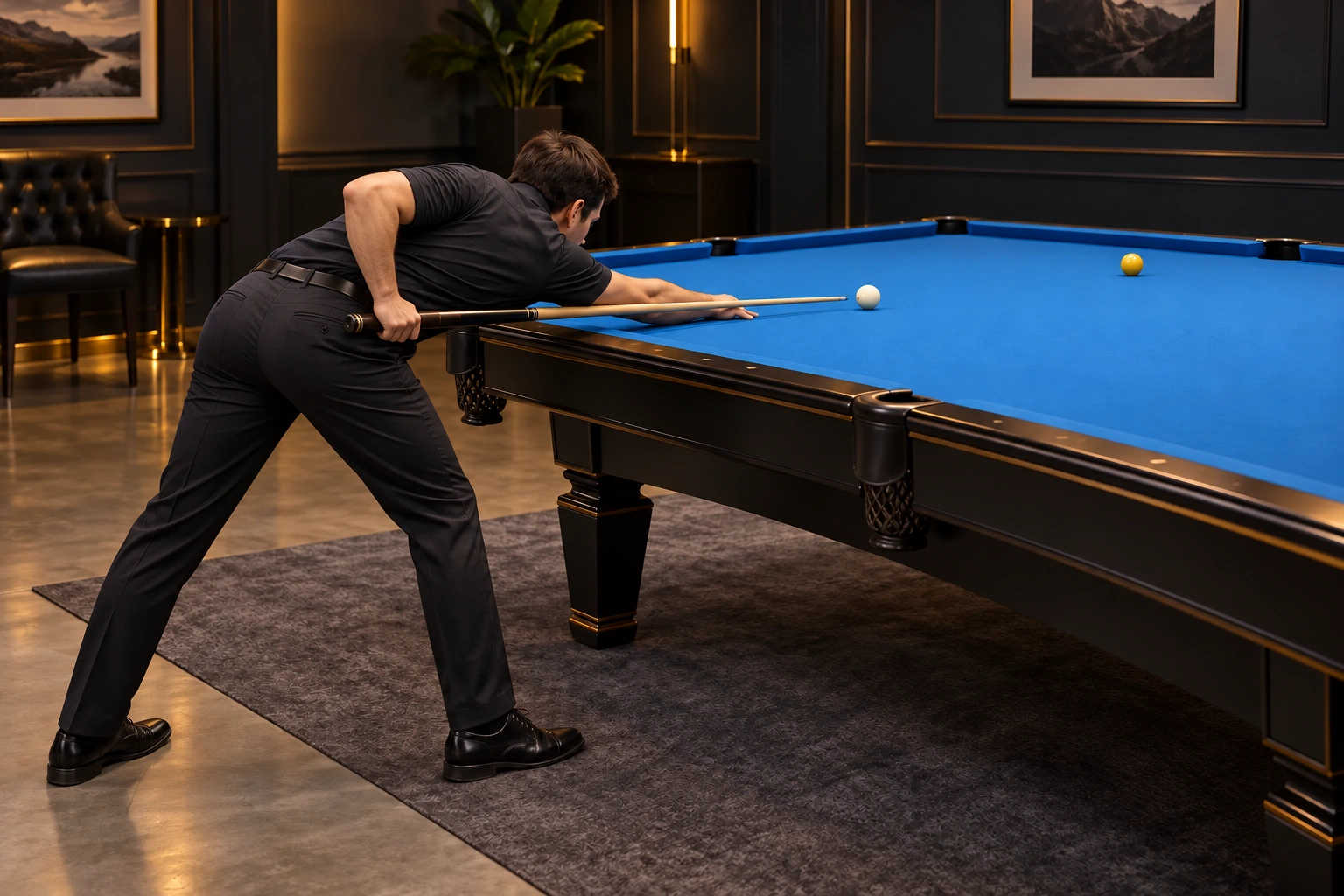
Observe the task instead of copying a body shape
Use a normal comfortable stance, familiar bridge and secure but unforced grip. Foot angle, head height, bridge length and pause duration are not universal numeric requirements. Do not force the chin onto the cue or imitate an illustrated body. Ask a qualified instructor about a repeated task-specific difficulty.
These are observations, not a branded sequence or compulsory thoughts during the forward stroke. Decide before addressing; if the picture changes substantially, stand up and restart. Persistent pain or visual symptoms need appropriate professional advice rather than a more rigid pose.
| Field | Question at this shot | A hold is appropriate when |
|---|---|---|
| Comfort and support | Can the address be held without discomfort or relying on the bridge to carry body weight? | Pain, dizziness or unsafe reach |
| Bridge stability | Does the guiding hand remain planted without dragging or squeezing the shaft? | An unstable or uncomfortable bridge |
| Cue clearance | Can the cue move through the intended ordinary stroke range? | Body or equipment obstructs the motion |
| Chosen line | Was one line chosen before address and retained until delivery? | Repeated late steering |
| Tip-contact control | Was the intended contact retained without an obvious miscue? | Contact remains uncontrolled |
| Observation finish | Was a brief natural finish retained so movement can be observed? | Result cannot be observed safely |
Change only straight-shot distance
The illustrative playing bed is 8×4 units, equivalent to 100×50 inches. A 2.25-inch ball has radius 0.09 and diameter 0.18 units. Coordinates describe ball centers from the lower-left cushion-nose corner. The center envelope for intact cushions is x=0.09 or 7.91 and y=0.09 or 3.91: the ball edge, not its center, touches the nose. Real pockets interrupt that envelope at the four corners and at (4,0) and (4,4). Inspect the actual pocket mouths and reject any rail target in a gap or jaw area. Scale the construction to your measured bed and actual ball size; these coordinates are not universal diamond values.
The ghost center is (5.839003, 2.919502), one diameter behind the object along the pocket line. Each start lies on the same straight incoming line. No intentional sidespin; one comfortable pace. These shots check ordinary delivery and observation, not a guaranteed stop, follow or draw finish. Only one active ball pair is placed.
Take six struck attempts at each distance, 18 total. If the distant start causes unsafe reach, use a mechanical bridge with proper instruction or record the station held; do not count an unplayed station as six failures. A stopped session uses actual denominators.
| Ghost-to-cue distance | Cue center | Fixed target |
|---|---|---|
| 1 units | (4.944576, 2.472288) | Object (6,3); pocket (8,4) |
| 1.75 units | (4.273756, 2.136878) | Object (6,3); pocket (8,4) |
| 2.5 units | (3.602935, 1.801468) | Object (6,3); pocket (8,4) |
Keep six check columns beside the pocket outcome
For every struck attempt record 0 or 1 in each observed field and an independent 0 or 1 called-pocket result without a foul. A complete record contains 18 pocket opportunities and 18×6=108 observable cells. The six fields are not weights in an overall playing-ability score, and an essential comfort or clearance hold cannot be averaged away.
Hypothetical full-record field counts are 18,17,18,14,15,16 out of 18, or 98/108 recorded passes. Pocket outcomes are 14/18. Neither fraction proves a universal improvement or explains the miss by itself. Break the record down by distance; do not hide the long-shot pattern in one total.
Use video only for a concrete question
With room and participant permission, place a stable camera outside every ball and player path. Keep the same registered viewpoint for comparable attempts. Inspect a few representative strikes for cue clearance, lateral change or obvious contact, not attractiveness of a pose. A single camera perspective cannot establish exact three-dimensional alignment.
Do not add physical gates or hard objects to this worksheet; those belong to separately specified diagnostic protocols. Save the setup and distance with the clip. Change one detail only after identifying an observable repeated issue, then repeat the same record on a separate occasion.
Use the separate registered video protocol if camera perspective is the unresolved evidence problem.
Recheck the standing alignment task if the chosen line changes during descent.
Transfer one stable observation without a named ritual
Select one task-specific cue from your own evidence, such as rebuilding an unstable bridge before addressing. Test it in six ordinary shots with differing demands, retaining the pocket and process records separately. This six-shot transfer is a new observation, not an extension of the 18-shot distance score.
If both records are unclear, simplify the task or ask an instructor to observe it. A comfortable repeatable cue path matters more than a compulsory elbow motion, foot angle, pause count or promise of extreme spin.
Compare an aiming candidate fairly after delivery is sufficiently stable.
Read current Ariakon playing-cue information at the verified destination; this diagnostic does not establish product superiority or exact fit.
Sources and further reading
References support the specific factual information above. The practical checklists are Ariakon editorial guidance.