
Aiming and alignment · 4 min read
How to Compare Advanced Pool Aiming Systems
An unfamiliar reference needs a clear contract before a fair trial. What is being visualized, which changes are allowed, and what would count as an invalid attempt? This guide supplies that contract and a crossover record. It does not teach a proprietary pivot system or declare one aiming picture best for everyone.
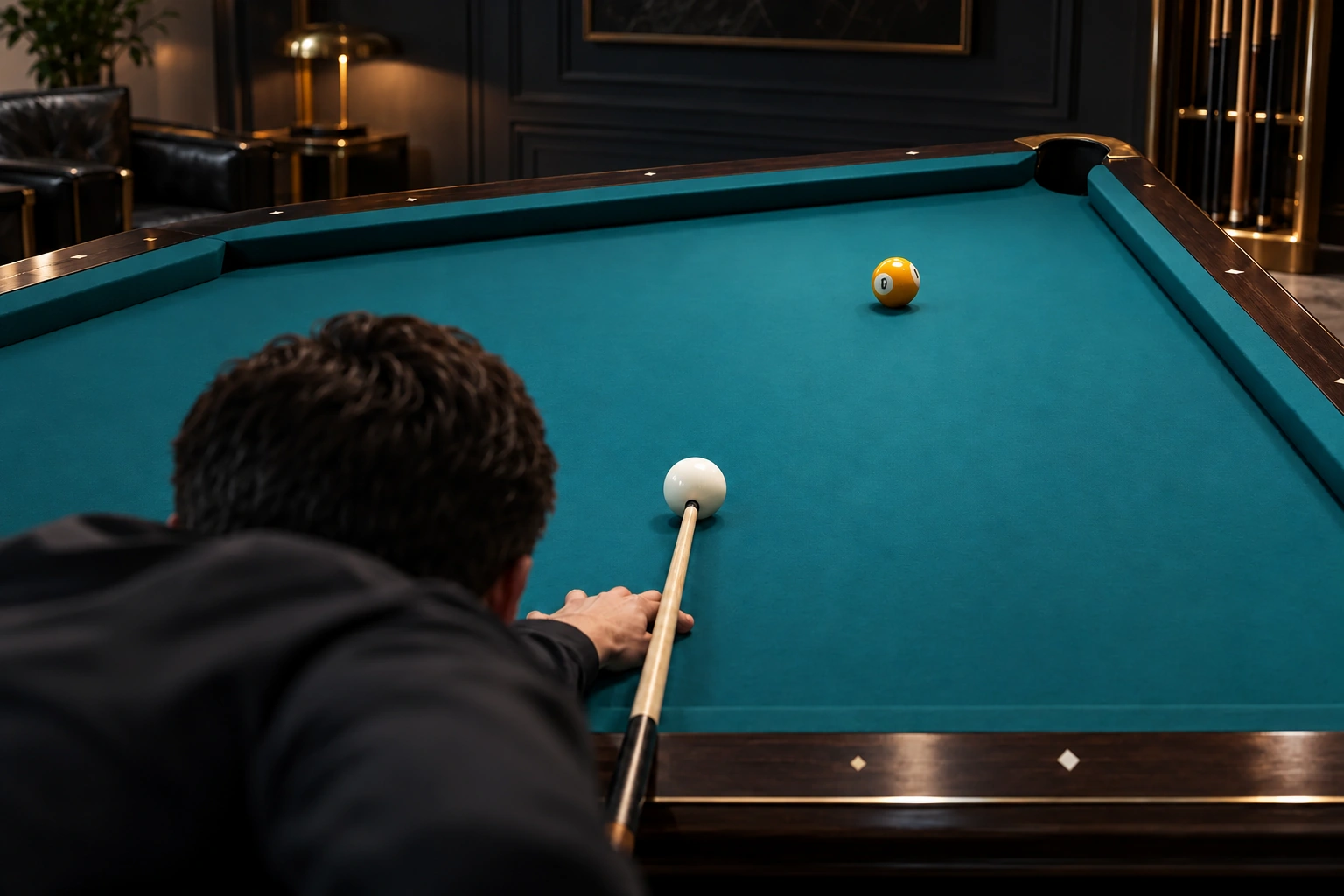
Write the reference contract before taking a score
Record the instructions you actually have permission to use privately, without importing names or product claims into the score sheet. If the method is undefined, asks you to improvise a pivot, requires unsafe reach or changes tip offset, mark it NOT COMPARABLE for this no-sidespin trial. That is a limits finding, not proof the method is ineffective.
Use familiar equipment and a comfortable normal address. A method that changes stance, cueing and speed at once cannot isolate an aiming-picture effect. The comparison may describe a complete routine preference, but must not claim a causal visual advantage.
| Reference family | Question to answer | Trial boundary |
|---|---|---|
| Imagined contact position | Where must the cue-ball center arrive? | An equal-size ghost ball is tangent, not overlapping |
| Object-ball contact picture | How is that point translated into the incoming center line? | Do not aim the cue-ball center straight at a surface point |
| Projected overlap | What overlap is visible along the incoming line? | Silhouette overlap is not physical overlap on the cloth |
| Cue-outline observation | What is observed at normal address? | No marks or universal angle code assumed |
| Alignment-change method | What exact authorized instruction does it require? | Do not invent or relabel a proprietary sequence |
Use the separate two-reference comparison when the question is only ghost-ball versus fractional overlap.
Test an unmarked outline observation without treating it as a proprietary aiming algorithm.
Use six fixed distance-and-direction layouts
The illustrative playing bed is 8×4 units, equivalent to 100×50 inches. A 2.25-inch ball has radius 0.09 and diameter 0.18 units. Coordinates describe ball centers from the lower-left cushion-nose corner. The center envelope for intact cushions is x=0.09 or 7.91 and y=0.09 or 3.91: the ball edge, not its center, touches the nose. Real pockets interrupt that envelope at the four corners and at (4,0) and (4,4). Inspect the actual pocket mouths and reject any rail target in a gap or jaw area. Scale the construction to your measured bed and actual ball size; these coordinates are not universal diamond values.
Original object O=(6, 2.8), corner pocket P=(8, 4), ghost center G=(5.845651, 2.707391). The three starts are 30° from the pocket-direction vector, at the distances in the table. Reflect every center by y→4−y, including O, G and the pocket, for the other direction. Never reflect only the cue ball. The straight cue-center approach reaches the tangent ghost center; throw and delivery still require observation.
Use room-permitted position references, remove any helper ball before striking, and photograph the reset. The wider nine-position resource supplies the elementary construction; this page adds an unfamiliar-reference audit rather than another aiming grid.
| Distance | Cue center, original | Cue center, reflected |
|---|---|---|
| 1.4 units | (5.166143, 1.483353) | (5.166143, 2.516647) |
| 2 units | (4.874926, 0.958765) | (4.874926, 3.041235) |
| 2.6 units | (4.583708, 0.434177) | (4.583708, 3.565823) |
Recreate the underlying center construction before using these six matched layouts.
Counterbalance a familiar baseline and a defined candidate
Call the familiar routine A and the candidate B. On a first occasion use A then B at layouts 1,3,5 and B then A at 2,4,6. On a separate occasion reverse every order. Take four scored attempts per layout per routine: 6×2×4=48 per occasion, 24 per routine. Two occasions allocate 96 scored attempts, 48 per routine.
Allow two unscored familiarization shots per routine before each occasion: four additional strikes, 52 total strikes for a complete occasion and 104 across both. These are allocations, not a required continuous workload. Rest or stop as needed; keep actual attempts and unused slots visible. Do not erase a miss by calling it a warm-up after the fact.
Separate pocket results from contract compliance
Hypothetical records: A makes 31/48 with 45/48 process flags; B makes 33/48 with 37/48 flags. The two extra makes do not establish improvement when the candidate disrupted its contract more often. Keep directions and distances separate; a reversing lead or a one-side miss pattern needs another question, not a sales conclusion.
A struck foul or deliberate mid-stroke change remains in the outcome denominator. An administrative setup interruption before striking is not a shot: log it and fill the slot only after a valid reset. If work stops early, report the actual denominator rather than 48.
| Field | One attempt earns 1 when | Maximum per routine, two complete occasions |
|---|---|---|
| Pocket outcome | Called ball enters called pocket without a foul | 48 |
| Process flag | Frozen setup, speed, tip offset and routine contract were retained | 48 |
| Miss description | Write overcut, undercut, jaw, delivery change or interruption | Not a point score |
Transfer only the question the record answered
Keep a candidate only if it is understandable, comfortable and repeatedly useful under the same stated conditions. Do not transfer this record to sidespin, rail shots or another cue without a new version. A made ball alone cannot validate exact contact geometry or a predicted cue-ball route.
If both routines scatter, simplify delivery before changing labels. If a picture creates tension or steering, return to the baseline and ask a qualified instructor to observe a specific task.
Check the distance-only fundamentals record when delivery is the unresolved variable.
Plan a useful next-shot zone after pocketing and routine evidence are stable.
Sources and further reading
References support the specific factual information above. The practical checklists are Ariakon editorial guidance.