
Position play · 4 min read
Pool Pattern Play: Plan Routes With More Margin
A useful position zone is one you have checked from more than its center. This original planning worksheet compares a broad and narrow request on the same simple first shot, then observes the continuation from the actual result. It does not promise a cue-ball route from an attractive curved arrow.
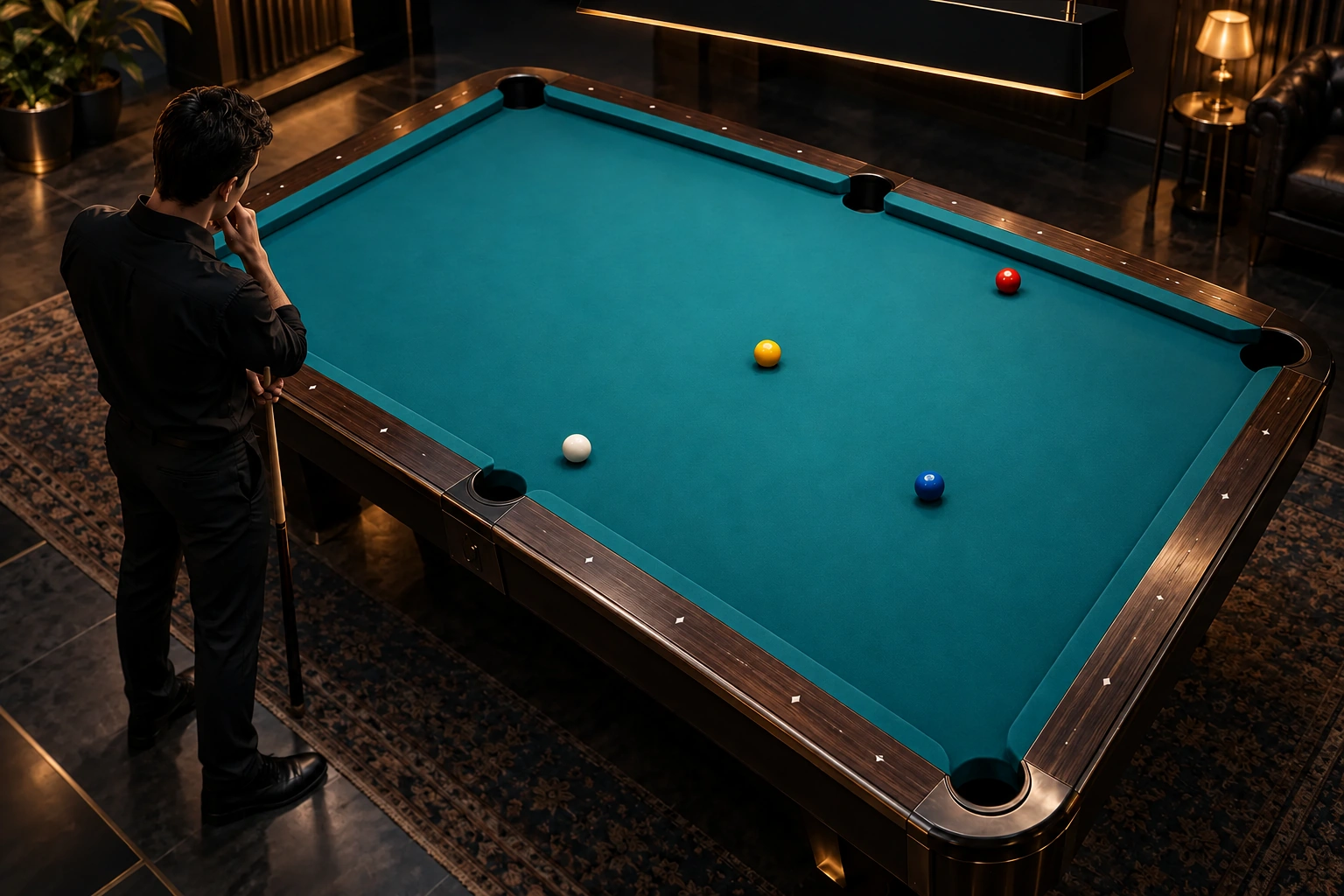
Write a fixed three-ball practice layout
The illustrative playing bed is 8×4 units, equivalent to 100×50 inches. A 2.25-inch ball has radius 0.09 and diameter 0.18 units. Coordinates describe ball centers from the lower-left cushion-nose corner. The center envelope for intact cushions is x=0.09 or 7.91 and y=0.09 or 3.91: the ball edge, not its center, touches the nose. Real pockets interrupt that envelope at the four corners and at (4,0) and (4,4). Inspect the actual pocket mouths and reject any rail target in a gap or jaw area. Scale the construction to your measured bed and actual ball size; these coordinates are not universal diamond values.
This is an editorial practice format, not a complete ruleset. The first shot is straight along (2,1); the tangent ghost center is (5.839003, 2.919502). A controlled draw return can approach the requested zones behind that point, but no fixed tip height or speed is guaranteed. Calibrate the return separately before attempting a full pattern.
| Item | Center | Called pocket |
|---|---|---|
| Cue ball | (4,2) | First shot begins here |
| Object 1 | (6,3) | (8,4), upper-right corner |
| Object 2 | (5,1.5) | (8,0), lower-right corner |
| Object 3 | (2,3) | (0,4), upper-left corner |
Establish the measured draw return before requesting a tight first transition.
Validate zones from their corners
Both rectangles straddle the reverse first-shot line. A is 0.6×0.3=0.18 square units; B is 0.2×0.1=0.02, so B has one ninth the geometric area. That does not mean one ninth the pocketing probability. The entire cue center must finish inside the called rectangle.
Before scoring, place the cue ball at each of the four corners of each rectangle and inspect the line to Object 2’s tangent ghost center and its pocket path. Check no other ball obstructs those lines, then decide whether the view is makeable and comfortable for you. Clear geometry is not proof of your shot percentage. If a corner is unusable, reduce or replace the zone and save a new version rather than counting it as good position.
| Zone | x interval | y interval | Purpose |
|---|---|---|---|
| A, broad | 4.2 to 4.8 | 2.1 to 2.4 | First workable margin request |
| B, narrow | 4.4 to 4.6 | 2.2 to 2.3 | Nested request, not another promised path |
Compare zone requests before extending the run
Shoot five first-shot attempts calling A, then five calling B. On a separate occasion reverse that order. Reset all centers after a miss or foul; do not move Object 2 to rescue a result. Ten first-shot attempts per occasion provide ten pocket outcomes and ten position flags.
Pocket outcome earns 1 for Object 1 in its called pocket without a foul. Position earns 1 only when that pot succeeds and the cue center rests inside the called zone with Object 2’s line available. Record actual center, wrong side, short, long or scatter rather than assigning success from distance alone. The broad zone includes the narrow one, but score only the zone called on that attempt.
Score continuation as a third distinct question
Continue after a successful first shot even if position missed the requested zone, provided the actual next shot is safe to attempt. Replan from the actual cue center; a continuation can succeed without a zone flag. Stop and reset on a miss, foul or unsafe reach. No cue-ball route from Object 2 to Object 3 is predicted here; call a personally usable next zone before Object 2 and record what occurred.
Hypothetical A block: 4/5 first pots, 3/5 position flags, 2/5 continuations. B block: 4/5 first pots, 1/5 position, 1/5 continuation. Totals are 8/10,4/10,3/10 respectively, not a combined 15/30 ability percentage. Five samples do not establish that the broad request always wins.
| Record | Requirement | Maximum for ten attempts |
|---|---|---|
| First pocket | Called Object 1 pot, no foul | 10 |
| Called zone | First pot plus cue center inside the called usable rectangle | 10 |
| Continuation | Continue without moving balls; Objects 2 and 3 in order into called pockets, no foul | 10 |
Keep planning and execution errors separate
If every corner was geometrically clear but the first return scattered, work on the return control. If the cue center entered the zone yet the next shot was not usable, the zone validation was incomplete. If the first two jobs passed and the third ball failed, study that transition rather than rewriting the first pocket line.
In games, limited pockets, traffic and the required order change the zones. Preserve alternate continuations and reevaluate after each actual result. Do not enlarge a zone merely to convert misses into retrospectively successful planning.
Compare route choices separately when one cushion versus two is the real decision.
Use the narrower angle-window task when arrival side is the specific difficulty.
Sources and further reading
References support the specific factual information above. The practical checklists are Ariakon editorial guidance.