
Cue-ball control · 3 min read
Compare One Rail and Two Rail Pool Position Routes
A second cushion is not automatically safer, harder or better. It changes the cue-ball path, the direction from which the target is crossed and how speed errors appear. This paired test keeps the first shot and landing zone fixed so a player can compare one-rail and two-rail routes on the same table. The result is a route choice for this layout—not a universal claim about every cloth or cushion.
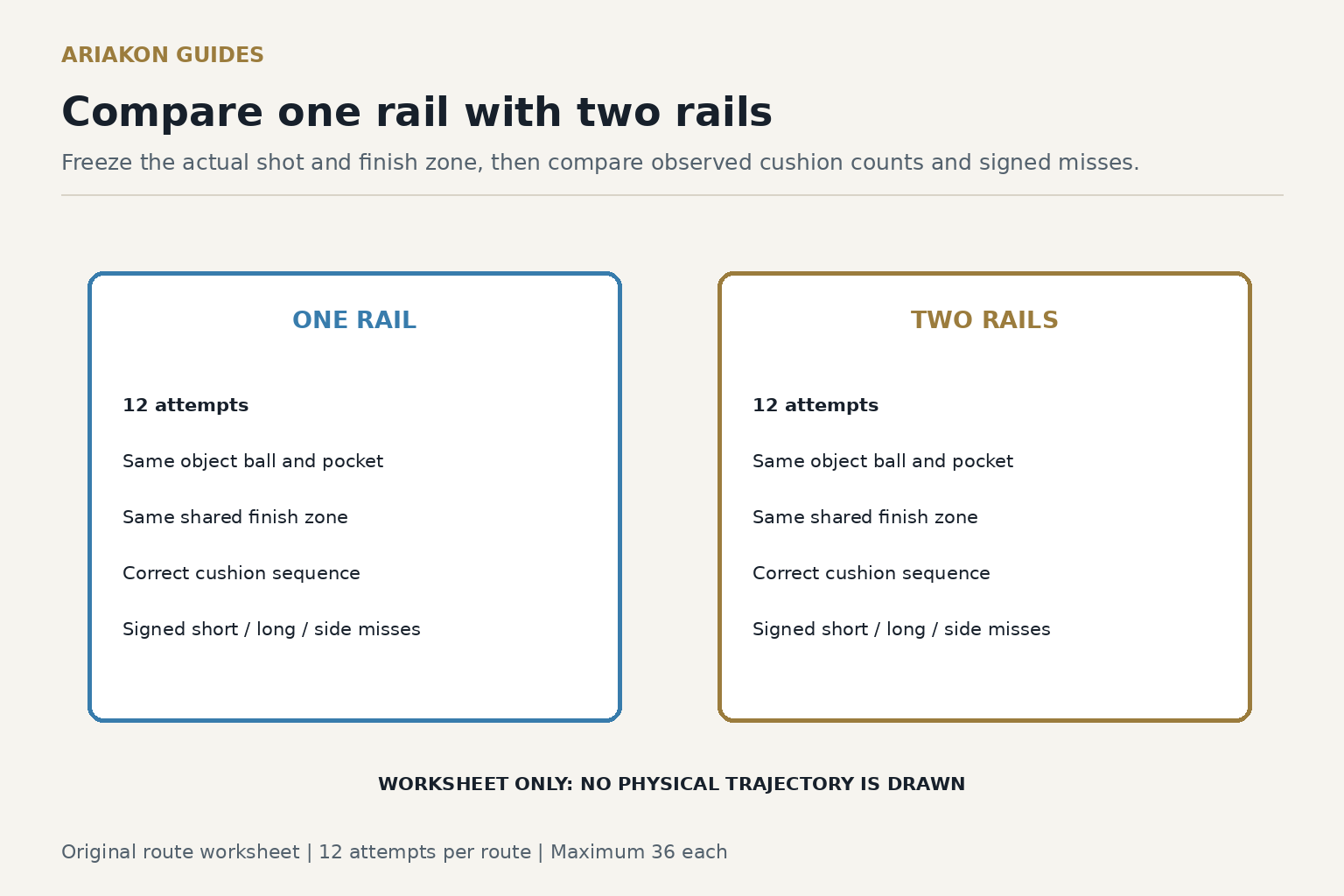
Mark one shot and one shared landing zone
Use the foot-left corner as the pocket. Put the object ball one diamond up the long rail and one diamond toward table center. Put the cue ball one diamond farther toward center and one diamond toward the head rail. On the opposite half, mark a rectangular target two diamonds long and one diamond wide, with its long edge parallel to the long rail.
Before scoring, shoot one legal center-axis trial for each route. Adjust only the target location if one route is physically blocked or requires unsafe elevation. Do not move the balls once scoring begins. Cushion response changes with speed and conditions, so record the table and session rather than borrowing an old speed call.
Choose the kind of position first when the next shot calls for an area, line or exact point rather than a route comparison.
Define the two routes before the first pair
| Route | Cushion sequence | Target entry | Signed miss |
|---|---|---|---|
| One rail | Long rail, then zone | Across the short edge | Short/long along the route |
| Two rails | Long rail, short rail, then zone | Along the long edge | Inside/outside the zone |
Shoot twenty-four paired attempts
| Round | Pairs | Order | Why reverse it |
|---|---|---|---|
| 1 | 6 | One rail, then two rails | Establish both baselines |
| 2 | 6 | Two rails, then one rail | Reduce a fixed order advantage |
Score the route and the finish separately
| Points | First shot | Called cushions | Final cue ball |
|---|---|---|---|
| 0 | Foul or miss | Any | Any |
| 1 | Pocketed | Wrong count or sequence | Any finish, including an accidental zone result |
| 2 | Pocketed | Correct | Outside; signed miss recorded |
| 3 | Pocketed | Correct | Center finishes in zone |
Compare the two thirty-six-point totals
Each route receives twelve attempts and has a maximum of 36. Keep pocket successes, correct cushion sequences, target finishes and signed misses in separate columns. A three-point total difference is only one made target, so repeat the comparison on another day before treating a small gap as stable.
Worked example: one rail scores 28 with four long finishes; two rails scores 24 with five finishes outside the target's near edge. The evidence does not say one rail is always superior. It says the current one-rail route is more repeatable for this target, while the two-rail route needs a speed block aimed at its entry line.
Make the game decision with four checks
For transfer, add the next object ball beyond the shared zone and play six two-ball patterns: three with the better-scoring route first, then three with the alternative when traffic makes it useful. Score 1 for pocketing the first ball, 1 for the called cushion route and 1 for leaving a makeable next shot; maximum 18.
| Check | One-rail question | Two-rail question | Decision note |
|---|---|---|---|
| Traffic | Is the direct lane open? | Are both cushion lanes open? | Name the blocker |
| Zone crossing | Does the path cross the narrow edge? | Does it travel through the long edge? | Prefer margin |
| Scratch | Where does an overhit finish? | Where does a short hit finish? | Mark pocket lines |
| Evidence | What did twelve attempts show? | What did twelve attempts show? | Use the current table |