
Cue-ball control · 4 min read
Troubleshoot Draw Shots That Stop Instead of Coming Back
A stopped cue ball is a useful observation, but its resting mark cannot reveal the original tip location. This diagnostic keeps contact, delivery, arrival rotation, pot and finish as separate fields before choosing one safe retest.
Keep a symptom separate from impact evidence
A nearly stationary cue after a verified straight pot is compatible with near-stun arrival. It does not by itself prove a precise zero spin or explain why requested draw was absent. A pocket miss, collision asymmetry or unreadable finish makes that inference weaker. Inspect the observable event before asking for more effort.
Use sound equipment, approved clean balls and comfortable ordinary delivery. A loose tip, hop, scoop, cloth strike or pain stops the block. No progressively lower contact is prescribed.
Freeze one exact pocket line
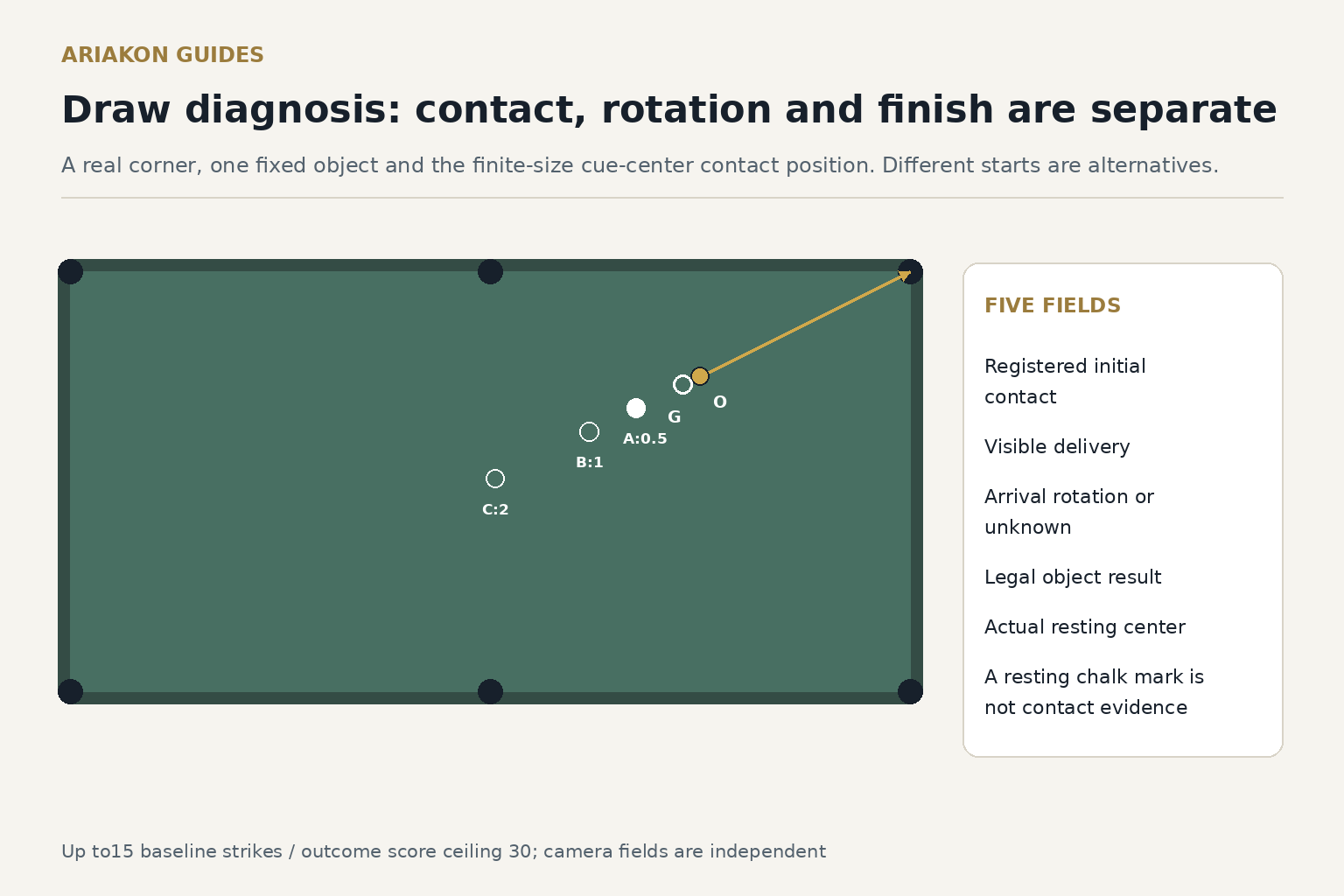
Coordinates are ball centers on an illustrative 100 by 50 inch bed: x=0..8 along length, y=0..4 across width, origin at the lower left cushion nose. One unit is 12.5 inches. For 2.25 inch equal balls, radius is 0.09 and diameter 0.18 units. Intact cushion center boundaries are x=0.09,7.91 and y=0.09,3.91; pockets interrupt the physical boundary at the four corners and (4,0),(4,4). Measure actual bed, balls and jaws before scaling. Remove every measuring aid before shooting; never mark a competition table.
Use O(6,3),P(8,4),G(5.839003,2.919502) with u=(2,1)/sqrt(5). Three cue starts are C_A=G−0.5u=(5.39179,2.695895), C_B=G−u=(4.944576,2.472288), C_C=G−2u=(4.050149,2.025074). Each row calls a cue-center rest disk radius 0.18 at its own start C minus 0.25u. These are chosen modest return requests, not predicted results.
Record the intended vertical request and pace. Use an existing permitted practice-ball feature with a continuously registered recording if rotation is to be inspected. A chalk mark at rest has rotated; it cannot locate initial contact without orientation registration. Never add chalk as a ball aiming marker in a match.
Keep five evidence fields independent
| Field | Known evidence or honest limit |
|---|---|
| Contact | Registered readable initial contact, or unknown; resting mark alone insufficient |
| Delivery | Observed cue path and any hop; camera cannot measure grip force |
| Arrival rotation | Readable registered rotation immediately before impact, or unknown |
| Object result | Known legal called pot, miss/foul, or unknown |
| Cue rest | Actual resting center and called disk, or unknown |
Advance on observed outcomes without demanding unseen video
Take five reset attempts at A. Only after at least four known legal pots, three known called finishes and no safety concern may B begin; apply the same gate before C. Stop progression at the first failed or incomplete row. The baseline ceiling is 15 actual strikes only if every row is reached; later unused rows are not misses.
Per attempt score 0 for a known foul or miss;1 for legal pot with known finish outside disk;2 for pot plus finish inside disk. A pot with hidden finish leaves nested points unknown while retaining its pot separately. Maximum 10 per fully known row,30 for three completed rows. Contact/rotation evidence is a separate diagnostic ledger; an unreadable contact is not automatically a0-point physical failure.
Let the supported question select the retest
If a registered view shows a changed initial request, investigate that delivery. If readable arrival rotation changes across distance under otherwise matched inputs, record that observation with its limits; it is not proof that distance alone caused it. If only final outcomes are known, the cause remains unresolved. Improve the view or repeat a simpler row rather than inventing retained spin.
Take one new five-attempt row after one supported safe change to pace, contact request or observation. Keep the old row. A fixed requested tip location does not certify delivered offset, and a slow phone clip may miss the interval you need. No unknown is converted to zero spin.
Transfer the farthest passed task separately
At the farthest passed start take five new ordinary attempts using the same pot and disk, scoring 0..2 separately, maximum 10. Then use an actual leave to plan a next ball in ordinary practice. A cut changes the cue path, so do not call that new task a straight backward diagnostic. Fifteen baseline plus five retest plus five transfer is 25 strikes only if all gates and blocks finish.
Sources and further reading
References support the specific factual information above. The practical checklists are Ariakon editorial guidance.