
Cue-ball control · 3 min read
Train the Tangent Line With a Simple Pool Drill
When the cue ball reaches the object ball sliding without forward or backward roll, it initially leaves along the tangent line—perpendicular to the object ball's line of travel. Learning to see that reference turns position play from vague feel into a route you can test. The line is a starting point; speed, cut angle, follow, draw, sidespin and rail contact still shape the final path.
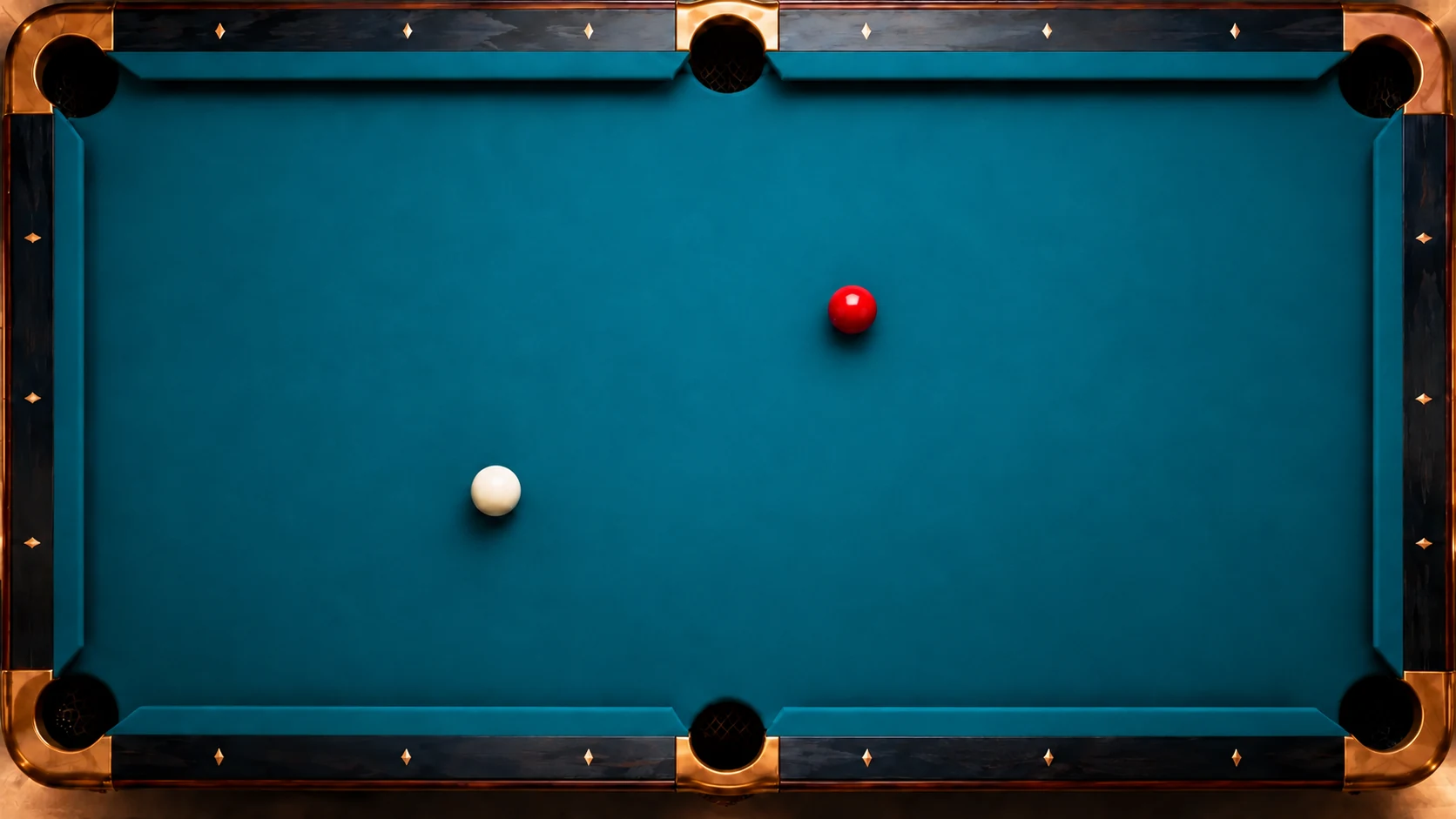
Build the reference line
Place an object ball on a simple cut to a pocket. Visualize its center-to-pocket direction and the ghost-ball center one ball diameter behind the object ball on that direction. Through that ghost-ball center, imagine a perpendicular line. This is the cue-center tangent reference in the equal-ball, no-throw idealization; it is parallel to, but displaced from, a line through the object-ball center.
Use removable markers outside the ball paths or a printed practice diagram. Never draw on cloth or place a rigid object where a ball can strike it.
Create true stun at contact
Stun describes the cue ball at the instant it meets the object ball, not merely a center-ball hit at address. Friction with the cloth changes the cue ball as it travels, so a longer shot may need a lower hit or more speed to arrive sliding.
Begin with a short distance and medium speed. Confirm stun by watching the cue ball depart close to the predicted tangent line rather than guessing from tip position alone.
Move a target along the line
Use visual target references outside every possible ball path, or removable marks approved by the venue. Remove loose paper, chalk and other objects before the stroke. Shoot the same cut repeatedly and vary only speed until the cue ball stops at several distances along the tangent direction.
Score both line and distance. A ball that travels the right direction but twice as far as planned is not complete position control.
Compare follow and draw departures
After a stable stun set, use a small amount of follow. The cue ball bends forward from the tangent reference. Use a small amount of draw and it curves back from that reference.
Keep the cut and speed as constant as possible. The exercise teaches tangent as the neutral baseline from which vertical spin changes the route.
Watch for conditions that move the result
Cut angle, ball cleanliness, cloth speed and shot speed affect when the cue ball begins rolling and how far it travels. Sidespin and rail contact add more variables, so leave them out during the first calibration.
Recheck the drill on an unfamiliar table before trusting a precise match route. The geometry remains useful, but the distance response belongs to the equipment in front of you.
Use a fifteen-shot progression
- Five stun shots to three distance targets on the tangent line.
- Five follow shots starting from the same cut.
- Five draw shots starting from the same cut.
- Mark the cue-ball finish after every attempt.
- Change only one variable within a set.
- Finish by using one calibrated route in a three-ball pattern.