
Cue-ball control · 4 min read
Diagnose Draw Distance Errors With a Contact and Speed Log
A draw shot that returns the wrong distance does not identify its own cause. The cue tip may have struck higher than intended, the delivered speed may have changed, or the object ball may have been missed. This log keeps one straight shot fixed and records those events separately. It diagnoses a practice pattern; it does not claim to measure exact tip offset or cue speed without instruments.
Freeze the shot before diagnosing it
Choose a straight line from a corner-pocket center into the table. Place the object ball one measured diamond unit along that line and the cue ball one more unit behind it on the same line. Confirm the three centers are collinear. Mark a draw target centered one diamond behind the cue ball’s starting position, half a diamond deep and one diamond wide, and use the same balls and exact centers throughout the block.
Shoot four unscored warm-ups. Choose one low contact that you can reproduce without approaching a miscue and one comfortable medium-speed intention for the baseline and a clearly slower second call. Those words are personal calls, not calibrated velocities. Once scoring starts, do not move the balls or target.
For any straight stop-shot score in this guide, center the finish window on the cue-ball center at object-ball contact: one ball diameter behind the object-ball center on the incoming line. The cue-ball starting position is not the stop destination. Keep the window size fixed before the block.
Build a draw-distance baseline first if the low contact itself is not yet repeatable.
Troubleshoot draw that stops when the cue ball consistently fails to return at all.
Log four facts on every attempt
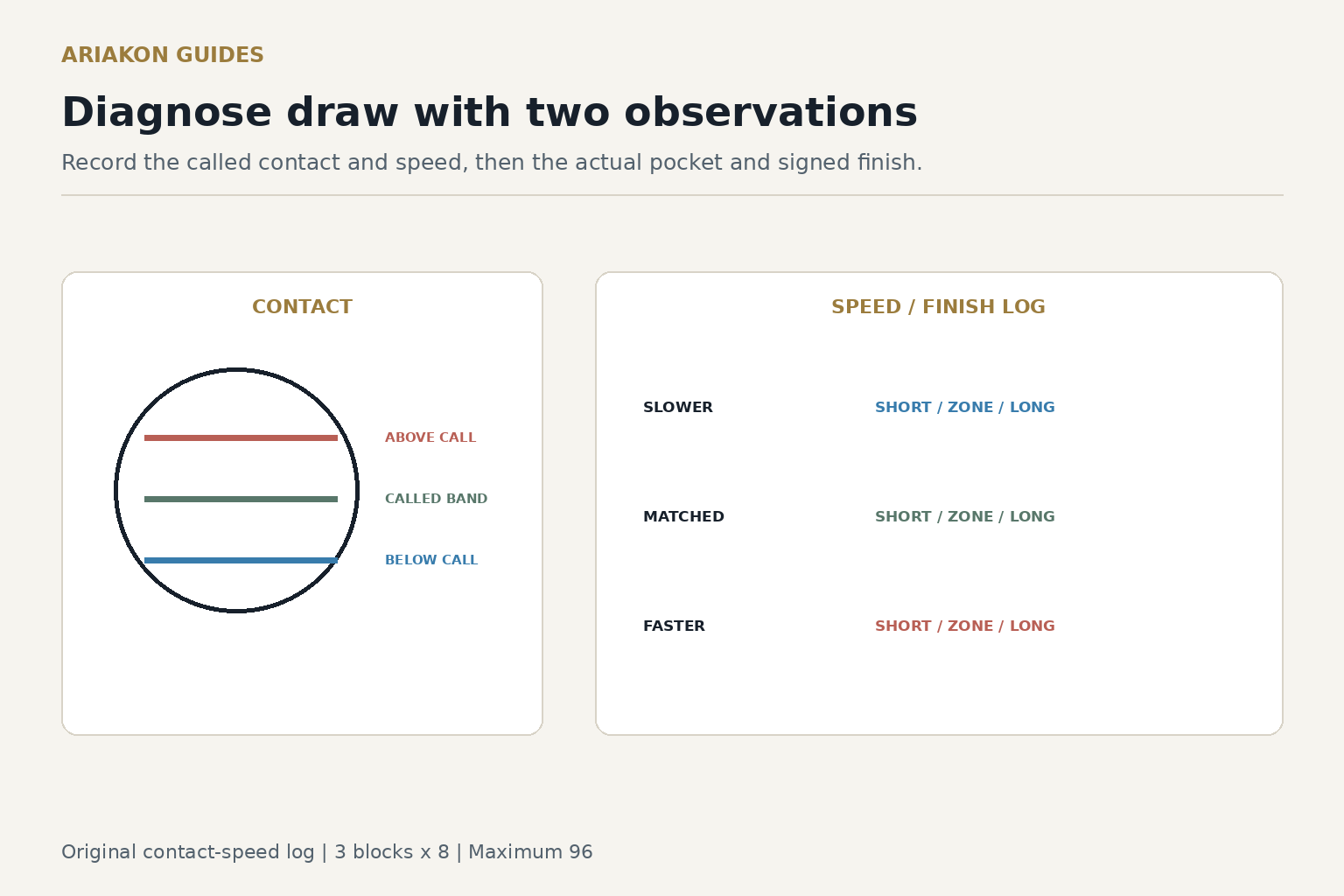
A striped cue ball can make the intended vertical-axis contact easier to inspect. Chalk normally before each shot, then inspect any visible transfer mark; do not leave a thick reference mark that changes the contact. If you cannot observe contact reliably, record unknown rather than inventing a value.
| Field | Write before the shot | Write after the shot |
|---|---|---|
| Contact | Low contact call | Below, near or above the chalk mark |
| Speed | Soft, medium or firm | Slower, matched or faster than call |
| Called corner | Made, left miss or right miss | |
| Draw finish | Target center | Short, in zone or long; estimate diamonds |
Run twenty-four shots in three blocks
| Block | Attempts | Contact call | Speed call | Purpose |
|---|---|---|---|---|
| A | 8 | Chosen low contact | Medium | Establish finish pattern |
| B | 8 | Same contact | One step slower | Test speed contribution |
| C | 8 | Same contact | Return to medium | Check whether baseline returns |
Use the first-failed-event matrix
| Observed cluster | Most useful interpretation | Next controlled action |
|---|---|---|
| Contact above call; finish short | Contact changed before distance | Repeat eight at the original speed; protect contact |
| Contact matches; speed slower; finish short | Delivered speed is the earlier change | Repeat the slower block deliberately and set a nearer zone |
| Contact and speed match; finish long | The current pair overdraws this target | Test one smaller speed call, keeping contact fixed |
| Pocket misses alternate sides | Distance evidence is contaminated by aim/delivery | Return to straight-shot alignment work |
| Rows scatter with no pattern | Observation or setup is not stable | Widen the target and repeat another day |
Score execution without pretending it proves cause
Worked example: Block A scores six pockets, seven contact matches, five speed matches and three target finishes. Five short finishes coincide with slower-than-called speed, while contact mostly matches. Block B deliberately uses that slower speed and puts five balls in a separately recorded nearer reference zone; those five do not count as original-target points. Block C returns to medium and reaches the original target five times. The next action is a medium-speed calibration block, not a new tip position.
For transfer, keep the same draw target but move the cue ball half a diamond farther away for six attempts. Score it separately. A changed cue-ball-to-object-ball distance creates a new condition; it does not belong in the original twenty-four-shot comparison.
| Point | Requirement |
|---|---|
| 1 | Pocket the object ball in the called corner |
| 1 | Observed contact matches the pre-shot contact call |
| 1 | Observed speed matches the pre-shot speed call |
| 1 | Cue-ball center finishes in the draw target |
| Maximum 96 | Twenty-four attempts; keep four columns separate |