
Cue-ball control · 3 min read
Simplify a Pool Shot Plan to One Route and One Speed
Extra options can become noise after the decision is made. This drill reduces a position shot to four calls: one pocket, one cue-ball route, one speed word and one finish zone. It does not claim every layout has only one good route. The simplification happens after hazards and alternatives are compared, and before the player bends into the stance.
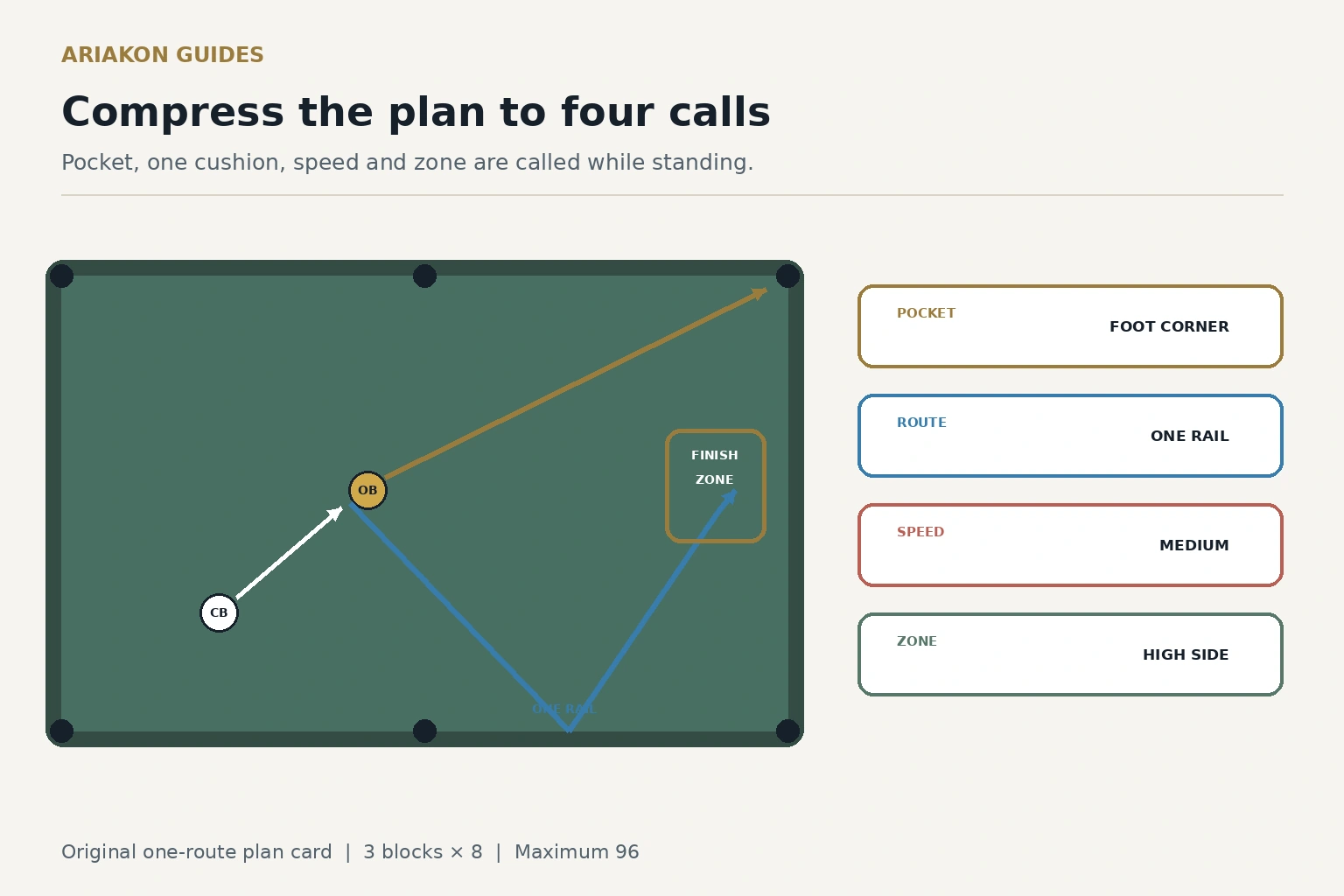
Choose a layout with a visible route fork
Place an object ball about one diamond from a foot corner and the cue ball near table center on a moderate cut. Put a second object ball near the table's opposite half as the next shot. The cue ball should be able to reach a broad position zone by a simple one-rail route; a more complex multi-rail route may also be visible but is not used in the baseline.
Mark the two ball centers and a position zone about one diamond wide by half a diamond deep. Inspect scratch lines, interfering balls and the wrong side of the next object ball. If the simple route crosses an unavoidable scratch or blocker, redesign the station; simplicity does not excuse a bad plan.
Review advanced fundamentals for the broader relationship between routine, delivery and position.
Compare cue-ball routes deliberately when two routes genuinely need testing before one is selected.
Make a four-part standing call
Soft, medium and firm are personal speed calls, not calibrated velocities. Say the four calls while standing. Once down, stand up if a hazard or aim picture changes; do not silently switch route or speed during the final stroke.
| Call | Example | What stays fixed |
|---|---|---|
| Foot-left corner | Object-ball destination | |
| Route | Long rail once | Cue-ball path family |
| Speed | Medium | Personal delivery intention |
| Zone | High side of next ball | Acceptable cue-ball finish |
Run three eight-shot blocks
In Block C, a drawn start that makes the route unsafe is a correct rejection, not a forced shot. Replace it with another nearby start and log rejected. The purpose is commitment to a valid plan, not obedience to a card.
| Block | Attempts | Constraint |
|---|---|---|
| A | 8 | Same pocket, one-rail route, medium call and broad zone |
| B | 8 | Same plan; shrink only the finish zone by about one ball |
| C | 8 | Draw a nearby cue-ball start; restate the same route family and speed or stand up and reject it |
Score the four calls
Record the first changed component: pocket, route, speed or zone. A made ball that takes two rails after a one-rail call earns the pocket point but not the route point. A correct route that runs long earns route but not zone.
Worked example: Block A scores 27 of 32 and Block B scores 21. Five of the six lost points are zone points while route and speed calls still match. The smaller zone, not a failure to simplify, caused the score change. Repeat the original broad zone before changing spin or route.
| Point | Requirement |
|---|---|
| 1 | Pocket call completed legally |
| 1 | Cue ball used the called route family |
| 1 | Delivered speed matched the pre-shot personal call |
| 1 | Cue-ball center finished in the called zone |
| Maximum 96 | Twenty-four attempts |
Know when the one-route rule ends
For game transfer, play a three-ball pattern six times. Before every shot, name pocket, route, speed and zone. For each complete three-ball pattern, score one point only if every shot’s call was completed before stance and one only if every delivered shot kept its call unchanged, maximum twelve across six patterns. Outcome stays in a separate note so planning discipline is not confused with one lucky roll.
| New information | Response |
|---|---|
| Scratch line appears | Stand up and choose again |
| Interfering ball blocks the lane | Reject the route |
| Speed call no longer reaches the zone | Replan while standing |
| Only vague doubt remains | Return to the chosen call and deliver |
| Match clock or referee instruction applies | Comply; use the shortest valid call |