
Cue ball control · 4 min read
Build Precise Pool Draw Without Forcing the Stroke
Useful draw is not measured by how far the cue ball can travel. It is measured by whether the cue ball returns along a predictable line at the speed the next shot requires. Clean low contact and a smooth delivery come first; distance is added only after those controls remain stable.
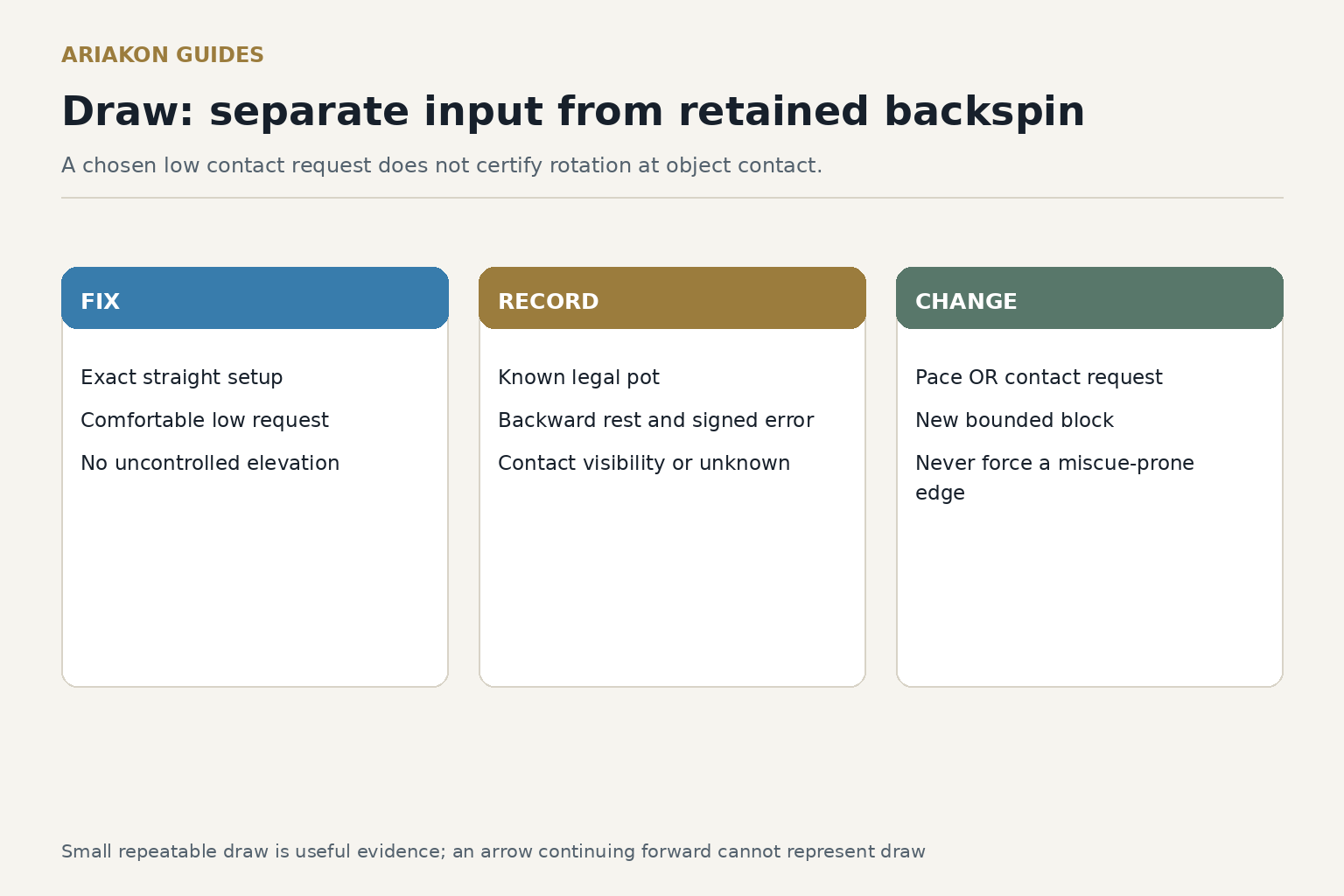
Understand what creates draw
A draw shot reaches the object ball while the cue ball still has backspin. After contact, that rotation pulls the cue ball backward from the tangent-line path. If cloth friction has already converted the backspin to slide or forward roll, the cue ball will draw less or not at all.
Tip position, cue speed, distance, cloth condition and cue elevation all affect the result. That is why copying one low contact point without controlling the rest of the setup produces inconsistent distances.
Start with a short straight shot
Place the cue ball one or two diamonds from an object ball that is straight to a pocket. Chalk, keep the cue as level as the rails allow and strike modestly below center with a smooth accelerating stroke.
Begin by drawing the cue ball only a few inches. A clean small draw gives better feedback than a hard attempt that pockets the ball but sends the cue ball sideways.
Protect the contact point
- Use a stable bridge that does not rise during the final stroke.
- Keep the grip secure but relaxed enough for the cue to travel.
- Pause at address and confirm the intended low-center point.
- Accelerate through the cue ball instead of stabbing downward.
- Finish on the shot line and observe whether the cue ball returns straight.
Change one variable at a time
Hold the setup and tip position constant while testing three cue speeds. Then hold speed constant and make small safe changes in tip height. Record the draw distance or whether the cue ball finishes in a chosen virtual zone.
Do not move lower merely because one attempt was short. An off-center or elevated hit can waste the added tip offset and increase miscue risk.
Extend distance progressively
Move the cue ball farther from the object ball in small steps. Longer travel gives cloth friction more time to reduce backspin, so the shot may require more cue speed or a carefully lower hit.
If accuracy falls apart, return to the last distance that produced a repeatable legal pot and backward finish. Preserve that record before trying a greater distance.
Use zones in real patterns
Add a cut angle and mark a broad position zone. With draw, the cue ball initially departs closer to the tangent line before backspin curves the route. Practice predicting both the early path and final zone.
Choose draw when it creates a simple route with margin. If follow, stun or a safety offers a larger landing area and less scratch risk, maximum draw is not the percentage decision.
Keep an exact ordinary baseline for this record
Coordinates are ball centers on an illustrative 100 by 50 inch bed: x=0..8 along length, y=0..4 across width, origin at the lower left cushion nose. One unit is 12.5 inches. For 2.25 inch equal balls, radius is 0.09 and diameter 0.18 units. Intact cushion center boundaries are x=0.09,7.91 and y=0.09,3.91; pockets interrupt the physical boundary at the four corners and (4,0),(4,4). Measure actual bed, balls and jaws before scaling. Remove every measuring aid before shooting; never mark a competition table.
Use O(6,3), real upper right corner P(8,4), intended contact cue center G(5.839003,2.919502) and C(4.944576,2.472288). With u=(2,1)/sqrt(5), G=O minus 0.18u and C=G minus u. The centers are collinear and the equal balls are tangent at G.
Choose a comfortable ordinary pace and keep equipment fixed. Record actual strikes, known legal pots and the task-specific observation separately. A chosen cue-rest window, when needed, is a radius 0.18 disk about G; it is not a guaranteed result. Unknown observations stay unknown, and a safety stop leaves later allocations unused. Use the exact mirrored setup x→8−x only in a separately dated transfer record.
Sources and further reading
References support the specific factual information above. The practical checklists are Ariakon editorial guidance.