
Cue ball control · 4 min read
How to Stop the Cue Ball With Control
A stopped cue ball occupies its own center position just behind the object ball’s original center. It does not replace the object ball at the same point. This guide calibrates that finish over three distances and keeps pocket errors separate from unwanted travel. It is not a follow/draw drill or a multi-ball pattern curriculum.
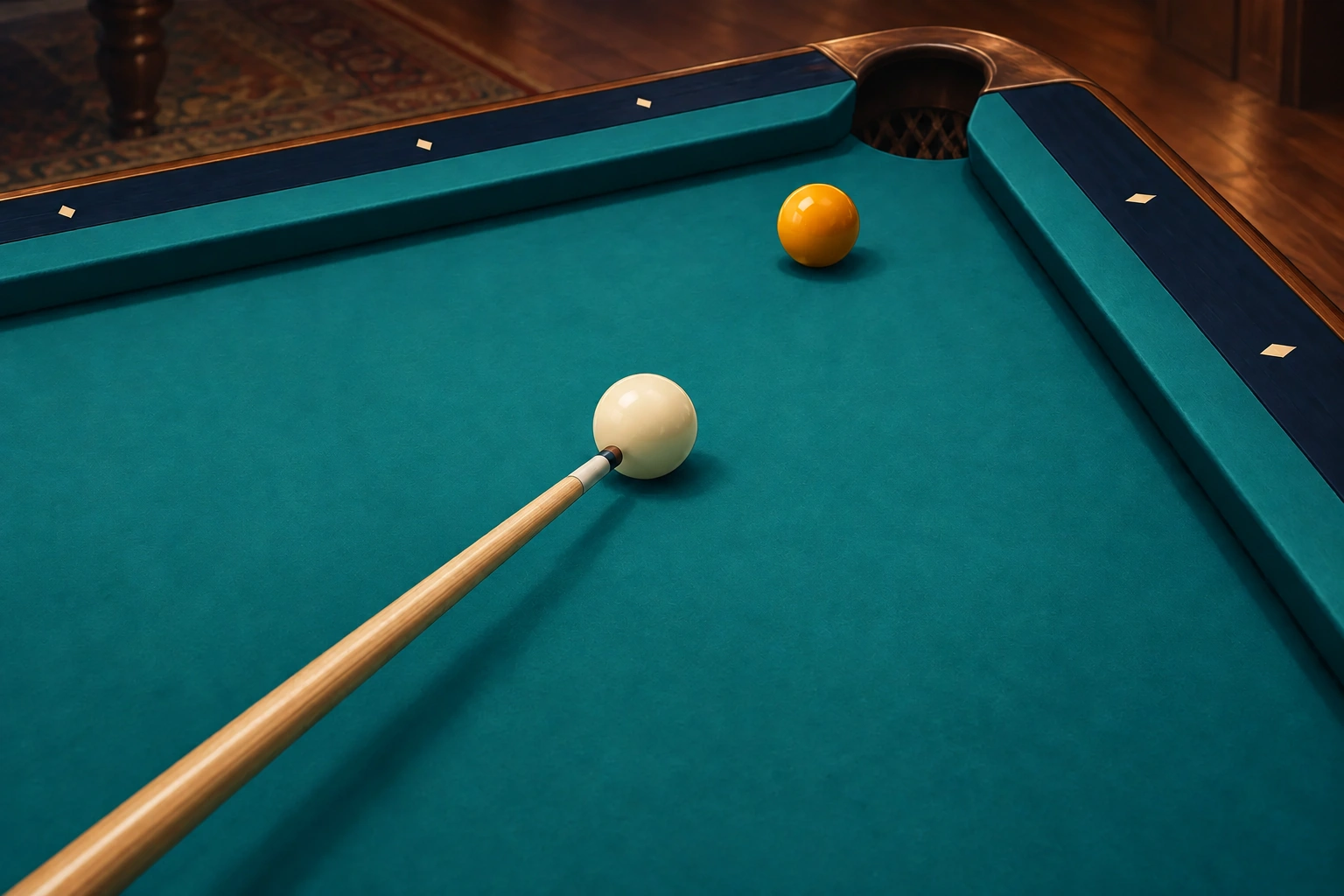
Define a stop before trying to produce one
On a full, straight collision between similar balls, a cue ball arriving with little forward or backward rotation can finish close to its collision position. A cut leaves a sideways component; roll or backspin can add travel after impact. Real ball and cloth conditions are not ideal, so score an observed finish rather than promise mathematically zero movement.
Keep a comfortable, near-level cue and a familiar controlled delivery. There is no fixed low-tip setting that produces a stop at every speed and distance. A harder strike can change both arrival state and risk; do not respond to every forward finish by increasing force.
Check the complete delivery baseline if cue contact or alignment is not repeatable.
Locate the ball-center stop disk
Coordinates describe ball centers on an illustrative 100×50-inch bed: x=0..8 along the length, y=0..4 across the width, origin at the lower-left cushion-nose corner. Equal 2.25-inch balls have radius 0.09 and diameter 0.18 units. Intact-cushion center limits are 0.09 and 7.91 in x, 0.09 and 3.91 in y. Pockets interrupt these limits at the four corners and at (4, 0),(4, 4). Inspect actual mouths and jaws; scale to the measured bed and actual ball size. These are not universal diamond coordinates. Remove measuring aids before a shot; do not mark a competition table.
Hold object O(6, 3) and real upper-right corner P(8, 4) fixed. The unit pocket direction is (2, 1)/√5. The tangent cue-ball center at contact is G=O−0.18×(2, 1)/√5=(5.839003, 2.919502). Use a disk of radius 0.18 about G as the chosen stop tolerance: one ball diameter of center error, not a ring behind the starting cue ball.
A measuring photograph or off-table reference can locate the disk. No ring or object remains on the playing surface. The tolerance is a practice choice, not a rule or guarantee of next-ball position.
| Station | Ghost-to-start distance | Cue center |
|---|---|---|
| A | 1 | (4.944576, 2.472288) |
| B | 1.6 | (4.40792, 2.20396) |
| C | 2.2 | (3.871263, 1.935632) |
Keep a pocket count beside the stop count
Shoot six struck attempts at each start: 18 total. Freeze each block’s intended contact, familiar moderate pace and equipment. Reset both balls. Count a pot when O enters the called corner without a foul. Count combined success only when that pot also leaves the cue-ball center within the stop disk. Record actual attempts if the session stops; no invented eighteenth result.
Log a pocket miss separately before interpreting arrival spin. For pocketed shots outside the disk, use forward, backward or lateral as mutually exclusive primary labels; if the finish is diagonal, use the largest projected error component and retain its measured vector. A lateral error warrants checking straightness and unintended side contact before changing height.
| Measure | Example | Meaning |
|---|---|---|
| Called pot | 5/6 | One pot failure remains a pot error |
| Pot plus stop disk | 3/6 | Three usable combined outcomes |
| Pocketed but outside disk | 2 | One forward and one backward primary error |
| All primary labels | 3 success +2 stop errors +1 pot error=6 | No double-counting in this summary |
Make one small arrival-state experiment
A repeated forward finish on verified straight pots is consistent with forward rotation at impact; a backward finish is consistent with retained backspin. Both are hypotheses constrained by alignment and equipment. Keep the layout and pace request fixed and test a modest contact-height change only within your controlled range. Then run another six attempts at that same station, a new record rather than a retrospective correction.
If misses alternate, pause adjustment and inspect the setup, clean-ball condition and delivery. Keep the cue level where practical; forced low contact, an elevated cue or a miscue is a reason to simplify. A phone cannot reliably quantify arrival rotation when the view is inadequate. Mark it unknown.
Use differential probes for mixed errors instead of guessing one cause from a scattered block.
Read the next ball from the actual finish
For a separate six-shot transfer, use station B and add a next object N(3, 2.5), called to the real upper-left corner (0, 4). Its ghost center is (3.160997, 2.419502). From G the next line is open and neither N nor its next route obstructs the first shot. The stop disk provides a useful next-shot region, but the exact leave must still be inspected.
After the first shot, do not reset the cue ball to G. Name the available next line from its actual resting center; the next pot is not part of the eighteen-shot calibration score. A good stop is a positional choice only when that next task is useful.
Study stop-shot pattern choices separately once distance calibration is dependable.
Compare ordinary follow as a different position tool when stopping leaves the wrong next angle.
Sources and further reading
References support the specific factual information above. The practical checklists are Ariakon editorial guidance.