
Cue ball control · 4 min read
Control Follow on Long Straight Pool Shots
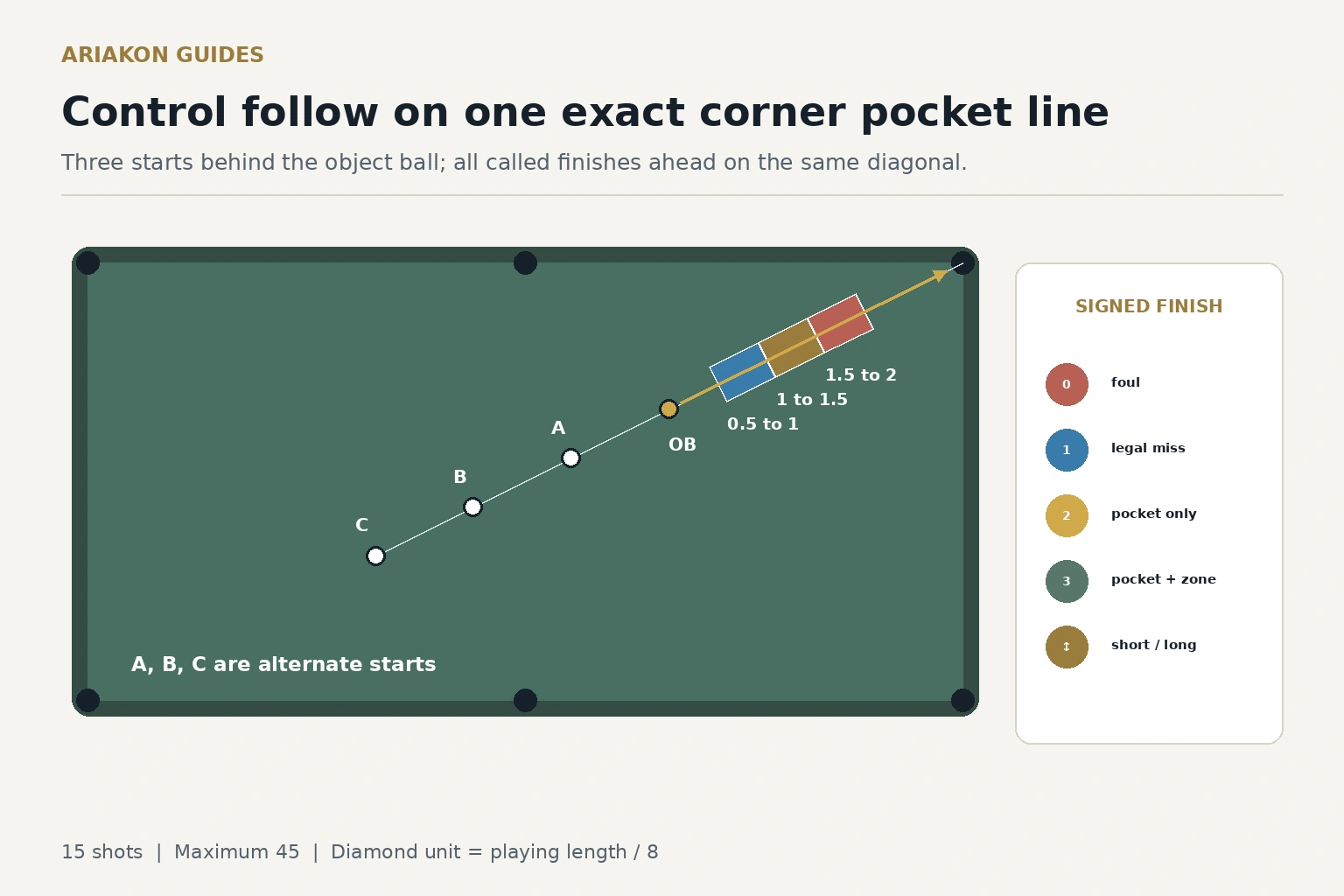
Long straight follow asks two things at once: deliver the cue ball on the pocket line and preserve forward rotation until impact. More force is not automatically more follow. Distance, cloth, ball condition, tip height and speed change when natural roll develops. This ladder holds the object ball line fixed, changes only cue ball distance and uses signed landing zones to separate pocketing from follow distance control.
Establish one straight pocket line
Use the upper right corner pocket and a diagonal shot line, rather than the table's long centerline. Measure the playing surface between cushion noses. Let x run from 0 to 100 along its length and y from 0 to 50 across its width, with the upper right pocket at (100, 0). Set the object ball at (66.46, 16.77). Cue ball starts A, B and C are (55.28, 22.36), (44.10, 27.95) and (32.92, 33.54). All centers lie on the same pocket line. One diamond unit is one eighth of playing length, measured along this diagonal, not projected along a rail.
Start modestly above center with a comfortable, repeatable speed and no sidespin. Forward rotation at impact determines whether the cue ball continues after the full hit. Keep contact height fixed during the first pass and record speed changes instead of changing both together. Use practice marks only with the table owner's permission and remove them before a match.
Learn the general follow route first if rolling cue ball paths and tip height changes are not yet familiar.
Mark three follow windows
Measure every called finish from the original object ball center toward the corner pocket, along the same diagonal. Give each window a total lateral width of two ball diameters, centered on the shot line. The farthest finish is still one diamond unit short of the pocket; a scratch always scores zero. A ball center on a shared boundary belongs to the shorter window.
| Stage | Cue ball start | Called finish beyond object ball | Attempts | Purpose |
|---|---|---|---|---|
| A | 1 diamond | 0.5 to 1 diamond | 5 | Confirm line and rolling contact |
| B | 2 diamonds | 1 to 1.5 diamonds | 5 | Preserve roll over distance |
| C | 3 diamonds | 1.5 to 2 diamonds | 5 | Control the longest delivery |
Score pocket and follow separately
| Points | Result | Record |
|---|---|---|
| 0 | Any foul, including a scratch | First failed event |
| 1 | Legal contact; object ball misses | Left or right miss |
| 2 | Object ball pocketed; finish outside called window | Short, long or lateral |
| 3 | Object ball pocketed; cue ball center in called window | Clean window |
Use a forty five point gate
Fifteen attempts have a maximum of 45 points. Pass the ladder at 34 or better, with at least three clean pockets and two called zone finishes at every distance. A cue ball that reaches the zone after a jawed object ball earns only 1 point because the delivery line is not yet reliable.
Record every cue ball finish as short, zone or long and every object ball miss as left or right from the shooter's view. Change only one variable in the next five shot block.
Diagnose the first repeated pattern
| Pattern | Inspect first | One next action | Hold fixed |
|---|---|---|---|
| Pocketed; cue ball short | Roll at impact | Add a small tip height change or one speed band | Aim and start |
| Pocketed; cue ball long | Excess speed | Reduce one speed band | Tip contact |
| Same side object ball miss | Alignment and delivery | Return one distance and use a center line gate | Follow call |
| Miss side alternates | Reset and grip tension | Rebuild the setup; do not add spin | Object ball mark |
Transfer one passed distance to a rack
Use the hardest passed stage as the first shot of a two ball pattern. Put a second object ball so the called follow zone leaves a natural cut. Shoot five attempts: 0 for a foul, 1 for legal first contact, 2 for the first ball, and 3 for the first ball plus a playable second shot; maximum 15.
If the transfer fails only after adding sidespin, return to the no sidespin baseline. The ladder measures long straight delivery; compensating for squirt, swerve and throw is a separate comparison.
Sources and further reading
References support the specific factual information above. The practical checklists are Ariakon editorial guidance.