
Cue ball control · 4 min read
Advanced Cue Ball Control Through Lines and Speed
Cue-ball control needs a chosen pocket line, an arrival-state request and an observed finish. A stun cut supplies a tangent reference; remaining forward or backward rotation can change the later route. This guide organizes a direction-and-distance log before adding sidespin. No rule of thumb or illustration predicts a complete path on every table.
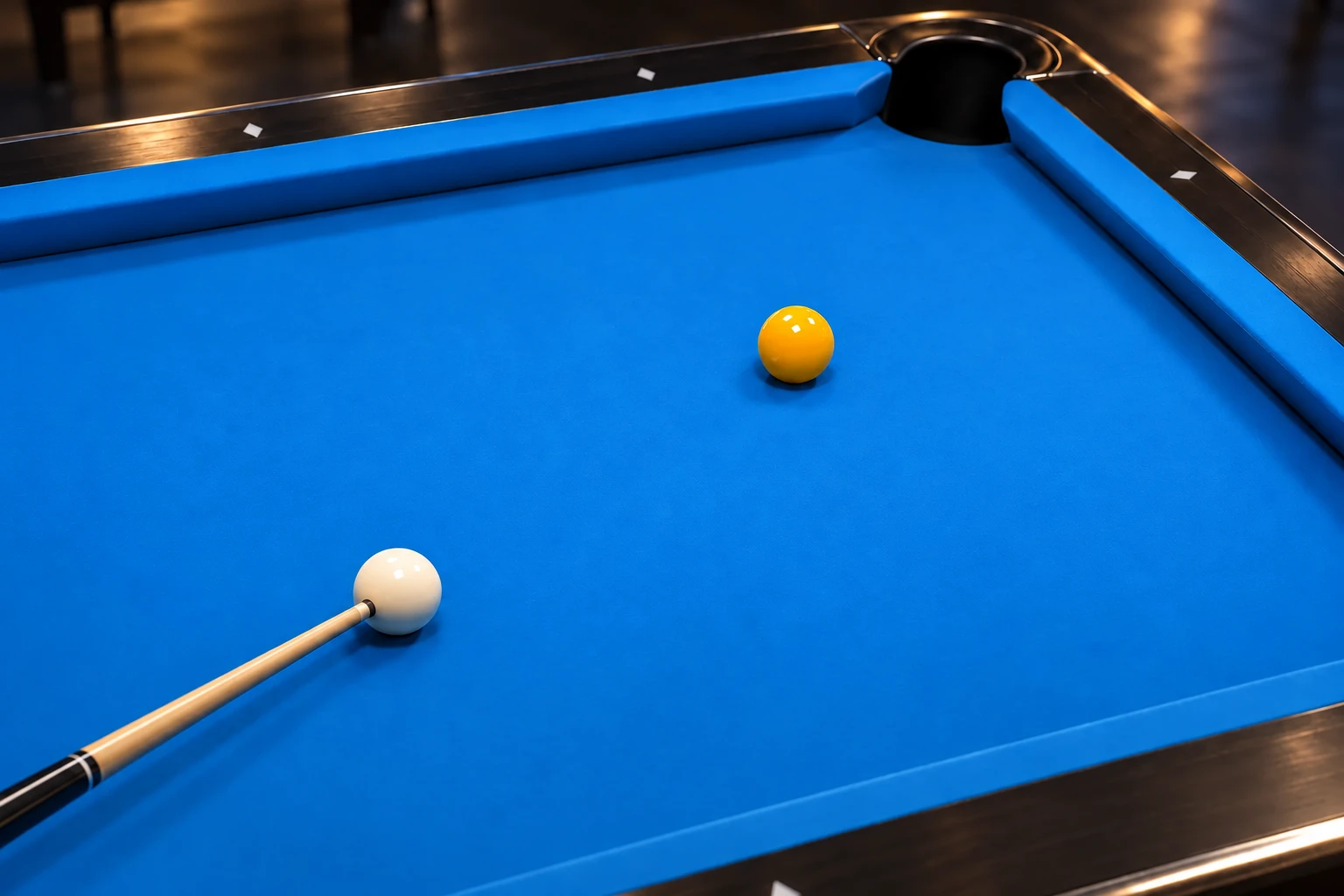
Predict the natural route first
For an idealized equal-ball stun cut with no intentional sidespin, the initial cue-ball direction is tangent to contact and perpendicular to the object-ball direction. A straight full contact is a different case: its sideways component vanishes. Forward roll or retained draw can then change the later motion through cloth interaction. Observe the route instead of treating a sketch as measured physics.
Place an imagined lane rather than a hairline on the table. Position play needs an acceptable next shot, so a broad route that crosses the position zone is often safer than trying to stop on one exact point.
Separate direction from distance
Tip height and the cue ball's spin state at impact strongly influence direction. Stroke speed and the amount of travel before contact strongly influence how much spin remains and how far the cue ball continues. Practice those variables separately so a long result is not mistaken for a directional error.
Use a genuine cut on an illustrative 100 by 50 inch cushion-nose rectangle, with origin at the head-left corner, x along the length and y across the width. Set cue center C=(25,25), object O=(70,15), and real corner P=(100,0). For equal 2.25-inch balls, u=(P−O)/|P−O|=(0.894427,−0.447214), and tangent cue center G=O−2.25 u=(67.987539,16.006231). The incoming C→G direction differs from u, producing a cut of about 14.75 degrees before throw. The appropriate tangent is perpendicular to u and passes through G, not O. Scale to the actual bed and ball size, inspect clearance, and remove setup aids before striking.
Take five intended-stun attempts, five intended-roll attempts and five intended-draw attempts with this same object and pocket, using only controlled comfortable deliveries. A cut is not a stop-shot task. Log the called pot, actual early cue-ball direction, first rail if any and final center separately. The fifteen attempts are an observation block, not a three-state performance ranking or a guarantee of one shared finish zone. Use actual denominators if stopped.
Build a speed ladder
- Choose one natural angle and three large cue ball target zones.
- Shoot center ball or a known vertical tip position at soft speed until the cue ball reaches the near zone.
- Repeat for medium and firm speed without changing the aiming line.
- Record the average finish and the spread of misses for five attempts at each speed.
- Reduce the target size only when both the average and spread are stable.
Use vertical axis spin before side spin
Follow, stun and draw change the post contact route without introducing cue ball deflection from side spin. In many patterns, changing speed or using a different vertical tip height reaches the position zone with fewer variables. This is especially valuable when the object ball is distant or the pocket is tight.
Add side spin when it provides a specific rail angle, avoids traffic or enlarges the position route. Calibrate the cue and bridge length you actually use because deflection, swerve and throw can alter the shot. Avoid treating one compensation as universal across cues and speeds.
Choose routes that cross the position zone
A cue ball moving across a narrow target can enter and leave it quickly. When possible, select a route that travels along the long dimension of the position zone. This gives speed error more room while preserving a usable next angle.
Work backward from the next shot. Decide which side of the next object ball is valuable, identify the acceptable zone, then choose the current cue ball route. Advanced control is tied to pattern decisions rather than isolated spin demonstrations.
Diagnose misses with a route log
Record object ball pocketing, first cue ball direction, first rail contact and final distance. A missed object ball points first to aim or delivery. A correct pot with the wrong initial cue ball line points toward spin state or contact. A correct line with the wrong finish points toward speed.
Do not change several variables after one result. Repeat enough attempts to identify a pattern, then adjust tip height, speed or aim separately. Clean equipment and stable table conditions make the comparison more meaningful.
Progress from drills to decisions
Finish practice with three ball patterns that offer at least two route choices. Predict each route aloud or in writing, choose one and score both the pocket and the quality of the next angle. This exposes whether a technically successful cue ball path was strategically useful.
Keep ordinary stop, follow, draw and cut-route records separate before combining them in a pattern. The simple collision and rolling references support the physical distinctions; the exact finish on your cloth remains an observation. Select the simplest reliably delivered route that provides a usable next shot.
Sources and further reading
References support the specific factual information above. The practical checklists are Ariakon editorial guidance.