
Cue ball control · 7 min read
Practice Small Swerve Adjustments Without Attempting Extreme Massé
A small sideways change can be useful only when you can distinguish it from an unstable delivery or an unmeasured finish. This worksheet compares permitted modest cue elevations while keeping the lane open. It records where the cue center crosses two lines, rather than rewarding a dramatic curve or prescribing a massé technique.
Make permission and instruction the first gate
Use this only in permitted practice, with a stable familiar bridge and a qualified instructor when changing cue elevation. Ask whether even modest elevated sidespin is allowed. Without permission or competent supervision, retain ordinary minimum-clearance cueing only; the three-height matrix is not authorized by this page. No special cue, claimed safe angle or universal butt-height increment is prescribed.
The PBIA manual treats small swerve and large-curve massé as different teaching topics and recommends specific, observable tasks. Here the dose, coordinates and decision rules are editorial choices, not its certification drill. Never raise the butt by fixed inches regardless of cue length, bridge position or ball clearance. Stop the entire block on hop, miscue, cloth contact, unstable reach or loss of control; leave later allocations unused.
Separate precontact path from object-ball throw before interpreting a sideways finish.
Check the wider artistic-practice safety boundary before any unfamiliar elevation change.
Use observation lines, not obstacles
Use ball-center coordinates on an illustrative 100×50-inch bed: x=0..8 along the length and y=0..4 across it, origin at the lower-left cushion-nose corner. One unit is 12.5 inches; equal 2.25-inch balls have radius 0.09 and diameter 0.18 units. Intact-cushion center limits are 0.09..7.91 and 0.09..3.91. The four corners and (4,0),(4,4) are real pockets. Measure the actual bed, balls, mouths and jaws before scaling. Remove measuring aids before striking; do not mark a competition table.
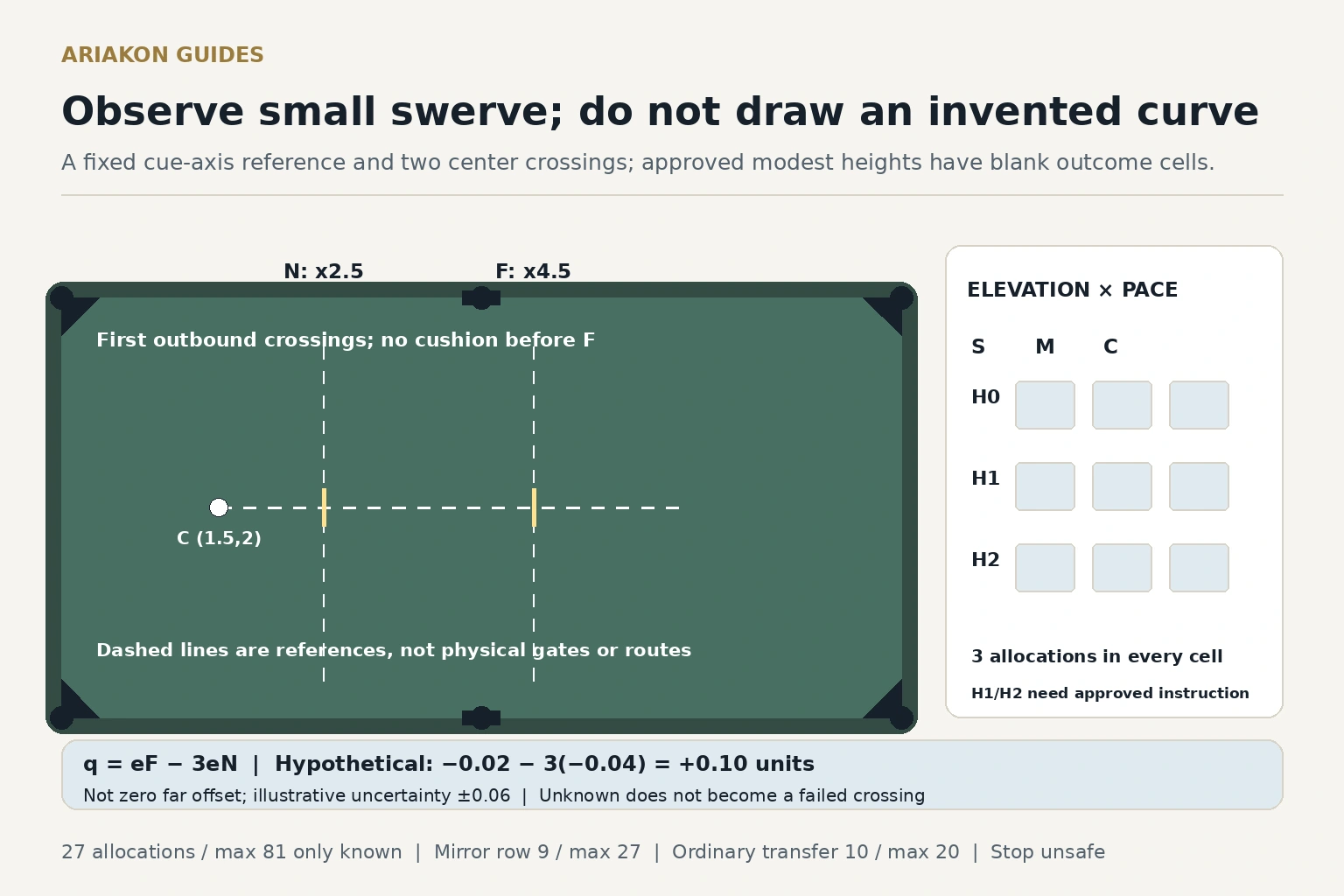
Place only cue center C(1.5,2), with the nominal cue axis along +x. Observe its first outbound center crossing at N: x=2.5 and F: x=4.5, before any cushion contact. Both comparison windows are centered on y=2. No paper strip, spare ball, block or gate may remain in the lane. Use rail references or a permitted fixed overhead recording; keep cameras and stands outside the bed and stroke path.
For the fixed left condition request a modest lateral tip position of 0.2 ball radii from the vertical centerline as viewed down the cue, about 0.225 inches for this illustrative ball. This is a repeatable setup request, not a proven delivered offset or a universal miscue limit. Keep the intended vertical contact, cue, bridge, ball and cloth fixed. Use a comfortable offset within reliable contact; if the request is not safe or observable, hold this test rather than forcing it.
Register three approved height labels and three gentle paces
Let H0 be the minimum practical clearance. Have the instructor establish two small, comfortable, permitted elevations H1 and H2 and record their actual address geometry before shooting. If either cannot be established safely, do not fill its row or call a partial page a complete matrix. Record cue-axis angle from a suitable side view, or label it unknown; butt height alone does not specify angle.
Use S, M and C for three familiar controlled pace requests, all capable of reaching F without an intended cushion contact. C means controlled, not a demand for force. During one height row use S,M,C,C,M,S,S,M,C: three of each, nine strikes. Repeat the same order at the other approved heights. The matrix has 27 allocations, not automatically 27 completed shots. Actual travel and pace variation stay in the notes; intended pace is not measured speed.
| Height label | S allocations | M allocations | C allocations | Keep with row |
|---|---|---|---|---|
| H0 minimum clearance | 3 | 3 | 3 | Actual geometry and permission |
| H1 approved modest change | 3 | 3 | 3 | Same cue, tip request and lane |
| H2 approved modest change | 3 | 3 | 3 | Unknown or unsafe means hold |
Give each observation its own record
If the ball stops before a line, record known not reached only when that is observed. If it leaves the image, do not invent a crossing. A scratch or off-table event fails safe delivery even if an earlier crossing passed. Wait for all motion to stop before retrieving the ball; reset the original center each time.
| Field | Record | Interpretation |
|---|---|---|
| Inputs | H/S/M/C; intended offset; actual visible differences | A changed delivery is a different input |
| Near crossing | eN = yN−2, signed | Pass if |eN| ≤ 0.18 |
| Far crossing | eF = yF−2, signed | Inner ≤ 0.09; outer >0.09 to 0.18; outside >0.18 |
| Visibility and safety | Known, unknown, not reached; any stop reason | Off-frame is not a physical miss |
Compare the far result with a straight extrapolation
With the start at y=2 and N one unit from C while F is three units from C, a straight path through the measured near crossing would give eF=3 eN. Compute q=eF−3 eN. A nonzero q is evidence of a departure from that straight extrapolation only within the measurement limits; it is not a direct measurement of initial squirt or proof of the complete continuous curve. Do not infer pure swerve from two crossings when the actual cue axis, start, pace or delivered spin is unresolved.
Hypothetical eN=−0.04 and eF=−0.02 give q=+0.10 units, or 1.25 inches on this illustrative bed. The far center remains below the reference line; it has not become zero-offset. A separate linear example eN=+0.03,eF=+0.09 gives q=0 despite a nonzero far offset. Neither example is a real cue test.
If each start, near and far center has an absolute y uncertainty of 0.01 units in a registered cloth-plane view, q=eF−3 eN+2 eC has a worst-case uncertainty of 0.01+3×0.01+2×0.01=0.06 units. The +0.10 example exceeds that illustrative bound; an apparent +0.03 does not. This bound assumes x locations and registration are adequately known. Add their effects or call the comparison unresolved when they are not. A cloth-plane calibration alone does not remove height parallax of the ball image.
Audit camera timing and visibility separately before treating small frame differences as exact physics.
Use nested scores without concealing missing evidence
The complete matrix has a maximum of 81 points only when all 27 nested scores are known. A cell is a candidate only after all three allocated strikes are safely completed, all three near passes and far crossings are known, and at least two far results are inner. Do not compensate for one cell failing with points from another. Choose the lowest approved elevation that meets the task; more visible curvature is not a reason to choose H2. Unknown is not one of the required successes.
For a hypothetical cell with scores 3,2 and unknown, report 5 of 6 known possible points from three actual strikes, not 5 of 9 and not a passed three-known gate. The known first two outcomes can remain useful even when observation needs repair.
| Points | Established outcome |
|---|---|
| 0 | Known safety stop or known near failure/not reached |
| 1 | Safe near pass; known far outside ±0.18 or not reached |
| 2 | Safe near pass; far outer band (>0.09 to 0.18) |
| 3 | Safe near pass; far inner band (≤0.09) |
| Unscored | Required prefix or finish unobservable; retain known crossings separately |
Mirror one row and test an ordinary shot separately
Only after a height row has all three pace cells pass, mirror the lateral tip request to right and repeat that row in the same nine-strike pace order. Keep its three-cell gates and maximum 27 separate from the initial 81. A nonmirroring result first calls for a setup/visibility review, not a diagnosis of the player or a demand for more spin.
For a separately gated ordinary transfer use O(6, 3), real upper-right P(8, 4), nominal contact center G(5.839003, 2.919502) and cue start C(4.944576, 2.472288). These centers make a straight no-sidespin reference; sidespin is not guaranteed to arrive at G. Use only the lowest approved tested elevation and pace, no blocker and no obstacle-clearing technique. Call a resting cue-center disk of radius 0.18 about G; inspect the actual contact and scratch risk before every strike.
Alternate baseline no-intentional-sidespin N and the permitted tested condition T as N,T,T,N,N,T,T,N,N,T: five each, ten actual strikes only if completed. Score 0 for known miss/foul, 1 for known legal pot with known finish outside the disk, 2 for pot plus known finish inside. A known pot with unknown finish stays unscored on this nested scale and remains a known pot separately. Maximum 20 requires ten known scores. Do not claim an aiming adjustment or general success rate from this sample.
The full allocation ceiling is 27+9+10=46 actual strikes only if all gates and blocks finish safely. A failed or incomplete matrix authorizes no automatic mirror or transfer. Preserve partial counts, and take any revised condition as a new record instead of rewriting the original misses.
Study offset cancellation as a separate distance-and-speed question rather than equating one elevation result with zero squirt.
Check a nominal tangent reference after contact when the ordinary transfer creates a different cue leave.
Sources and further reading
References support the specific factual information above. The practical checklists are Ariakon editorial guidance.