
Sidespin · 3 min read
When Squirt and Swerve Offset Each Other in Pool
Squirt and swerve can point in opposite directions on a sidespin shot. Squirt happens immediately as the cue ball leaves the tip; swerve develops while the elevated, spinning cue ball slides and curves. Under one combination of cue, elevation, speed, distance and cloth, their net displacement can approach zero. That crossing is a measured window—not proof that sidespin needs no compensation.
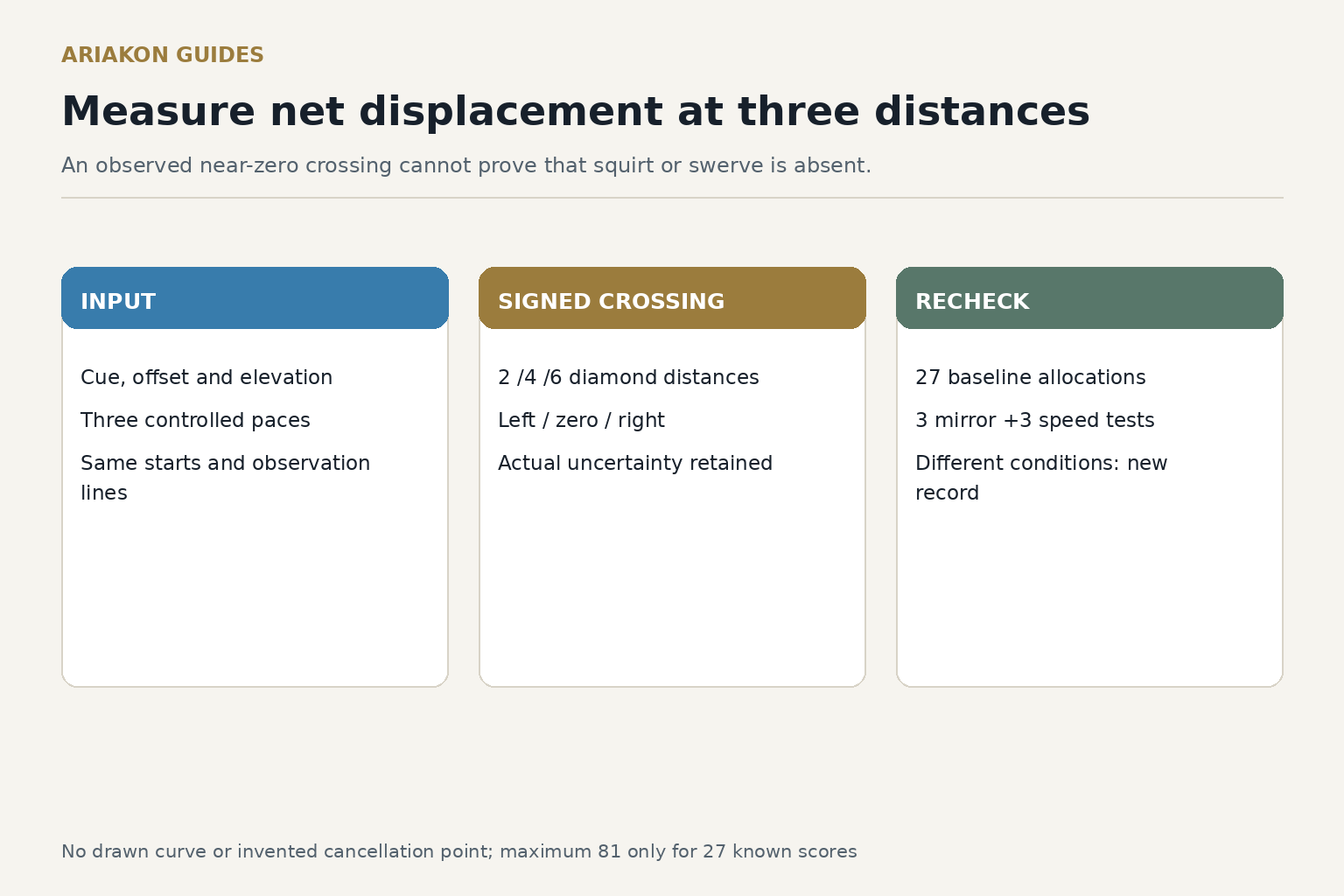
Track two effects and one result
| Observation | When it appears | Direction for one spin side | What changes it |
|---|---|---|---|
| Squirt | Immediately after tip contact | Away from spin side | Spin amount and shaft endmass |
| Swerve | During sliding travel | Curves back toward spin side | Elevation, speed, distance, cloth and spin |
| Net deflection | At the target line | Signed sum of path effects | All tested conditions |
| Throw | At object-ball collision | Changes object-ball line | Ball contact, speed and spin |
Learn the three effects before measuring them to keep cue-ball path and object-ball throw separate.
Build an open three-distance lane
Place the cue ball on the long string one diamond from the head rail. Aim through a two-ball-wide near gate one diamond ahead. Put signed target strips at two, four and six diamonds from the cue-ball start, using rail coordinates or removable references outside the cloth.
Use one-half tip of left sidespin, a fixed bridge and the lowest practical cue elevation that clears the rail. No object ball belongs in the lane; the exercise measures cue-ball path before throw can enter.
Run a twenty-seven-shot matrix
| Target distance | Soft | Medium | Firm controlled | Attempts |
|---|---|---|---|---|
| 2 diamonds | 3 | 3 | 3 | 9 |
| 4 diamonds | 3 | 3 | 3 | 9 |
| 6 diamonds | 3 | 3 | 3 | 9 |
Score the gate and signed finish
| Result | Points | Record | Meaning |
|---|---|---|---|
| Miscue, hop or near-gate miss | 0 | Stop reason | Delivery is not usable |
| Gate passes; target strip missed | 1 | Left or right | Initial line passed; finish uncontrolled |
| Target strip reached outside center window | 2 | Signed ball-width offset | Repeatable net deflection |
| Center one-ball window reached | 3 | Signed offset and conditions | Candidate offset window |
Require nine points of evidence for a zero crossing
Twenty-seven attempts have a maximum of 81 points. A speed-distance cell is a candidate offset window only when all three balls pass the near gate, all three reach the target strip and at least two finish inside the center window. Record the third result; do not discard it.
A small signed displacement at one observation line is a result for that tested condition. It cannot separately measure squirt and swerve or establish that either is absent. The cell belongs to the session conditions, not every shot on the table.
Mirror the spin and perturb one variable
Repeat the candidate cell three times with right sidespin and a mirrored target. Then change only speed one band for three more attempts. A useful window mirrors within one ball and moves predictably when speed changes; a result that vanishes with mirrored spin points to alignment or stroke asymmetry.
Next, repeat on a different table or after conditions change. If the signed median moves, update the row instead of preserving the old compensation.
Transfer without forgetting throw
Add an object ball at the candidate target distance on a modest cut to a corner pocket. Shoot five attempts with the tested sidespin, calling both pocket and cue-ball finish. Score 0 for foul or wrong contact, 1 for legal contact, 2 for pocket and 3 for pocket plus finish zone; maximum 15.
A near-zero cue-ball path does not remove spin-induced throw at the collision. If the cue ball reaches the expected contact but the object ball misses, keep the path calibration and diagnose throw separately.
Calibrate small swerve in an open lane when elevation, not ordinary sidespin, is the main variable.
Sources and further reading
References support the specific factual information above. The practical checklists are Ariakon editorial guidance.