
Video review · 4 min read
Read Slow Motion Trick Shots Without Misreading the Physics
Slow playback makes an event easier to inspect; it does not recover a contact that the camera never captured. Build an evidence ledger before explaining a spectacular result. Observation quality and successful execution are different scores.
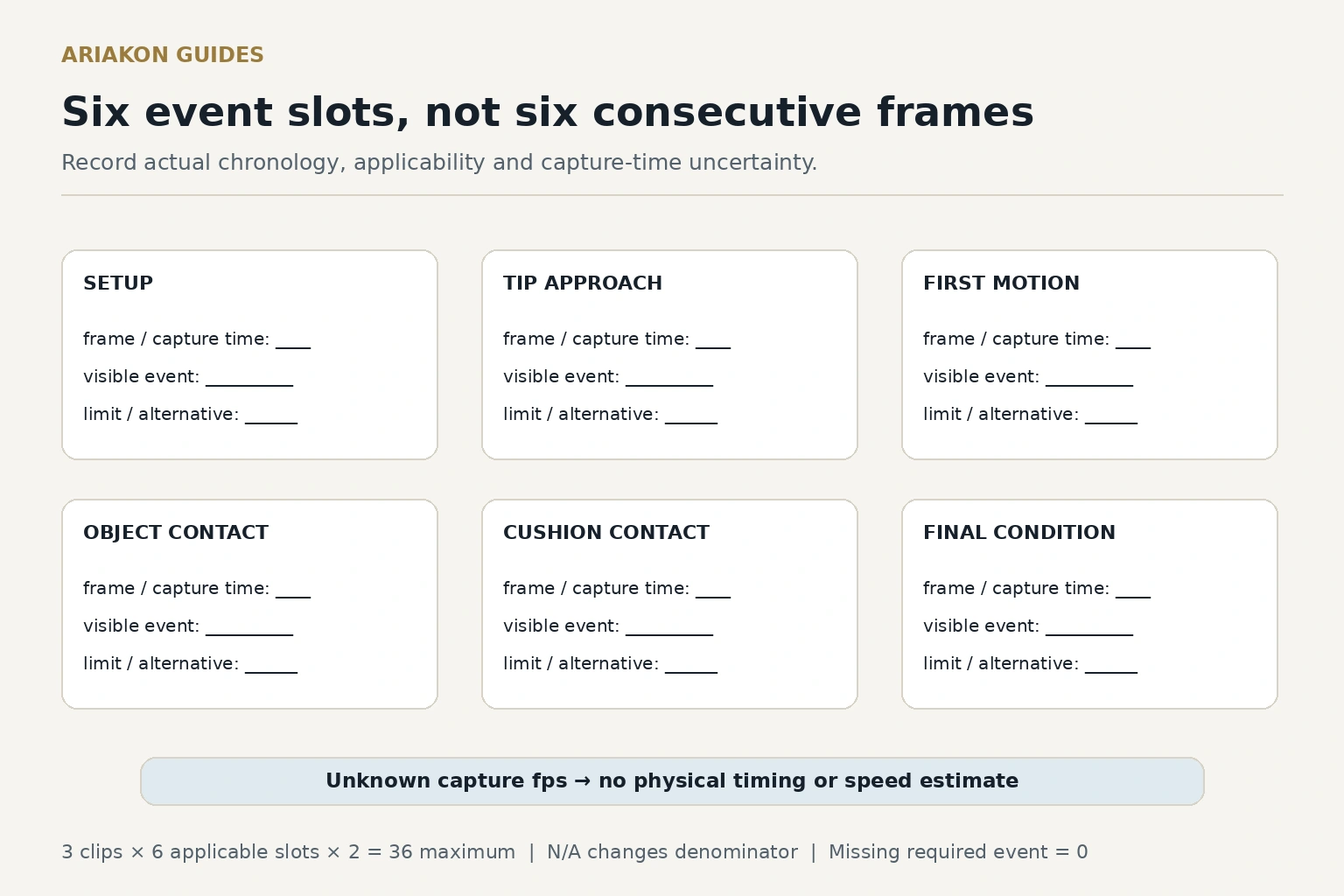
Preserve capture information before interpreting a clip
Use footage you own or have permission to inspect; do not download and republish another creator’s frames as original artwork. Keep the original file, capture frame rate when documented, playback rate, editing/interpolation history, camera angle and any same-plane scale reference. Unknown capture rate means unknown physical timing.
Use six event slots: setup, tip approach, first ball motion, first object contact, first cushion contact and final visible condition. They are not necessarily consecutive frames or a universal order: a kick can have cushion contact before object contact. Write the actual frame/time and chronological relation for each. Missing an essential event is unknown, not evidence it did not occur.
Inspect stroke timing as its own task instead of giving a trick-shot clip a delivery diagnosis it cannot support.
Score documentation rather than a physical explanation
If all eighteen slots apply, the maximum of 36 points measures ledger completeness only. A high score does not prove spin, force, tip performance or causation. An unseen required cushion event cannot be reclassified N/A to improve the score.
Illustrative one-clip task has five applicable slots scored 2,2,1,2,2 and one genuinely inapplicable cushion slot: 9/10, not 9/12 and not a successful-shot probability. Across clips sum scores and twice the number of applicable slots; retain every required-but-missing slot as zero and list it.
| Points per applicable slot | Evidence |
|---|---|
| 0 | Required event obscured/missing or unsupported assertion |
| 1 | Visible event described but timing, view or measurement limit incomplete |
| 2 | Visible event described, located and its relevant uncertainty recorded |
| N/A | Event genuinely outside the defined task; written reason, excluded from denominator |
Use capture time, not playback time
Illustrative capture at 240 frames/s played at 30 frames/s is eight-times slower. If frame 100 is the last observed still frame and 101 the first moving frame, onset is bracketed between samples 1/240 second apart, about 4.167 ms; this is not an exact tip-contact timestamp. Rolling shutter, blur and unresolved motion add limits.
A locally registered same-plane scale says 50 pixels represent 2.25 inches. A center displacement of 20 pixels across four capture intervals is 0.9 inches over 4/240 seconds, or 54 inches/s = 4.5 feet/s. These are hypothetical numbers; perspective, registration error and ambiguous centers must accompany any real estimate. Do not use the playback interval, an unrelated plane or interpolated frames as fresh measurements.
Replace a risky flourish with one ordinary component
Use ball-center coordinates on an illustrative 100×50-inch bed: x=0..8 along the length, y=0..4 across it, origin at the lower-left cushion-nose corner. Equal 2.25-inch balls have radius 0.09 and diameter 0.18 units. Intact-cushion center limits are 0.09..7.91 and 0.09..3.91. Six real pockets interrupt the boundary at the four corners and (4,0),(4,4). Measure the actual bed, balls and mouths before scaling; remove measuring aids before shooting and never mark a competition table.
Set object O(6,2), cue C(6,0.82) and intended first-contact cue center G(6,1.82), with no other balls. The chosen object route is straight toward the intact upper cushion: first object-center cushion location R(6,3.91). Its edge touches nose y=4, well away from the side pocket at x=4. No object pot is intended, and no jumping, massé or extreme elevation is part of the task.
Take six ordinary controlled strikes, three at each of two modest pace requests. Record the actual first object contact, later object cushion contact and rest center. The requested return rectangle x=5.7..6.3,y=2.2..3.2 is a chosen observation target, not a predicted rebound. Stop if the shot cannot be kept controlled.
| Points | Known result |
|---|---|
| 0 | Wrong first object or foul |
| 1 | Required first object; later cushion event not established |
| 2 | Required object plus later upper-cushion contact, no other foul |
| 3 | Score 2 plus object resting in the called return rectangle |
Keep alternatives and transfer limits visible
One point is not proof of a legal ordinary no-pot shot: the later rail event must be established. Unknown first contact stays unscored and reduces the component maximum by three. Note pace and camera uncertainty independently; the video ledger’s 36-point ceiling and the component’s 18-point ceiling are not one ability score.
A clip can demonstrate an outcome while leaving several physical explanations open. Film the ordinary component again from a useful fixed view before adding another element. The reverse-build resource develops a reproducible sequence; this ledger bounds what an existing clip can support.
Reverse-build a sequence from ordinary components after the evidence is interpretable.
Improve the capture setup for ball contact when a required event remains hidden.
Sources and further reading
References support the specific factual information above. The practical checklists are Ariakon editorial guidance.