
Artistic pool practice · 5 min read
Build a Safe Trick Shot Practice Progression From a Video
A polished trick-shot video can show the destination while hiding failed takes, exact coordinates, cue elevation, cloth conditions or a small setup aid. Copying the whole motion at once makes those unknowns compound. A safer method treats the clip as evidence, not proof: inventory visible facts, remove any hazardous or unverifiable element, reconstruct the last ordinary contact first and add dependencies backward under a stop rule.
Create an evidence ledger before placing balls
| Field | Visible fact | Unknown to mark | Safe response |
|---|---|---|---|
| Camera | Angle and any continuous view | Cuts, zoom or hidden rail | Do not infer hidden coordinates |
| Sequence | Order of clearly visible contacts | Off-frame or simultaneous contact | Reduce to last verified contact |
| Cue delivery | Approximate line and elevation | Tip point, speed or legal method | Use ordinary center-ball version first |
| Equipment | Balls, table and obvious props | Modified or specialty item | Exclude until independently verified |
| Outcome | Where visible balls finish | Number of attempts | Do not claim consistency |
Use the broad artistic-pool safety gates before reconstructing any specialty shot.
Apply a no-go filter
Stop if the clip requires a scoop, an unverified elevated strike, a ball leaving the controlled table area, breakable props, a person in the path, equipment modification or a room action that is not permitted. Jumps, massé shots and multi-ball aerial paths require venue permission and competent supervision; they are outside this beginner reconstruction.
The WPA Artistic Pool Division organizes the sport into eight disciplines and publishes defined shot programs. That structure is a useful reminder that specialty shots have named methods and controlled setups. A social clip without those details is not a complete instruction set.
Reduce the clip to one safe contact chain
Choose a clip whose last three events can be performed with ordinary rolling or stun contact: cue ball contacts Object A; Object A contacts Object B or a cushion; the final object reaches a broad target. Record every ball center with removable table-safe references and photograph the setup from directly above for your own reset only. Remove every reset aid before striking. For any selected sequence, save all centers, target boundaries and required event order first; if those facts cannot be established, keep it as observation only.
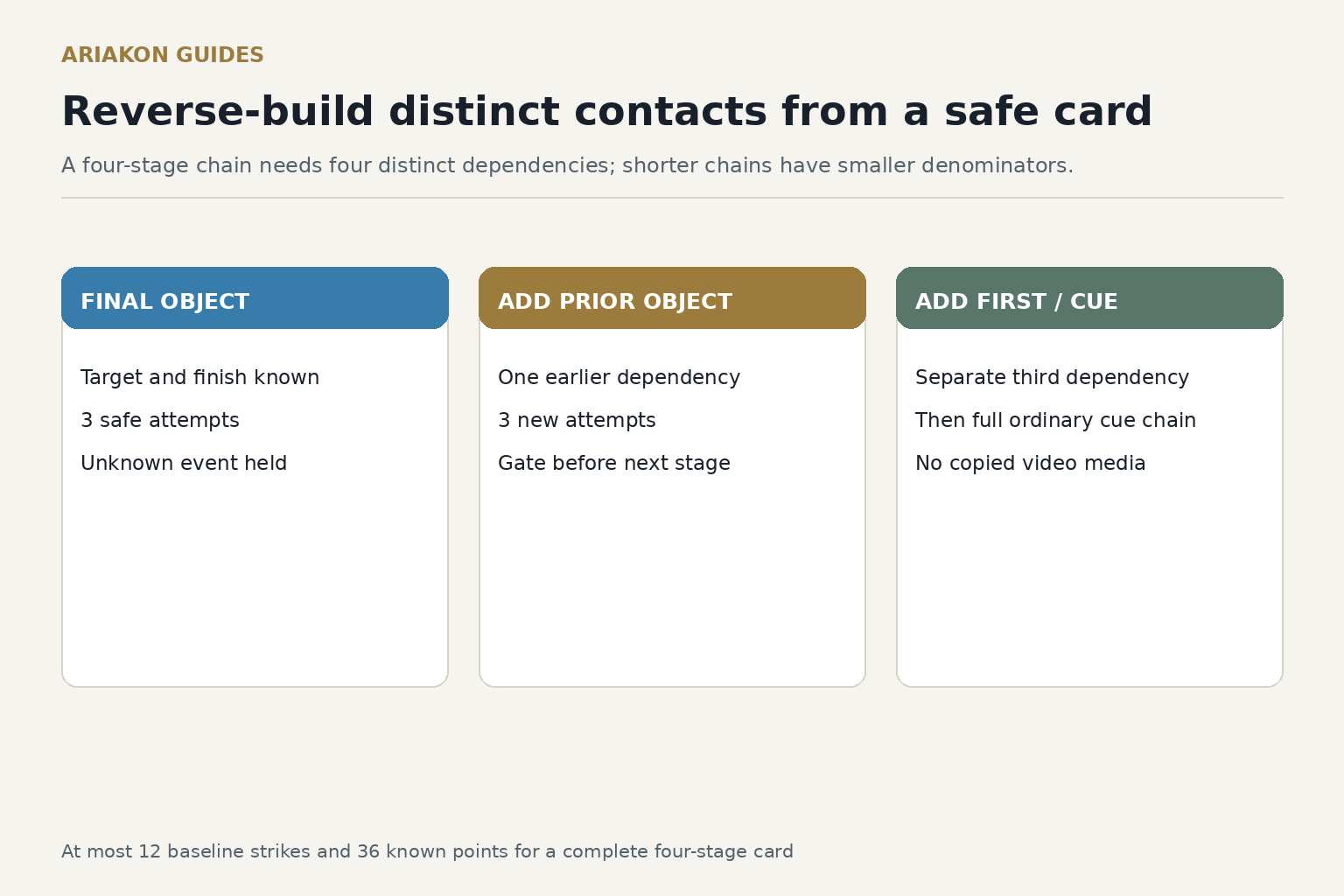
Work backward. Stage 1 is the final object to its target with no earlier balls. Stage 2 adds the preceding ball-to-ball or cushion contact. Stage 3 adds the cue-ball delivery. Stage 4 is the complete verified chain. Shoot three attempts per stage and do not advance on one lucky success.
Score four stages and require a gate
The four stages need distinct verified tasks on the chosen card. For a three-object chain use: final object to target; preceding object to final object; first object to preceding object; ordinary cue delivery through the whole chain. Do not count the same cue-to-two-ball layout twice as both Stage 3 and 4. A shorter safe chain has fewer stages and a smaller planned denominator.
At a stage with one event, score 0 known foul/wrong event,1 required event occurred but target failed,2 target achieved with known uncontrolled finish,3 target plus the called controlled finish. For a multi-event stage require its whole prefix before the same target/finish levels. Write exact criteria before shooting. Unknown evidence remains unscored, not an alleged physical failure.
| Result | 0 points | 1 point | 2 points | 3 points |
|---|---|---|---|---|
| Stage attempt | Unsafe or wrong first event | Correct first event only | Correct chain; final target missed | Complete called chain and target |
Use exact advancement and reset rules
For a four-stage card, three strikes per reached stage give at most 12 baseline strikes and 36 known possible points. Advance only after at least two complete target successes among three safe, known attempts. A failed stage ends the baseline progression; later stages are unused. A return to a prerequisite is a separately dated retest, not part of the original 12. A complete progression requires every reached gate and at least two full successes in Stage 4; a27-point total cannot waive a failed stage.
A complete progression passes at 27 or better with at least two full successes in Stage 4. Log the first failed event on every miss. The first changed event—rather than the final resting place—chooses the correction.
Diagnose one dependency at a time
| First failure | Likely variable | One correction | Hold fixed |
|---|---|---|---|
| Cue ball misses Object A | Delivery line | Shorten the first distance | All downstream centers |
| Object A reaches wrong side of Object B | First contact fraction | Move the aim reference slightly | Speed family |
| Correct contacts, final ball short | Energy through chain | Increase one named speed band | Coordinates |
| Occasional success only | Reset error or hidden dependency | Re-measure centers and repeat prior stage | Do not add another ball |
Transfer the method, not the spectacle
Use the same reverse-build method on an ordinary three-ball position route: define the final cue-ball zone, rehearse the last position shot, add the prior object ball and then run the three-ball pattern. Score five full attempts at 0 for foul, 1 for correct first contact, 2 for the final shot reached and 3 for the completed pattern; maximum 15.
Use the first observable missing dependency to choose the next small practice task. Keep the ledger and stage scores as your learning evidence. Do not present the reconstructed shot as the creator's original setup, a verified reproduction or a performance you can make on demand unless your own repeated results support that claim.
Sources and further reading
References support the specific factual information above. The practical checklists are Ariakon editorial guidance.