
Practice drills · 4 min read
Use Slow Motion Video to Review Your Pool Stroke
Slow playback helps ask when visible movement begins; it does not make a phone a laboratory instrument. Separate capture frames from playback speed, record the shot result and keep camera views matched before and after a change. One dramatic frame is an observation, not a cause of a miss.
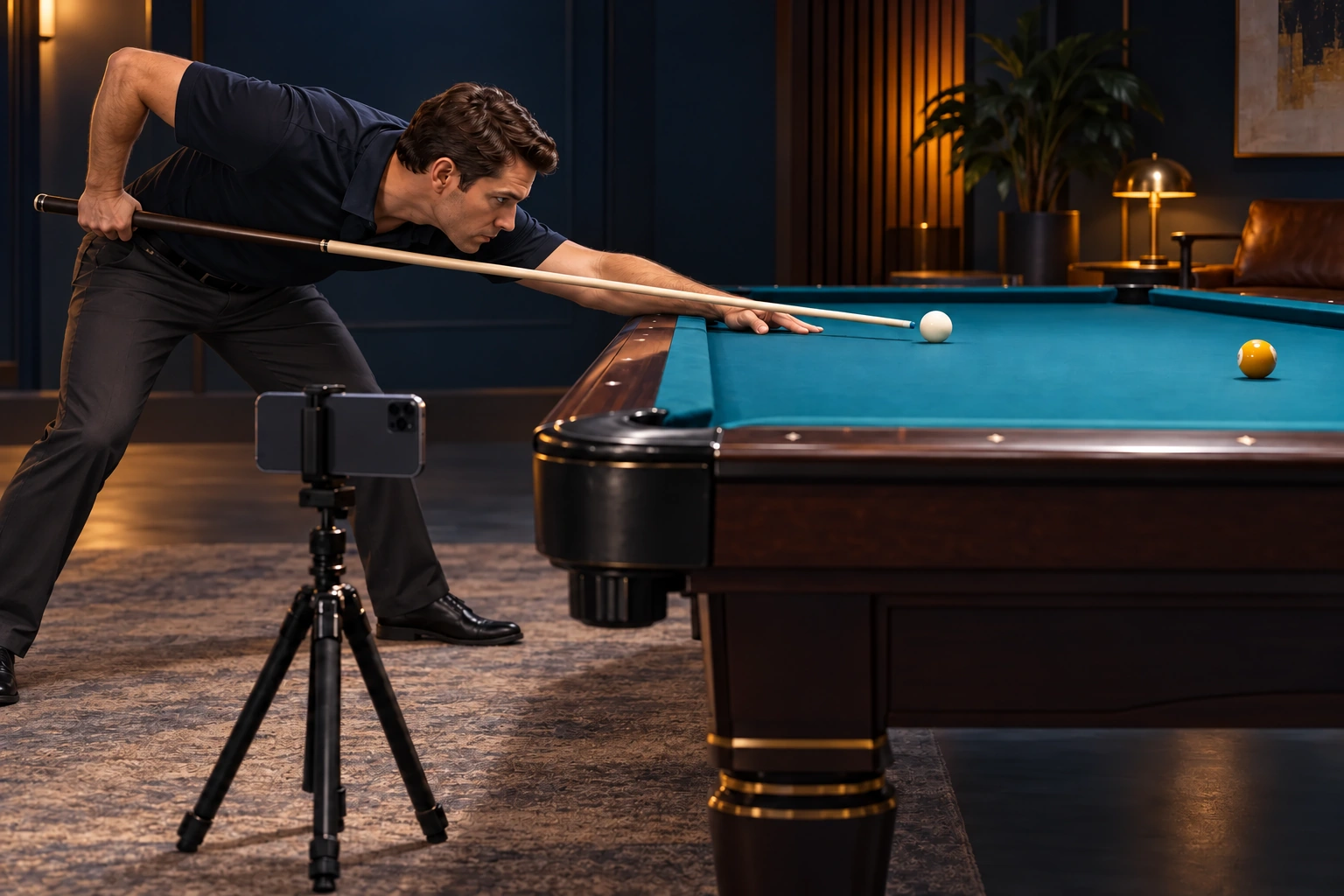
Write one visible question before recording
Choose a question such as whether the bridge base visibly moves before cue-ball motion, whether the grip side collides with the body, or whether the head begins rising before the strike interval. Do not ask ordinary footage to read grip pressure, internal muscle force or rotation on a featureless ball.
This resource compares matched slow-playback clips and their timing uncertainty. The separate fixed-camera worksheet covers a broader five-variable rear-view inventory; the stance and pendulum guides isolate different movement questions.
Register a broader fixed-camera inspection when the question is which variable deserves attention.
Use the stance-specific checklist when support or body clearance is the concern.
Freeze one shot and two safe camera views
Use ball-center coordinates on an illustrative 100×50-inch bed: x=0..8 along the length, y=0..4 across it, origin at the lower-left cushion-nose corner. Equal 2.25-inch balls have radius 0.09 and diameter 0.18 units. Intact-cushion center limits are 0.09..7.91 and 0.09..3.91; real pockets interrupt the boundary at four corners and (4,0),(4,4). Measure your actual bed, mouths and balls before scaling this example. Remove all measuring aids before shooting; do not mark a competition table.
Use O(6,3), P(8,4), G(5.839003, 2.919502) and straight cue start (4.944576, 2.472288). Request the same comfortable stop shot. Keep the entire bridge/cue-ball interval in view, plus the relevant upper body or grip side. Take a permitted rear-line view and a side view square to the shot, both off-table and away from walkways.
Record device capture rate, playback rate, orientation, light and camera position. Check that two fixed table references remain stationary in the frame. If exposure, blur, parallax or a blocked view hides the chosen event, improve recording or write unknown. Do not move a tripod mid-comparison and interpret the apparent line change as a stroke change.
Know what frame timing can resolve
If the cue ball is still in frame 99 and first visibly moving in frame 100, the start of resolvable movement is bracketed by those frames; exposure time and event visibility add uncertainty. Cue-tip contact itself may occur between frames. Report the bracket, not a fabricated exact impact timestamp.
For phone-dependent variable frame rates, use reliable frame timestamps when available; do not blindly divide by a nominal rate. Slow playback cannot reveal information that capture blur or missing frames destroyed.
| Example | Calculation | Limit |
|---|---|---|
| 240 captured frames per second | One frame interval ≈4.167 milliseconds | A one-frame event cannot justify a 1 ms contact-time claim |
| Four captured frame intervals | 4/240 second =16.667 milliseconds | Not four playback-frame intervals |
| The same clip shown at30 fps | Playback appears eight times slower | No additional capture detail is created |
Collect matched before and after blocks
Record four cells per attempt: registered view, chosen event visible, stated checkpoint met, and finish visible. Use pass, observed fail or unknown for each. The twenty shots create eighty planned cells, but compare A with D and B with C; do not pool unlike views into a causal claim. Record pots and actual cue-ball finish separately.
Hypothetical A=14/18 observed with two unknown, D=17/19 with one unknown, B=15/20, C=16/20 gives 62/77 observed and three unknown out of eighty planned. Those are documentation/checkpoint counts, not a stroke-quality rating. Unseen centered contact is not awarded because the ball was pocketed.
| Block | Attempts | View | Purpose |
|---|---|---|---|
| A | 5 | Rear | Baseline line and support |
| B | 5 | Side | Baseline clearance and movement timing |
| C | 5 | Same side | One changed routine or support variable |
| D | 5 | Same rear | Check whether the change created a new issue |
Retest one hypothesis and return to playing
Select a repeated visible discrepancy that coincides with a ball-result issue, then choose one small change. If the movement changes but the miss pattern does not, reopen the diagnosis instead of adding more corrections. A clean-looking clip can still be aimed incorrectly; repeated misses can have causes outside the chosen view.
Take five separate transfer shots without reviewing between each, giving twenty-five strikes if all blocks were completed. Note whether the one checkpoint and the requested result survive normal play. Keep transfer outcomes separate. End after one usable next action, and retain or delete recordings according to participant permission.
Recheck the exact stop outcome when the stroke looks repeatable but the cue ball keeps traveling.
Compare a controlled backswing experiment only if the transition question is supported by the footage.
Sources and further reading
References support the specific factual information above. The practical checklists are Ariakon editorial guidance.