
Practice · 3 min read
Inspect Five Pool Mechanics Variables With a Fixed Camera Setup
Video becomes unreliable when the camera moves, the shot changes or one angle is asked to explain the entire body. Register one safe rear-line view, shoot twelve identical attempts and score five visible variables as match, mismatch or unknown. This is separate from general diagnostic drills because the deliverable is a camera registration and inspection worksheet.
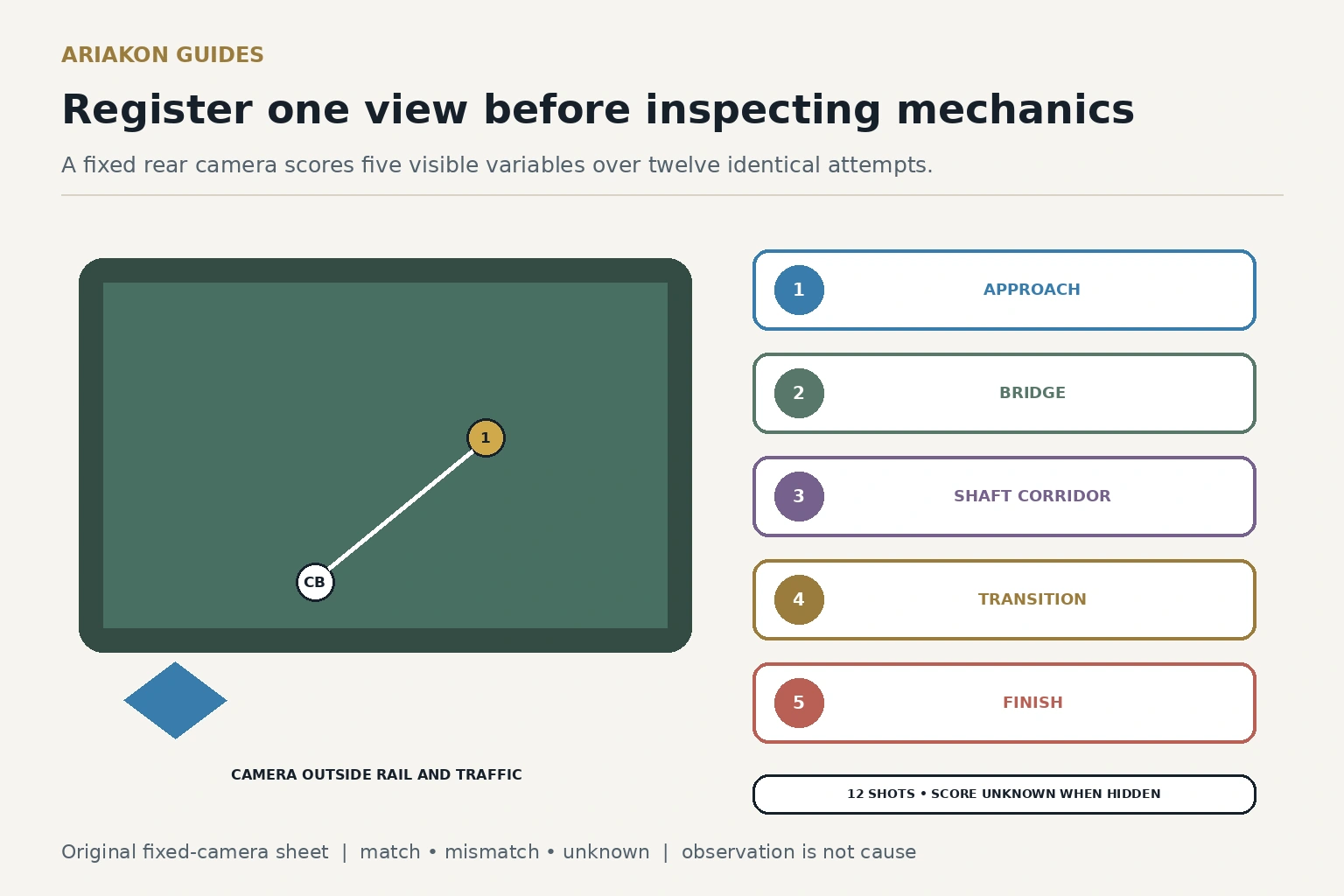
Register a safe rear-line view
Mark a straight stop shot with the object ball one diamond from a corner and the cue ball two diamonds behind it. Put the camera beyond the rear rail, centered on the shot line, with the full bridge-to-grip cue and stable body reference visible. Keep the tripod, operator and every cable outside cue, ball, player and spectator paths. Never place a device on the cloth.
Save a registration frame showing two stationary rail or room references. Lock position, height, zoom, focus and orientation for the full block. Ask permission from everyone visible or audible and follow venue policy. If a safe view is unavailable, do not film.
Start with diagnostic practice drills to choose the shot and result question before filming mechanics.
Film practice from two registered angles when a second view is genuinely necessary.
Define five variables the rear view can actually show
The camera does not measure anatomy, force, eye dominance, tip offset or causation from this view. Avoid drawn joint angles unless the setup has been calibrated for that purpose. Unknown is the honest score when clothing, blur or perspective hides a field.
| Variable | Registered reference | Score |
|---|---|---|
| 1 — Approach | Cue enters the saved shot-line corridor before bridge sets | Match / mismatch / unknown |
| 2 — Bridge | Bridge center and length align with table marks | Match / mismatch / unknown |
| 3 — Shaft corridor | Shaft remains inside two visual corridor guides | Match / mismatch / unknown |
| 4 — Transition | Usual warmup and final transition remain visible | Match / mismatch / unknown |
| 5 — Finish | Cue completes inside the finish corridor before rising | Match / mismatch / unknown |
Shoot and score twelve attempts
Record legal pocket and cue-ball stop separately from the five inspection fields. Each variable has twelve available matches, but those totals are observation counts—not mechanical grades.
| Before | During | After |
|---|---|---|
| Capture registration frame | Replace balls on fixed marks | Check registration frame again |
| Name pocket, speed and stop corridor | Do not review each attempt | Score five variables and outcomes |
| Label attempts 1–12 | Use the same center-axis shot | Preserve raw order; no highlight-only sample |
Worked example: choose one repeated mismatch
A hypothetical block produces Approach 11/12, Bridge 10/12, Shaft corridor 9/12, Transition 10/12 and Finish 5/12. Pocket is 9/12 and stop window is 7/12. Four of seven finish mismatches appear on attempts that also miss the stop window, but the rear view cannot prove why.
The next action is a second twelve-shot block with the same camera registration and one instructor-approved external finish corridor. Stance, grip, bridge and aim are not changed together. If the finish count improves while results do not, the hypothesis is revised rather than protected.
Add a second view only as a separate experiment
Never combine rear and side clips into an angle or causal measurement the cameras did not capture. The fixed setup is valuable because it preserves comparison, not because video is automatically objective.
| Question | Best next step |
|---|---|
| Did the rear registration move? | Repeat registration; do not score the block |
| Is timing hidden from the rear? | Run a separate fixed side-view block |
| Is contact point the question? | Use a task-specific close setup, not this body view |
| Does one mismatch repeat? | Test one variable or show evidence to an instructor |
| Is consent withdrawn? | Stop recording and follow the agreed deletion policy |