
Practice drills · 4 min read
Use Pool Drills to Diagnose What Needs Work
A practice result can narrow a question without diagnosing a player. This resource compares a cue-only speed task, a straight contact task and a cut-position task, then asks what changed when complexity was added. It does not turn three different percentages into one rating or replace a long-term improvement plan.
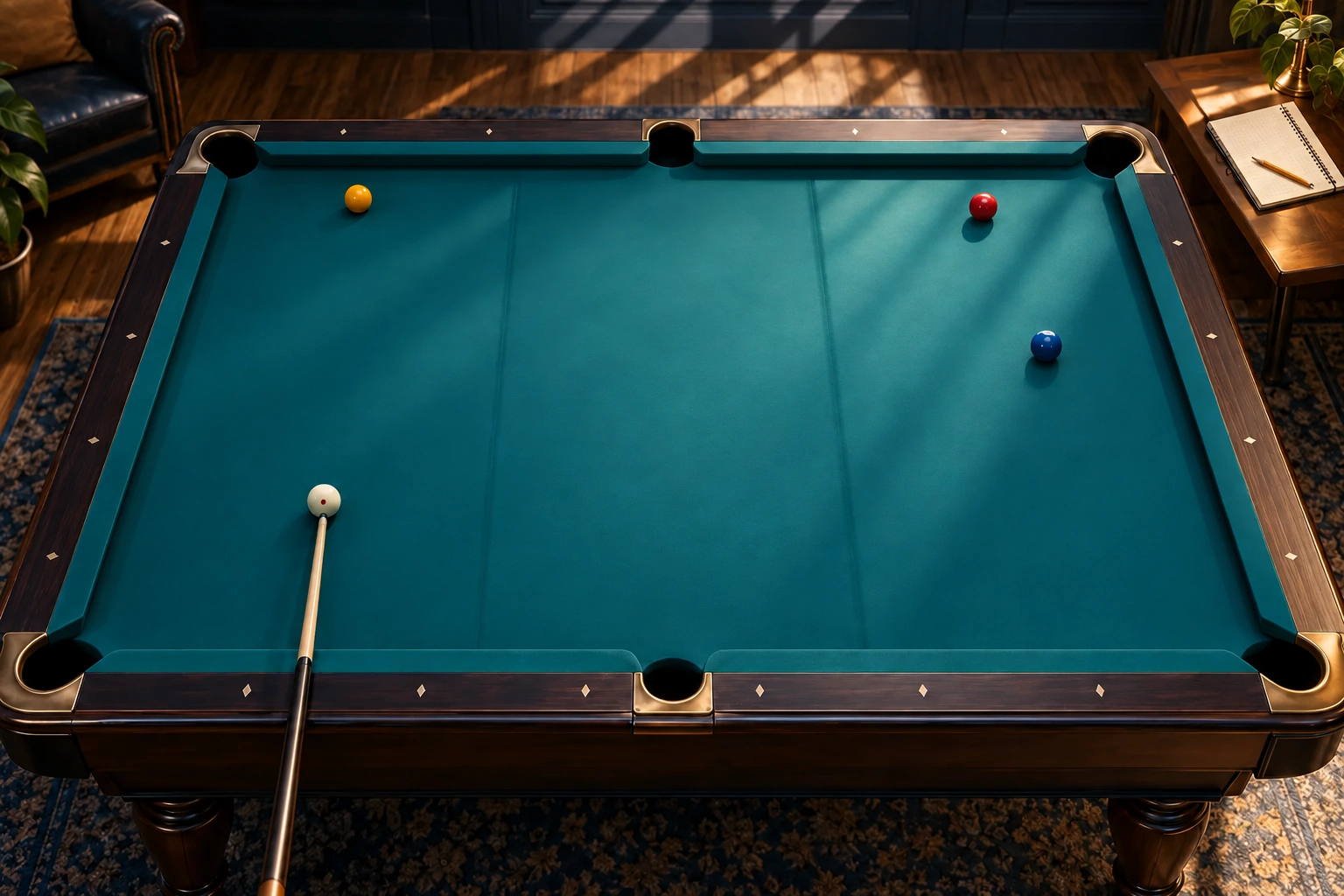
Freeze a question and a small observation contract
Choose a recent observed problem: repeated long finishes, uncertain tip contact, or a pot that succeeds while the next position fails. Do not begin with an assumed cause such as weak confidence or a bad elbow. Record the table, balls, cue, pace request and whether contact and finish can actually be observed.
Use familiar legal, low-risk strokes, with permission to practice and record. No hard gates or loose markers remain on the cloth. These are original probes with chosen sample sizes and target tolerances, not standardized examinations or proprietary training exercises.
Keep the longer improvement plan separate after this session has supplied a usable question.
Build only one probe at a time
Coordinates describe ball centers on an illustrative 100×50-inch bed: x=0..8 along the length, y=0..4 across the width, origin at the lower-left cushion-nose corner. Equal 2.25-inch balls have radius 0.09 and diameter 0.18 units. Intact-cushion center limits are 0.09 and 7.91 in x, 0.09 and 3.91 in y. Pockets interrupt these limits at the four corners and at (4, 0),(4, 4). Inspect actual mouths and jaws; scale to the measured bed and actual ball size. These are not universal diamond coordinates. Remove measuring aids before a shot; do not mark a competition table.
For the straight and cut probes use O(6, 3), P(8, 4), G(5.839003, 2.919502). The cut starts at C(4.8, 1.9); its ideal stun direction is the perpendicular unit vector(−1, 2)/√5. A disk of radius 0.20 centered at (5.481232, 3.635043) is a chosen position request 0.8 units along that tangent. It is not a guaranteed finish; speed and arrival state must be calibrated.
| Probe | Setup | Independent outcomes |
|---|---|---|
| A — speed without a pot | Cue (2, 2), no object balls; positive-x line; disk radius 0.40 about (5, 2) | Disk finish; signed length and lateral error |
| B — full contact | Cue (4.40792, 2.20396), O(6, 3), P(8, 4) | Called pot; pot plus stop disk radius 0.18 about G |
| C — cut and position | Cue (4.8, 1.9), same O and P; requested tangent disk | Called pot; pot plus requested position disk |
Use comparable records, not a common score
Complete six struck attempts on A, then six on B, then six on C. Allow a short rest and reset after every strike. Count each outcome over its actual attempts. Also report the position success among made pots, which is a different denominator; preserve both. A contact you could not see is unknown, not evidence of perfect delivery.
The cue-only task removes object contact and pocketing; it does not isolate every aspect of speed from direction. The straight task adds those demands, and the cut adds contact angle and arrival-state requirements. Differences suggest what to test next; they do not establish a single mechanical cause.
| Probe | Outcome | What the next question could be |
|---|---|---|
| A | 5/6 target-disk finishes | Basic cue-only distance request is fairly repeatable here |
| B | 5/6 pots; 3/6 pot-plus-stop, also 3/5 among pots | Check full-contact arrival state after verifying straightness |
| C | 4/6 pots; 1/6 pot-plus-zone, also 1/4 among pots | The cut/contact/route demand needs a simpler check |
| Not permitted | 5+3+1 divided by 18 as an ability percentage | Tasks and success definitions differ |
Confirm one candidate before changing the session
Choose the first task-specific repeated error, not automatically the smallest percentage. For B forward finishes, repeat B six times with one modest contact-height request changed and everything else held. For a poor C pot count, remove the position target and repeat the same cut before assigning the failure to speed. A confirmation adds six strikes: 24 total after all three baseline probes.
Write what stayed fixed, the one change and the actual pattern. Keep a change only as a provisional local result until another ordinary session repeats it. An improvement from 3/6 to 4/6 alone is not a meaningful causal proof; a stable signed error shrinking with controlled inputs is more informative.
Calibrate stop distance in its dedicated guide when the straight arrival-state question persists.
Separate pocket line from cue-ball plan when the cut probe introduces two unresolved tasks.
Hand the next session a precise task
Save one sentence naming the tested layout, observed error and next controlled question. This handoff differs from choosing the week’s practice priorities or grading a drill collection. When footage and results disagree or the fault remains unclear, a qualified instructor can evaluate the complete setup.
| Observed condition | Next action | Do not claim |
|---|---|---|
| Input or marks varied | Rebuild the frozen probe | That technique caused the score |
| Direction repeats but length misses | Run a same-route distance check | That adding spin is automatically the answer |
| Pot count falls on the cut | Verify chosen line and full setup | That a finish-zone miss proves poor speed |
| Fatigue or discomfort appears | Stop or shorten and record actual attempts | That unshot attempts were failures |
| No stable pattern | Collect another matched small record | A permanent skill rating |
Choose a next drill after the evidence check rather than turning every new miss into a new training plan.
Sources and further reading
References support the specific factual information above. The practical checklists are Ariakon editorial guidance.