
Aiming and position · 4 min read
Aim the Object Ball and Plan the Cue Ball as Separate Tasks
Players often lose the pocket line while thinking about position. Use two deliberate passes while standing: first solve the object-ball path and required collision, then choose the cue-ball state, route and speed. Reconcile the two plans before lowering into the stance.
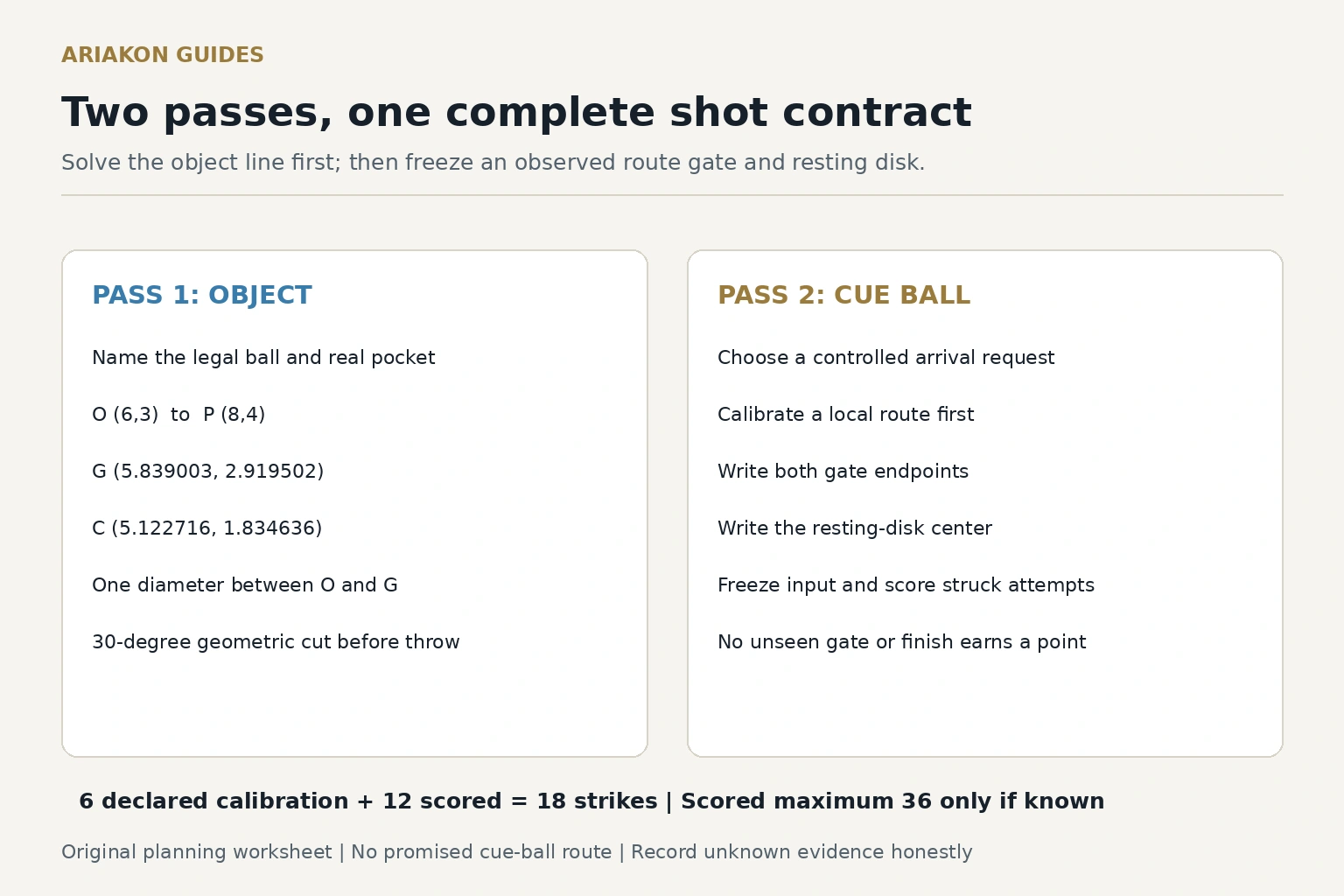
Pass one: solve only the object ball
Name the object ball and pocket. Trace the object-ball center line through the pocket center, choose the contact point and place the ghost-ball center on the opposite side of the object ball. Stand until that line is visually clear.
Do not add position spin yet. If the pocket line is uncertain, change the shot choice or aiming reference before planning the cue ball. The ghost-ball picture is a geometric starting reference; throw and delivery still affect the result.
Compare aiming references on a fixed shot when the object-ball solution itself is inconsistent.
Pass two: plan cue-ball state, route and speed
With the pocket line fixed, name the cue-ball state you want at collision: stun, natural roll, draw or a controlled amount between them. Draw the first route segment, choose a finish zone and select the minimum speed and spin needed to enter it.
Prefer a vertical-axis solution when it reaches an adequate zone. If side spin is necessary, state the expected deflection, swerve, throw and rail-response adjustments before changing the aim.
Choose between tangent and rolling reference routes when the first cue-ball segment is unclear.
Reconcile the plans before entering the stance
| Decision | Object-ball pass | Cue-ball pass | Stop and replan when |
|---|---|---|---|
| Target | Named ball and pocket | Named finish zone | Either target is vague |
| Collision | Contact point or ghost-ball center | Required cue-ball state | Spin choice changes the collision |
| Delivery | Aim line | Tip height and speed | Selected delivery cannot hold aim |
| Risk | Pocket acceptance and miss side | Scratch, blocker and leave | Position benefit does not justify pocket risk |
| Commitment | Final pocket picture | Final route picture | You change either picture while down |
Run a twelve-attempt scored progression
Use ball centers on an illustrative 8×4 bed representing 100×50 inches, origin lower-left between cushion noses, radius 0.09. Set O(6,3), real corner P(8,4), tangent cue center G(5.839003,2.919502), and C(5.122716,1.834636). This is a 30-degree geometric cut before throw. Scale to actual equipment, inspect the center envelope and pocket jaws, and remove all setup aids before striking.
First take two declared unscored calibration strikes for each of three controlled requests: intended stun, intended natural roll and intended draw, six calibration strikes. For each usable request register an observed local route before the first cushion and a personally controllable cue-center resting region. Select a gate point on that observed route 0.4 units from G, with a transverse half-width 0.18 measured perpendicular to the local direction. Write the two gate endpoints. Select a resting disk radius 0.25 around a safe repeatable interior finish and write its center. These are locally calibrated planning requests, not a universal thirty-degree or draw forecast. If no safe usable contract is observed, hold that request rather than guessing a gate.
Take four scored strikes for each available request, twelve maximum and eighteen physical strikes including all calibration. Call the exact request, gate and disk before address and retain the same ball centers. Score 0 for a miss or foul;1 for a legal called pot outside its route gate;2 for a legal pot through the gate but outside the disk;3 only for a legal pot through the gate and resting within the disk. Maximum 36 applies only to twelve fully observable results. Unknown gate or finish evidence remains listed outside the numeric subtotal, not automatically zero or three.
Log actual pockets, gate crossings and disk finishes independently beside the nested score. The requests can use different controlled deliveries; do not pretend spin alone was isolated. A cut cannot stop the cue ball merely by calling stop. Keep struck misses in the actual denominator and unused slots visible.
Diagnose the first failed task
A missed pocket with the cue ball moving near the planned route is still an object-ball failure. A pocketed ball with the wrong first cue-ball segment is a state-at-contact failure. A correct segment with the wrong distance is a speed failure. Record only the earliest failure for that attempt.
Work the earliest repeated failure. More position practice will not fix an unstable pocket line, and more aiming systems will not fix a route that is consistently correct but too long.
Transfer the two passes to a three-ball pattern
Place three balls in an open pattern. Before each shot, point to the object-ball pocket line, then trace the cue-ball route into a zone for the next ball. If the cue ball misses the zone, rebuild both passes from the new position instead of forcing the original pattern.
Award one point for a correct pocket-line statement, one for a complete route-and-speed statement and one for execution. Five layouts produce 45 possible points across three shots each. The notes should reveal whether aim, route choice or speed is the dominant loss.
Choose the right position target after the two-pass routine is stable.
Use the routine in advanced cue-ball work before adding more side spin and rail routes.
Sources and further reading
References support the specific factual information above. The practical checklists are Ariakon editorial guidance.