
Cue ball control · 4 min read
Compare the Tangent Line and Rolling Cue Ball Routes
Two angle numbers can be correct while a diagram is wrong because they use different reference lines. A stun tangent is perpendicular to the line of centers at collision. A useful rolling estimate turns about thirty degrees away from the incoming direction over moderate cuts. Neither line begins at the object ball’s center: the cue ball occupies its own contact center.
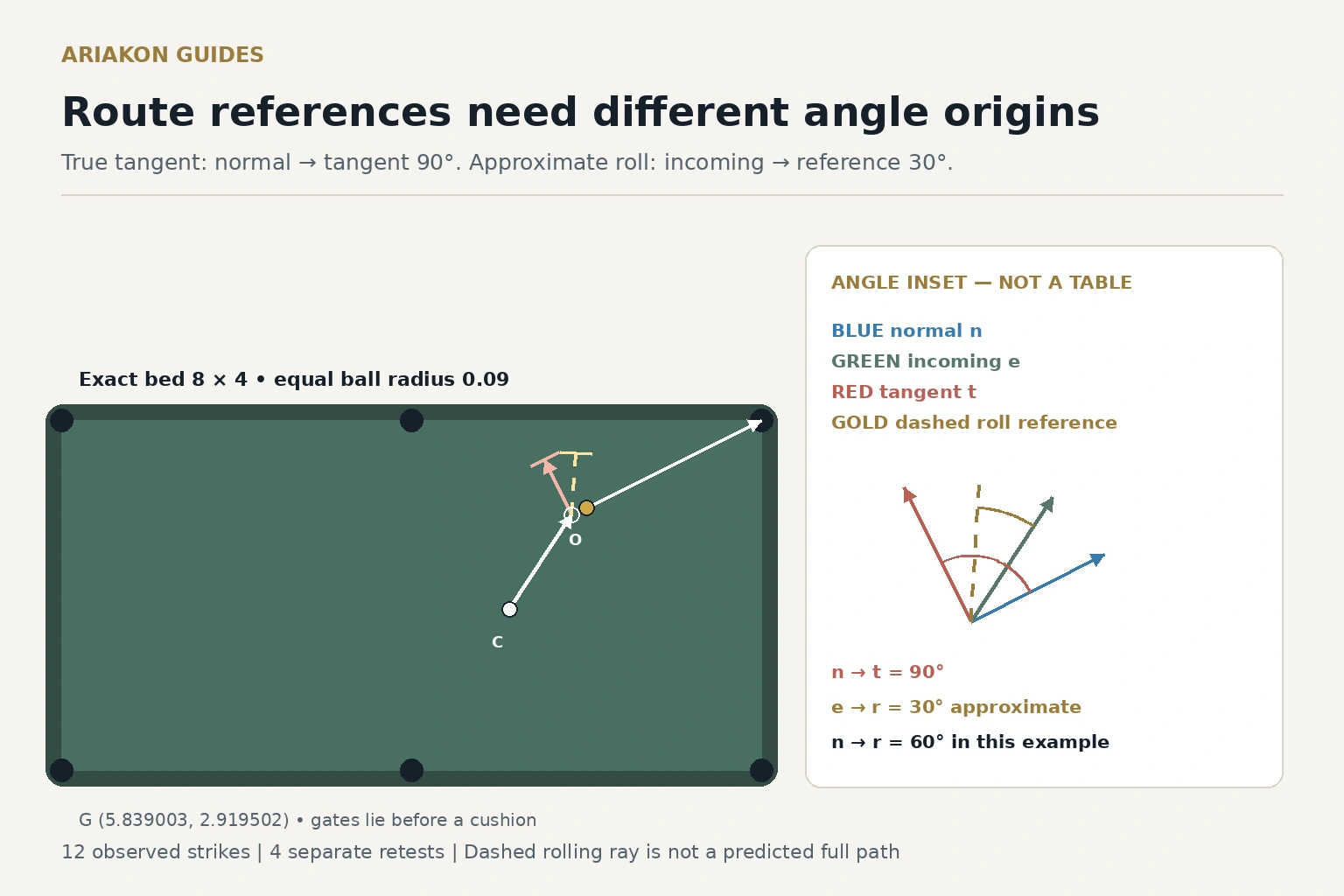
Keep the two angle origins separate
For an ideal equal-ball collision with stun and little unwanted sidespin, the cue ball initially retains the component tangent to contact. Friction and later cloth action can change that route. Natural forward roll produces a later curved transition away from the tangent; thirty degrees is a working estimate for moderate cuts, not a promise for all angles or speeds.
Tip height at the start does not prove spin at collision. Begin with a familiar stop-shot baseline and change the intended arrival state, not the pocket line. A phone view of an unmarked ball may not establish rotation; record the intended state separately from what you can observe.
Calibrate arrival state on a straight stop shot before this angled comparison.
Read the broader line-and-speed framework when deciding which route solves position.
Build the contact and both local references
Use ball-center coordinates on an illustrative 100×50-inch bed: x=0..8 along the length, y=0..4 across it, origin at the lower-left cushion-nose corner. Equal 2.25-inch balls have radius 0.09 and diameter 0.18 units. Intact-cushion center limits are 0.09..7.91 and 0.09..3.91; real pockets interrupt the boundary at four corners and (4,0),(4,4). Measure your actual bed, mouths and balls before scaling this example. Remove all measuring aids before shooting; do not mark a competition table.
Hold O(6, 3) and real corner P(8, 4). Let n=(2,1)/√5 be the object-line unit direction and G=O−0.18n=(5.839003, 2.919502) the cue center at contact. Incoming e is n rotated 30° counterclockwise; cue start C(5.122716, 1.834636) is 1.3 units behind G along e. This defines a 30° geometric cut before throw, not a measured half-ball result.
The tangent unit direction t=(−1,2)/√5 is exactly perpendicular to n. Draw it through G, not O. Extend the incoming direction e forward through G as a separate reference. The dashed rolling estimate r is e rotated another 30° counterclockwise. Its angle to n is therefore 60°, not 30°. Do not connect that dashed ray to a cushion and pretend it is the full path.
| Reference | Unit direction | Gate center |
|---|---|---|
| Tangent t | (-0.447214, 0.894427) | (5.525954, 3.545601) |
| Approximate rolling r | (0.059915, 0.998203) | (5.880944, 3.618244) |
Observe twelve attempts, not six plus hidden extras
Shoot six intended-stun attempts and six intended-natural-roll attempts, alternating S,R,S,R until twelve strikes are complete. Reset C and O each time. Keep equipment and a chosen comfortable pace request fixed; record any necessary arrival-state adjustment. The comparison is of resulting deliveries, not proof that spin alone changed.
For each reference define a gate perpendicular to its ray at the listed center, with center-crossing tolerance ±0.18 units. Use an unobstructed registered overhead view or permitted off-table references; no gate objects remain on the cloth. A gate hit is a measurement of proximity to a chosen reference, not automatic proof of correct physics.
| Field | Record |
|---|---|
| Object result | Pot, miss or foul for all twelve strikes |
| Local crossing | Pass, fail or unknown for that block’s reference gate |
| Finish | Actual coordinate or named region; no direction point inferred from finish |
| Arrival state | Intended stun/roll; independently observed only when resolvable |
Use separate denominators and interpret the example
Count pots out of six in each block. Count gate passes out of observable crossings, listing unknowns. A pot with a gate miss is still a pot; a gate pass with a miss does not prove useful position. There is no combined score where speed, pocket and state are interchangeable.
Illustrative notes: S has 5/6 pots and 4/5 visible gate passes with one unknown; R has 5/6 pots and 3/6 gate passes. This is not evidence that stun is superior. The approximate rolling ray can be systematically displaced from the actual rolling route, especially near a half-ball cut. Draw the repeatable observed route before calling the delivery wrong.
Retest one recurring discrepancy
First check ball replacement and actual contact. Then inspect whether the cue is level enough for the chosen task and whether unplanned sidespin or a different pace appeared. Do not fix a bent stun route by blindly adding force or fix every rolling miss by adding top.
Take four additional strikes at one frozen condition, making sixteen total if the baseline was completed. Record a revised hypothesis before the retest. Next choose an actual position window on a new layout and predict its safest route using the observed calibration; no scratch-free leave follows from a reference angle alone.
Separate object aiming from cue-ball planning when the pocket line and desired leave compete.
Sources and further reading
References support the specific factual information above. The practical checklists are Ariakon editorial guidance.