
Cue ball control · 4 min read
Use Pocket Acceptance Only When It Buys Useful Position
An off-center pocket request is useful only if the gained position is worth the lost pocketing margin. This resource compares three measured mouth targets and a usable next-shot zone. It is distinct from a visual corridor drill, a thin-cut speed comparison or a pocket-size specification sheet.
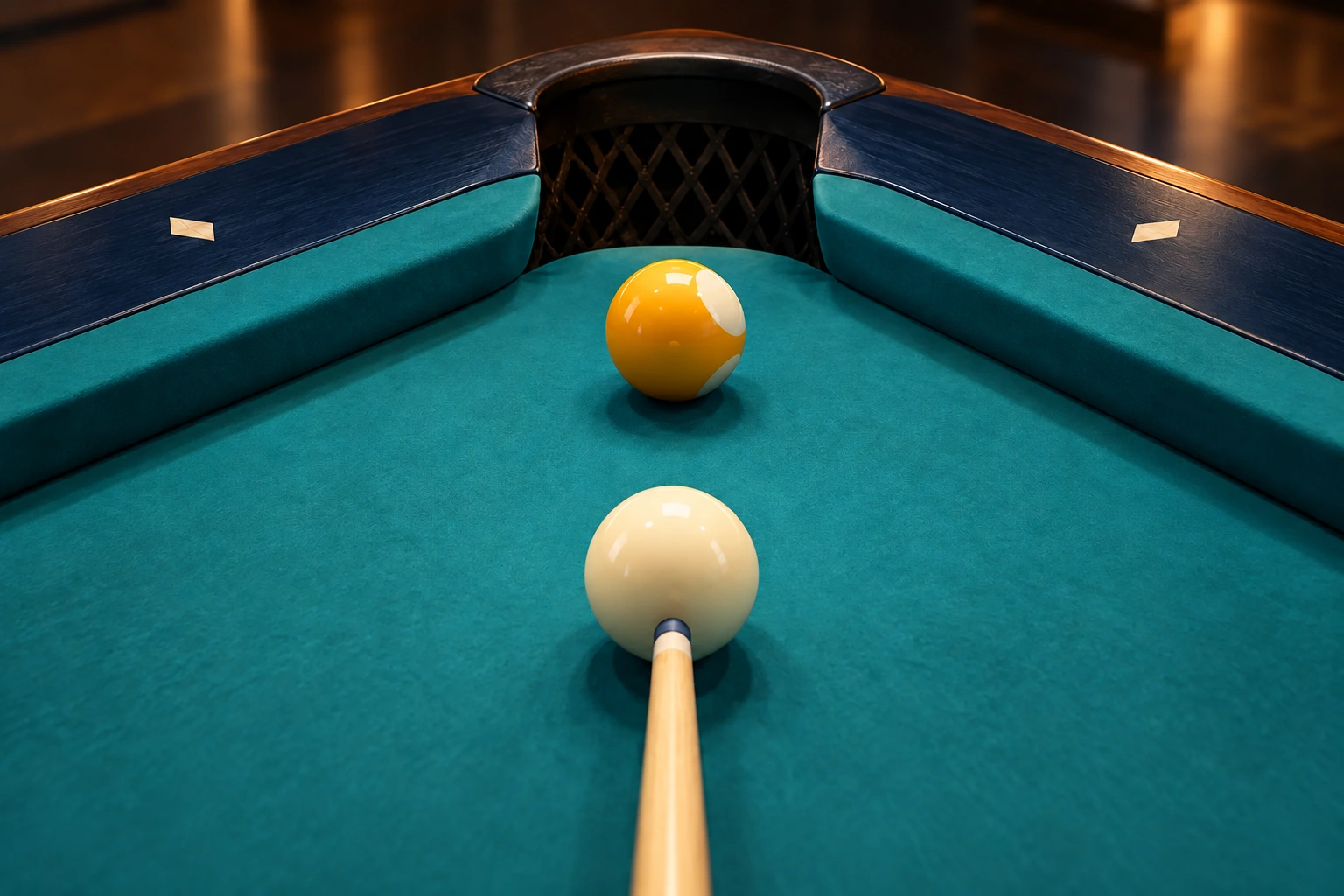
Start with a center-clearance model, then inspect the real pocket
Use an illustrative 100×50-inch bed represented by x=0 to 8, y=0 to 4, measured between cushion noses from the lower-left corner. Equal 2.25-inch balls have radius 0.09 and diameter 0.18 units. Intact-cushion center bounds are x=0.09 or 7.91 and y=0.09 or 3.91. Real pockets interrupt those boundaries at the corners and side midpoints (4, 0),(4, 4). Scale to your measured bed and ball size; actual jaws and shelf require inspection. Coordinates are ball centers, not edges or universal diamond values.
The mouth segment connects two real-facing tip locations in this illustrative cutaway. A ball center cannot use the entire visible mouth: at minimum its radius must clear both tips. Oblique approach, facing shape, shelf, speed and collisions can reduce usable acceptance further. Passing this necessary geometry check does not guarantee a pot.
Use the model only after mapping the actual mouth and adapting the numbers. Do not put a target on a cushion nose or treat the corner coordinate (8, 4) as an intact rail. When the actual jaw geometry cannot be measured safely, keep center as the default and use observed records without pretending the model is exact.
| Element | Model |
|---|---|
| Jaw tips | (7.74, 4) and (8, 3.74) |
| Mouth midpoint | (7.87, 3.87) |
| Ball radius / diameter | 0.09 /0.18 units |
| Mouth width | 0.26×√2≈0.367696 units, about 4.596 inches |
| Necessary center half-margin | 0.367696/2−0.09≈0.093848 units |
Call three actual mouth targets before shooting
Each offset runs along the mouth segment’s unit direction (1,−1)/√2, not toward an intact cushion. Both offsets are less than the necessary half-margin 0.093848. The incoming cue aims at the corresponding tangent center one diameter behind the object along that requested object direction.
The illustrated object-to-target segments also clear both modeled jaw tips by more than the ball radius. That is a geometric check only. Throw, actual facings and execution can still defeat the request. Rebuild the ball pair after every attempt and freeze one familiar pace and contact request. No sidespin correction or guaranteed curved cue-ball route is specified.
| Request | Mouth target | Tangent cue center |
|---|---|---|
| A, offset−0.04 | (7.841716, 3.898284) | (6.360714, 2.685985) |
| Center, offset 0 | (7.87, 3.87) | (6.35814, 2.689204) |
| B, offset+0.04 | (7.898284, 3.841716) | (6.355654, 2.692463) |
Validate one useful finish request independently
Add next object N at (3, 2.5), with its called real upper-left corner at (0, 4). N does not obstruct the first approach or object-to-mouth paths. After the first pot, the only remaining object is N; its tangent cue center is (3.160997, 2.419502). From each of the four requested zone corners the cue approach to that tangent center and N’s line to the pocket are geometrically clear. Confirm personal makeability and comfortable reach at those corners; clear geometry is not proof of success probability.
For the worked task, call a cue-center rectangle x=6.65 to 7.05, y=1.60 to 2.20. Check its four corners against the actual next-shot question before using it; if any corner is unsafe or unusable, replace the rectangle and save a new version before scoring. This broad interior zone is an experimental request, not a predicted postcollision path.
The different object directions change the geometric tangent reference at collision. A cue ball arriving with residual roll or draw need not follow that tangent, and even a stun reference does not determine the final resting point. Observe actual finishes and scratch risk rather than inventing a route from the target choice.
Validate the corners of a usable zone before counting arrival near a ball as good position.
Compare benefit and cost with separate flags
Take six struck attempts at each request, eighteen total, using Center,A,B order. On a separate repeat occasion use B,A,Center. Each complete occasion has six opportunities per request; keep conditions and actual denominators visible. A deliberately changed pace creates a new comparison, not a rescue for an edge miss.
Pocket flag is 1 for the called object pot without foul. Position flag is 1 only when that pot succeeds and the cue center rests inside the already validated rectangle with the next question still usable. Record jaw contact, short/long finish, actual center and process adherence separately. If entry cannot be observed, leave its description unknown.
Hypothetical Center: 6/6 pockets and 4/6 useful positions; A: 4/6 and 3/6; B: 3/6 and 2/6. Totals 13/18 and 9/18 are separate outcomes. Here the center request already buys more useful positions, so an edge request has not earned the extra risk. Small samples do not establish a universal superiority.
Reject an edge request that has no demonstrated job
Return toward center when the requested finish is already available, geometry is uncertain, repeated facing contact appears or speed cannot be controlled. Do not select the most dramatic entry after seeing the successful attempt and retrospectively call it the plan.
Only extend the task after a repeatable local benefit appears under matched conditions. Other tables, cut angles or speed requests need new evidence.
Use the separate visual-corridor task when observing entry identity is the primary question.
Compare thin-cut speed separately instead of changing speed in this mouth-offset trial.
Sources and further reading
References support the specific factual information above. The practical checklists are Ariakon editorial guidance.