
Aiming · 3 min read
Practice Thin Cut Speed Control With a Pocket Acceptance Test
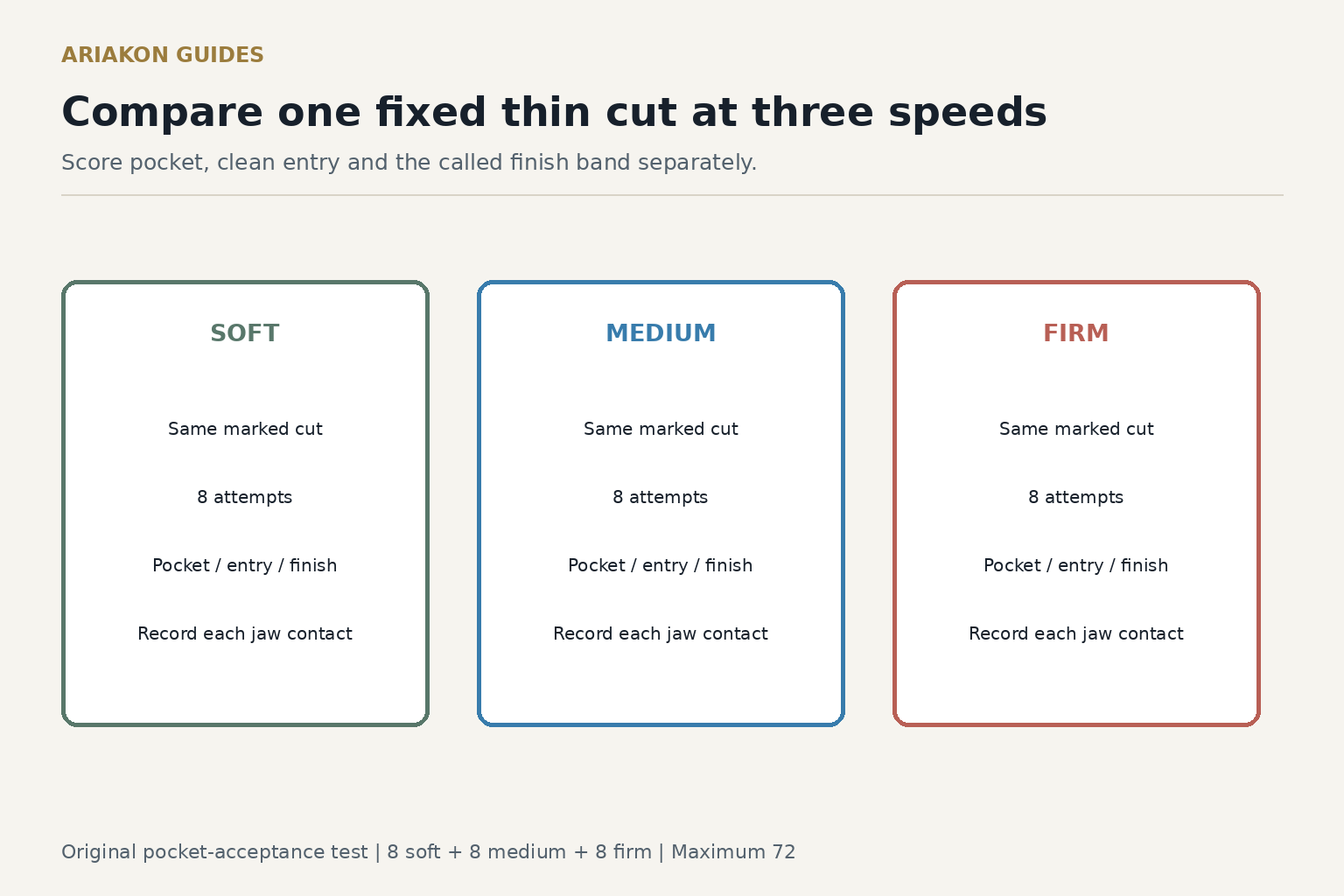
Speed changes more than cue-ball travel. It can change throw and the way an object ball interacts with pocket facings, so the same visual thin-cut picture may not accept soft, medium and firm deliveries equally. This test keeps the geometry fixed and compares personal speed bands. It maps one shot on one table; it does not measure pocket size or create a universal thin-cut speed rule.
Build one repeatable thin cut
Choose a foot corner. Put the object ball about one diamond from the short rail and half a diamond from the long rail. Put the cue ball about two diamonds up-table so the shot is a thin but comfortable cut along the long-rail side into the corner. Adjust during four unscored shots until the object ball can be pocketed at all three intended speeds without a forced reach, then mark both centers.
Use center-ball cueing and a level-as-practical cue. Define soft, medium and firm in personal outcome terms during calibration: soft reaches the pocket cleanly, medium reaches with useful pace, firm is assertive but comfortably below break speed. Keep those calls for the session.
Learn the thin-cut contact picture before adding the speed comparison.
Understand pocket-point rebounds when near- and far-jaw evidence clusters.
Mark a cue-ball finish lane
Place three broad cue-ball finish bands along the expected post-contact route, one for each speed. Calibrate them from the first four unscored shots and then freeze the bands. The zones are personal references, not predicted distances. Remove any loose marker that could contact a moving ball.
Observe object-ball entry as center/clean, near-jaw, far-jaw, rattle-drop, rattle-stay-up or unknown. Near and far are named from the incoming object-ball path. Do not infer a precise aim error from one jaw contact; speed, angle, facing and shelf all contribute.
Shoot eight at each speed
Replace both balls exactly after every attempt. Use the complete routine and call the speed before entering the stance. Do not compensate the aim after each miss. A single fixed adjustment is allowed only in a later retest after the first twenty-four shots are complete.
| Block | Attempts | Call |
|---|---|---|
| S | 8 | Soft personal speed; soft finish band |
| M | 8 | Medium personal speed; medium finish band |
| F | 8 | Firm controlled speed; firm finish band |
| Total | 24 | Same balls, marks, center-ball contact and pocket |
Score pocket, entry and speed control separately
Worked example: soft scores 17 of 24 with two near-jaw stay-ups; medium scores 21 with seven clean entries; firm scores 14 with three far-jaw contacts and four cue balls beyond the finish band. The next action is another medium block and a six-shot firm retest focused on delivering the called speed—not aiming progressively thinner.
If pocket points stay equal but cue-ball-zone points change, the table may accept all three speeds while position control does not. If clean-entry points collapse at one speed, repeat that speed before changing aim. If miss directions alternate, stabilize delivery and contact first.
| Point | Requirement |
|---|---|
| 1 | Object ball is pocketed in the called corner |
| 1 | Object ball enters cleanly without visible rattle; unknown earns zero |
| 1 | Cue-ball center finishes in the called speed band |
| Maximum 72 | Twenty-four attempts |
Transfer speed choice to game position
Place a second object ball as a position target beyond the cut. Shuffle six speed cards—two soft, two medium, two firm. Draw a card, call whether its cue-ball route offers a playable next shot and execute. Score one point for pocket, one for the original speed band and one for leaving an unobstructed view of the next ball. Maximum eighteen.
In a real rack, choose the speed that leaves the useful position with adequate pocket margin. The test is evidence for that decision, not a command to use whichever block produced the highest make count in every layout.