
Specialty shots · 3 min read
Pocket Points in Pool: Why Unusual Rebounds Are Unreliable
The point at a pocket mouth can produce a surprising rebound, but surprise is not the same as control. Cushion facing, pocket geometry, speed, spin, cloth and a very small contact change can alter whether a ball compresses, jaws, drops or returns. This eighteen-shot audit measures spread on the table in front of you and compares the specialty route with a conventional alternative.
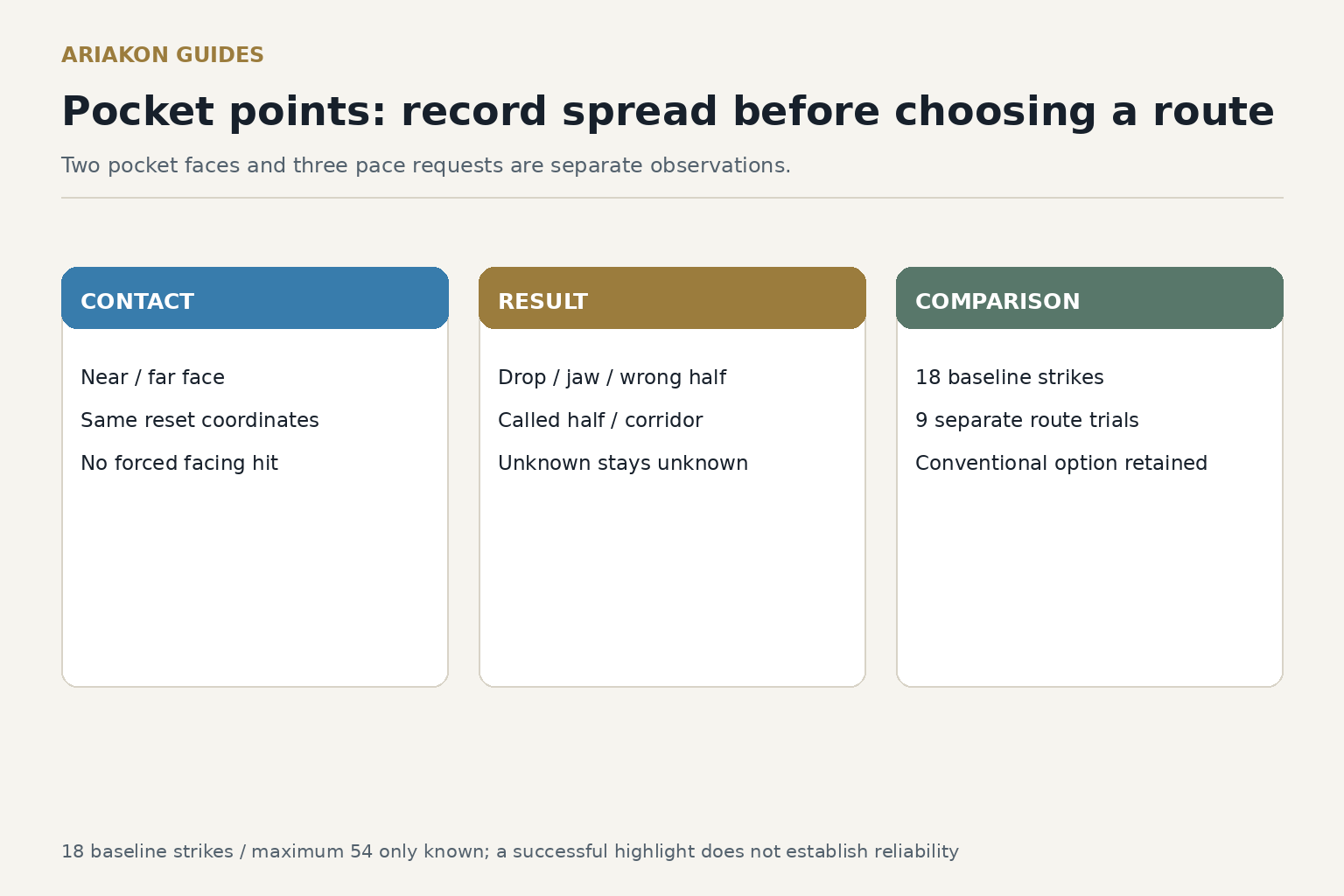
Treat the pocket as table-specific equipment
Pocket entry and rebound depend on entry direction, speed and the actual facing construction. A ball arriving near a point may contact cushion nose, facing, both surfaces in quick succession or the opposite jaw. That contact sequence is not visible enough to justify a universal rebound angle.
Inspect the chosen pocket before practice. Stop if the cushion, facing or cloth is loose or damaged. Never strike a point hard to create a more dramatic result, and do not use this drill as permission to damage house equipment.
Review transferable trick-shot controls before testing a specialty contact on an unfamiliar table.
Build two mirrored point lanes
Choose one corner pocket. Place an object ball one diamond up the long rail and one ball-width off that rail. Put the cue ball two diamonds away on a line that sends the object ball toward the near pocket point. Mark a broad one-diamond landing corridor on the opposite half of the table using rail diamonds only.
Mirror the object-ball and cue-ball positions to address the far point. The setup tests the object-ball rebound; do not place a blocker or another object near the pocket. Take a photo or coordinate note so all eighteen attempts use the same starts.
Run an eighteen-shot dispersion audit
| Pocket contact | Soft | Medium | Firm controlled | Attempts |
|---|---|---|---|---|
| Near point | 3 | 3 | 3 | 9 |
| Far point | 3 | 3 | 3 | 9 |
| Total | 6 | 6 | 6 | 18 |
Score observation, not spectacle
| Result | Points | Code | Interpretation |
|---|---|---|---|
| Missed intended point zone or unsafe hit | 0 | M | Delivery did not test the claim |
| Point contact; drop, jaw or wrong half | 1 | D / J / W | Contact occurred but route failed |
| Rebound reaches broad called half | 2 | H | Direction class repeated |
| Rebound finishes in one-diamond corridor | 3 | C | Useful placement for this setup |
Use the spread, not the best attempt
Eighteen attempts have a maximum of 54 points. A speed-and-point cell is provisionally repeatable only when all three balls contact the called point zone, at least two finish in the broad called half and none threatens to leave the table. Record the full three-result spread, not only the prettiest rebound.
If one setting produces C, J and W, it is not calibrated. Recheck the start and reduce speed. If the same point sends all three to the same half but outside the corridor, move the target corridor only after a second unchanged three-shot set confirms the pattern.
Compare a conventional route
| Route | Attempts | Success condition | Match-use question |
|---|---|---|---|
| Best point setting | 3 | Called contact plus corridor | Does the smallest miss still leave a safe table? |
| Ordinary one-rail route | 3 | Ball through the same corridor | Is the larger contact surface more forgiving? |
| Containing safety | 3 | Cue ball or object ball reaches called safe zone | Can you avoid needing the rebound at all? |
Set a strict game-transfer gate
Use the pocket-point route in a scored game only if it wins the nine-shot comparison, the exact table and pocket have been tested that day, the miss does not risk equipment or an easy opponent leave, and ordinary routes are genuinely worse. Otherwise select the conventional rail or safety.
A filmed one-off success is evidence that a result can occur, not that it is reliable. The practical skill is recognizing the high-sensitivity contact and declining it when the table, score or leave cannot absorb the spread.
Choose safer kick, bank and curve routes when the pocket-point audit does not meet its game-transfer gate.