
Specialty shots · 4 min read
Compare Legal Jump and Massé Techniques Before Practicing
Jump and massé are not two versions of the same stroke. A legal jump drives an elevated cue ball down into the playing surface so it rebounds over an obstacle; a massé uses elevation, off-center contact and spin to curve the path. Both increase cloth, equipment and control demands. The first skill is deciding whether either belongs in today's rules, venue and practice plan.
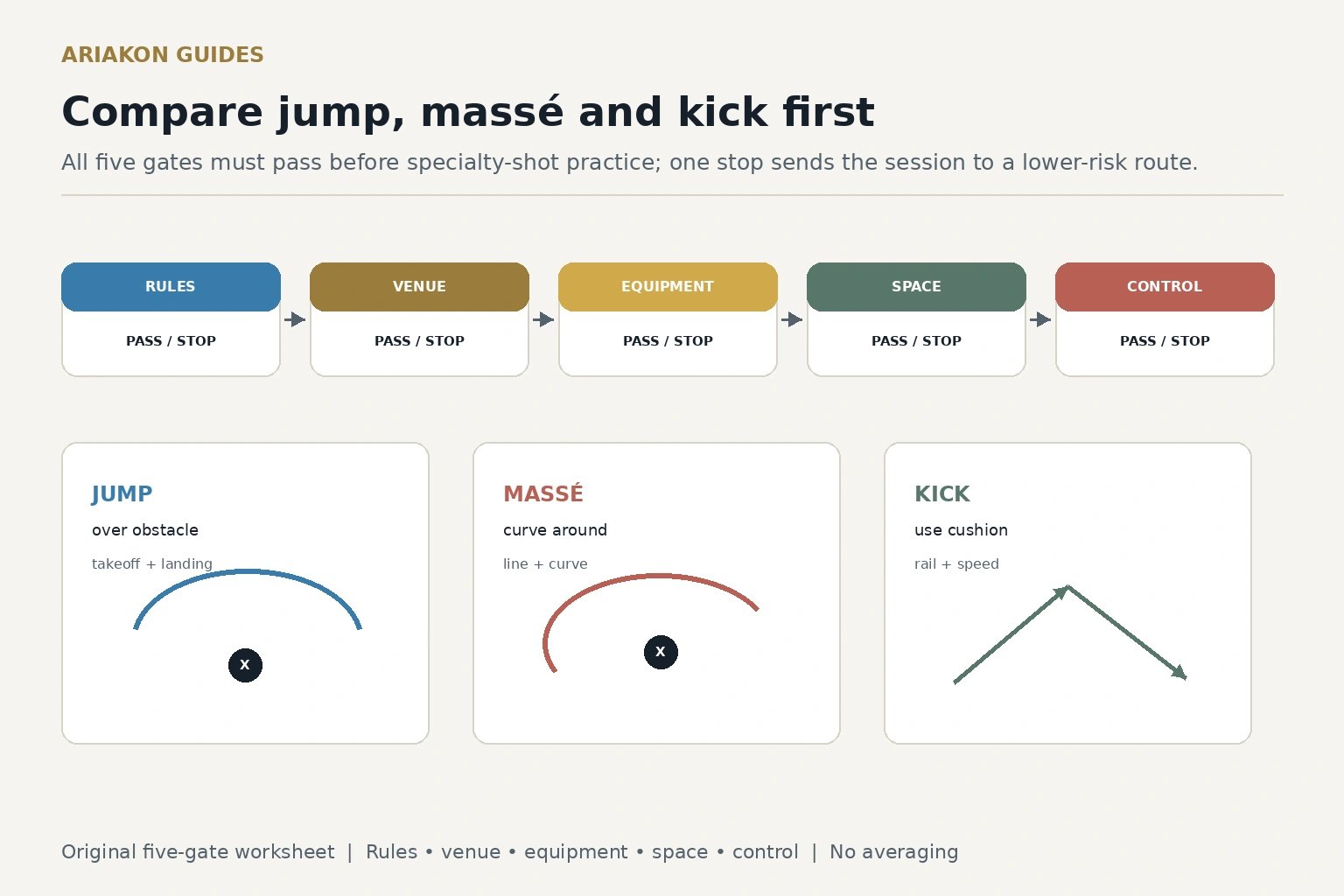
Start with the current rule and local permission
The WPA Rules of Play effective September 15, 2025 define a legal jump by an elevated cue and downward strike into the playing surface. The same rules treat a scoop—tip contacting cloth and cue ball together so the ball rises—as a miscue, and intentional miscues can be unsportsmanlike conduct. Blackball separately makes jumping over any ball a foul, showing why discipline matters.
The general WPA rules do not give blanket permission from a venue or equipment owner. Ask whether jump or massé practice is allowed, whether a dedicated practice table or instructor is required and which cue rules apply. A local no ends the comparison.
Choose among kick, jump and curve escapes for the broader match decision after rules and permission are known.
Compare the jobs, not the spectacle
| Dimension | Legal jump | Massé or strong curve | Lower-risk alternative |
|---|---|---|---|
| Primary job | Pass over an intervening obstacle | Curve around a blocking line | Kick or containing safety |
| Cue action | Elevated, downward legal strike | Elevated, off-center spin stroke | Normal-height rail route |
| Main precision | Takeoff, clearance and landing | Initial line, curve timing and speed | Rail contact and speed |
| Table exposure | Concentrated downward force | Tip proximity and possible cloth contact | Ordinary rolling contact |
| Prerequisite | Qualified instruction and permitted equipment | Reliable modest swerve before more curve | Basic kick calibration |
Apply five non-negotiable gates
| Gate | Pass evidence | Stop signal | Next action |
|---|---|---|---|
| 1. Rules | Exact discipline permits method | Unknown or expressly prohibited | Read current event rule |
| 2. Venue | Owner or instructor explicitly permits practice | No permission or fragile cloth | Choose normal-height route |
| 3. Equipment | Permitted cue and sound tip | Unknown cue rule, damaged tip or improvised prop | Inspect or obtain instruction |
| 4. Space | Clear landing or curve lane and empty perimeter | Ball, rail or person in uncontrolled zone | Redesign without blocker |
| 5. Control | Required prerequisite passes repeatedly | Hop, scoop, cloth mark or uncontrolled ball | Stop immediately |
Use a worksheet before placing an obstacle
Score each gate pass or stop; do not average them. Five passes allow only the planned entry exercise. Any stop sends the session to a kick, safety or lower-risk prerequisite. Write the rule link, permission source, cue, cloth condition, instructor or supervision plan and intended landing or curve zone.
Do not begin by jumping an object ball or attempting an extreme curve. A blocker makes failure more consequential and hides whether basic delivery is controlled. The World Pool-Billiards Association Artistic Pool Division lists Jump and Massé as formal disciplines, which underscores that these are developed skills, not casual shortcuts.
Choose a bounded entry exercise
| Path | Open-lane exercise | Three-attempt pass | Immediate stop |
|---|---|---|---|
| Jump | Instructor-defined downward contact with no obstacle; mark a broad landing zone | All balls stay on table; three legal contacts; two land in zone | Scoop, cloth contact, uncontrolled hop or ball off table |
| Small curve | Use the existing modest-elevation open-lane swerve matrix | Near gate 3/3; called far zone 2/3 | Miscue, hop, cloth mark or need for more elevation |
| Kick alternative | One-cushion lane through a two-ball-wide gate | Gate 3/3; legal object contact 2/3 | No safe perimeter or uncertain rule |
Calibrate only small swerve in an open lane before considering any stronger curve.
Work a decision example
Example: 9-ball permits a legal jump, the room allows it only with an instructor, the player has an approved cue but no supervised session today, and a one-rail kick is open. Rules pass, equipment passes, but venue conditions do not. The correct worksheet result is kick—not an unsupervised jump justified by a three-out-of-five score.
Second example: a small curve is allowed, the lane is empty and the player passes the modest-swerve gate without hop. That supports repeating the same small-curve exercise. It does not authorize a steep full massé or prove match reliability.
Promote technique only after control survives conditions
Record ten separate prerequisite sessions before narrowing a landing zone, adding a blocker or increasing curve. Each session must name table, cloth, ball condition, permission and pass result. A single cloth mark or uncontrolled ball ends that session and requires inspection.
In match play, the route still must outperform a legal kick or safety on contact probability and miss consequence. A spectacular option is not automatically the responsible or percentage option.
Sources and further reading
References support the specific factual information above. The practical checklists are Ariakon editorial guidance.