
Specialty shots · 5 min read
Kick, Jump or Curve? Choose the Best Escape
Choose an escape only after checking legality, accessible space and evidence that you can execute the complete task. The apparent shortest line does not establish the safest choice, and a legal first hit does not automatically establish a legal shot. This is a decision worksheet, not a tutorial for learning an elevated-cue technique during a match.
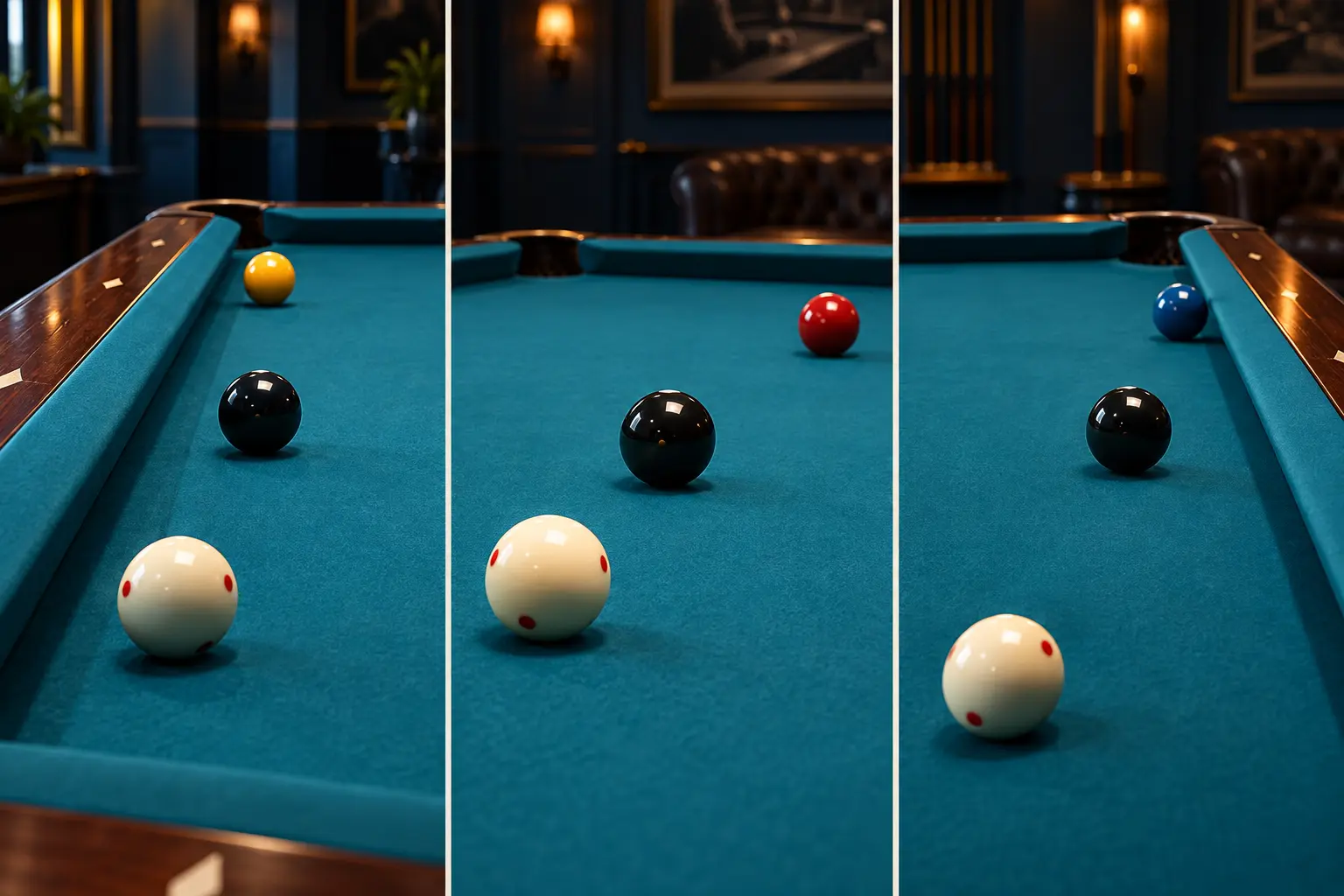
Eliminate unavailable options before comparing scores
The WPA rules page currently links the rules effective September 15, 2025. Its general jump definition requires an elevated cue to drive the cue ball into the surface and rebound; intentional scooping or miscuing is not a legitimate shortcut. Individual disciplines and rooms may prohibit jumping even when a stroke would meet that definition.
If a gate is unresolved, defer that candidate. Do not assign it a poor score and then select it because another technique scored worse. Normal fouls, deliberate misconduct and game-specific strategic choices are not interchangeable; this worksheet does not recommend an intentional foul.
| Gate | Record before selection |
|---|---|
| Game | Current discipline, first required ball and later cushion/pocket requirement |
| Venue | Explicit permission for the method; unknown permission means unavailable |
| Equipment | Permitted sound cue, tip and assembly; no improvised parts |
| Space | Clear cue/bridge motion, cloth area, landing and perimeter |
| Repetition | A previously practiced controlled input, not a new power experiment |
| Consequence | Actual scratch, ball-off-table and likely reply risks beyond first contact |
Inspect one blocked geometry without claiming three proven routes
Coordinates describe ball centers on an illustrative 100×50-inch bed: x=0..8 along the length, y=0..4 across the width, origin at the lower-left cushion-nose corner. Equal 2.25-inch balls have radius 0.09 and diameter 0.18 units. Intact-cushion center limits are 0.09 and 7.91 in x, 0.09 and 3.91 in y. Pockets interrupt these limits at the four corners and at (4, 0),(4, 4). Inspect actual mouths and jaws; scale to the measured bed and actual ball size. These are not universal diamond coordinates. Remove measuring aids before a shot; do not mark a competition table.
Use C(2.4, 0.8), required target T(6.5, 2.2) and higher-numbered blocker B(4.45, 1.5). The blocker is centered on the direct line. The upper-cushion mirror candidate uses V(6.5, 5.62), R(5.045436, 3.91), with cue-center first contact (6.383374, 2.337107). Both kick legs clear B by more than a ball diameter. This establishes a candidate line, not a safe leave.
For a jump, the airborne center must avoid B and land in controlled open cloth before T; for a curve, the complete cloth path must clear B without touching another ball or damaging cloth. No cue angle, flight height or curve amount is specified by the top view. Only attempt those candidates with prior controlled competence, appropriate supervision and explicit permission.
Build the beginner kick construction when the first rail line is the unresolved part.
Measure jump landing distance separately before treating a clear airborne line as a usable escape.
Compare complete tasks, with unavailable rows left blank
In an ordinary practice session, record five struck trials of each available candidate at the frozen layout. If only the kick is permitted and practiced, that is five attempts, not fifteen failed or imaginary trials. Do not teach yourself a jump or curve simply to complete the table. No loose object or paper remains on the cloth.
For a common finish request, use the cue-center rectangle x=1..3, y=2.6..3.4. It is a chosen goal to compare observed results, not a prediction that every route reaches it. Score each attempt 0 for a foul or no required hit, 1 for a complete legal result outside the requested zone, 2 for a complete legal result inside it. A candidate with five trials has maximum 10; compare only common permitted conditions.
| Candidate | Permission/input confirmed | Actual attempts | Required first hits | Complete legal outcomes | Legal plus finish zone | Scratch/off-table or other problem |
|---|---|---|---|---|---|---|
| Kick | Yes / unavailable | Record | Record | Record | Record | Record |
| Jump | Yes / unavailable | Record | Record | Record | Record | Record |
| Curve | Yes / unavailable | Record | Record | Record | Record | Record |
Let consequences veto a tempting hit count
Hypothetical same-layout records: kick 5 trials, 4 first hits, 3 complete legal outcomes, 2 legal-zone finishes; jump 5 trials, 4 first hits, 2 legal outcomes, 0 zone finishes, with one scratch. The kick scores 5/10 and the jump 2/10 under this practice rule. Curve is unavailable, not 0/10. These tiny samples are local observations, not calibrated probabilities or universal technique rankings.
Inspect the opponent’s actual reply after a legal shot. The rectangle may not hide the target or prevent a pot; write direct view, blocked view or uncertain and note the relevant line. If the zone repeatedly leaves an easy return, refine the goal before using the score as strategic evidence. Stop any session when an unsafe flight, cloth contact or unstable elevated delivery occurs.
Build the defensive leave as a distinct task when making contact is no longer the limiting event.
Make a match decision using only established evidence
Recheck the real balls and current rule situation; the practice marks are not the match. Choose an available candidate with a controlled input and acceptable miss consequence. A longer kick can beat an unpracticed jump, while a well-established permitted jump may be better in another geometry. No broad subject rule chooses for you.
If none has a safe, legal, reproducible input, ask the qualified official about the applicable procedure and accept the actual game consequence. Keep learning outside the match. The Ariakon store destination below is verified as a break-and-jump cue listing, not evidence that its current tip or configuration is accepted by your event or that it guarantees escape success.
Inspect the current Ariakon break-and-jump configuration and independently confirm equipment acceptance for the actual event.
Sources and further reading
References support the specific factual information above. The practical checklists are Ariakon editorial guidance.