
Strategy · 4 min read
Turn Defensive Kicks Into Controlled Replies
When you are hooked, the first task is legal contact. The next task is limiting the opponent's opportunity. A defensive kick uses speed, contact fullness and a chosen rail route to separate the cue ball and object ball after the hit. It turns an escape from a hopeful touch into a planned reply.
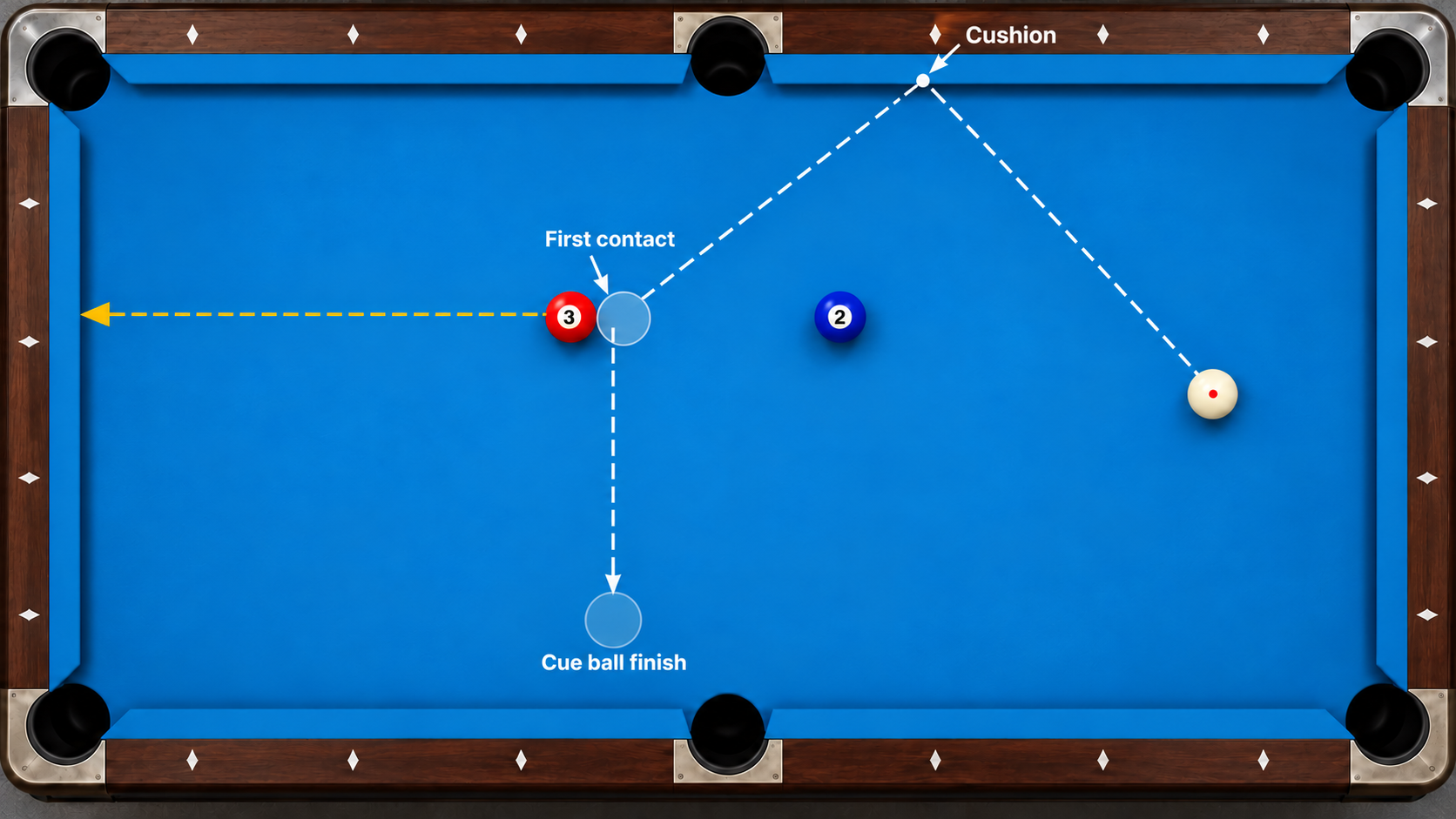
Define success before choosing a rail
Identify the legal object ball and the post contact requirement for the game. Then rank outcomes: pocket the ball if a high percentage route exists, create distance, send one ball to cover, or at minimum avoid leaving a straight open shot.
A route that makes contact easily but sells out every time is incomplete. A difficult two rail route may also be wrong if a simpler one rail hit can send the cue ball safely up table.
For ordinary WPA eight ball, nine ball and ten ball shots, a cushion touched before the object ball does not satisfy the post contact rail requirement. If no ball is pocketed, a ball must reach a cushion after legal object contact. A push out and some other disciplines have different rules. The illustration uses a legal red 3 in an eight ball solids layout; it is not a rotation setup with the 2 still on the table.
Choose the largest legal contact window
View the object ball from the last cushion and estimate the visible interval between blockers. Aim through the middle of that interval when a full hit is safe. If the defensive result needs a thin edge, identify which side sends the two balls toward safer regions.
Build in table error. Spin, rail compression and speed can shift a kick line. A route with a ball wide contact window is preferable to one that demands a paper thin edge unless the wider hit creates an obvious loss.
Use contact fullness to create separation
A fuller kick transfers more cue ball speed into the object ball and tends to reduce cue ball travel after impact. A thinner hit preserves more cue ball speed and sends the two balls in different directions. Use that relationship to choose the escape.
If the object ball is near danger, a thin contact that leaves it near its current cushion may be safer. If the cue ball can hide behind traffic after a fuller hit, moving the object ball away may be the better trade.
Control speed before adding English
Begin without sidespin and calibrate speed and vertical contact until the cue ball reaches the intended object contact. Center at the tip does not guarantee stun at impact because cloth friction develops roll. For the illustrated vertical departure, adjust vertical contact to arrive with little forward or backward rotation. Use enough speed for a ball to reach a cushion after contact when required, then measure the actual finishes.
Add sidespin only when it meaningfully changes the cushion line or the cue ball's path after contact. Recalibrate that route because sidespin can change the initial aim, curve and cushion rebound. A familiar mirror system is only a geometric starting point.
Check the return from the other chair
After choosing the kick, imagine the opponent at the expected finish. Can they see the entire object ball? Is there a natural bank or combination? Can they play a simple safety that leaves you in the same trap? Adjust toward distance or cover if the reply is too comfortable.
The score matters. When giving ball in hand would likely lose the rack, favor the route with the largest legal contact margin. When the opponent already has a simple runout, a more aggressive separation may be justified.
Practice with result based scoring
- Choose an eight ball layout with the 3 as a legal first ball and the blue 2 blocking the direct route. Record ball centers and the chosen cushion point before the first attempt.
- Score zero for any foul or scratch. Otherwise earn one point for the complete legal shot, including a pocket or the required cushion after contact.
- Add one point if the final centers are separated by at least half the playing length. Measure straight line separation rather than guessing from the artwork.
- Add one point if the opponent has no direct pocketing shot on a legal ball. Check from the actual finish, not from your predicted finish.
- Repeat ten times for a maximum of 30 points. Log legal contact, separation and reply separately. Change one variable only after a repeatable miss. The pictured finish is a route concept, not a promise of a successful safety.
Sources and further reading
References support the specific factual information above. The practical checklists are Ariakon editorial guidance.