
Strategy · 2 min read
Use Three Questions to Choose the Right Pool Shot
Good shot selection is not a hunt for the cleverest option. It is a short comparison of what you can execute, where the cue ball must go and what the table looks like when the attempt fails. Three questions make that comparison fast enough to use in real play.
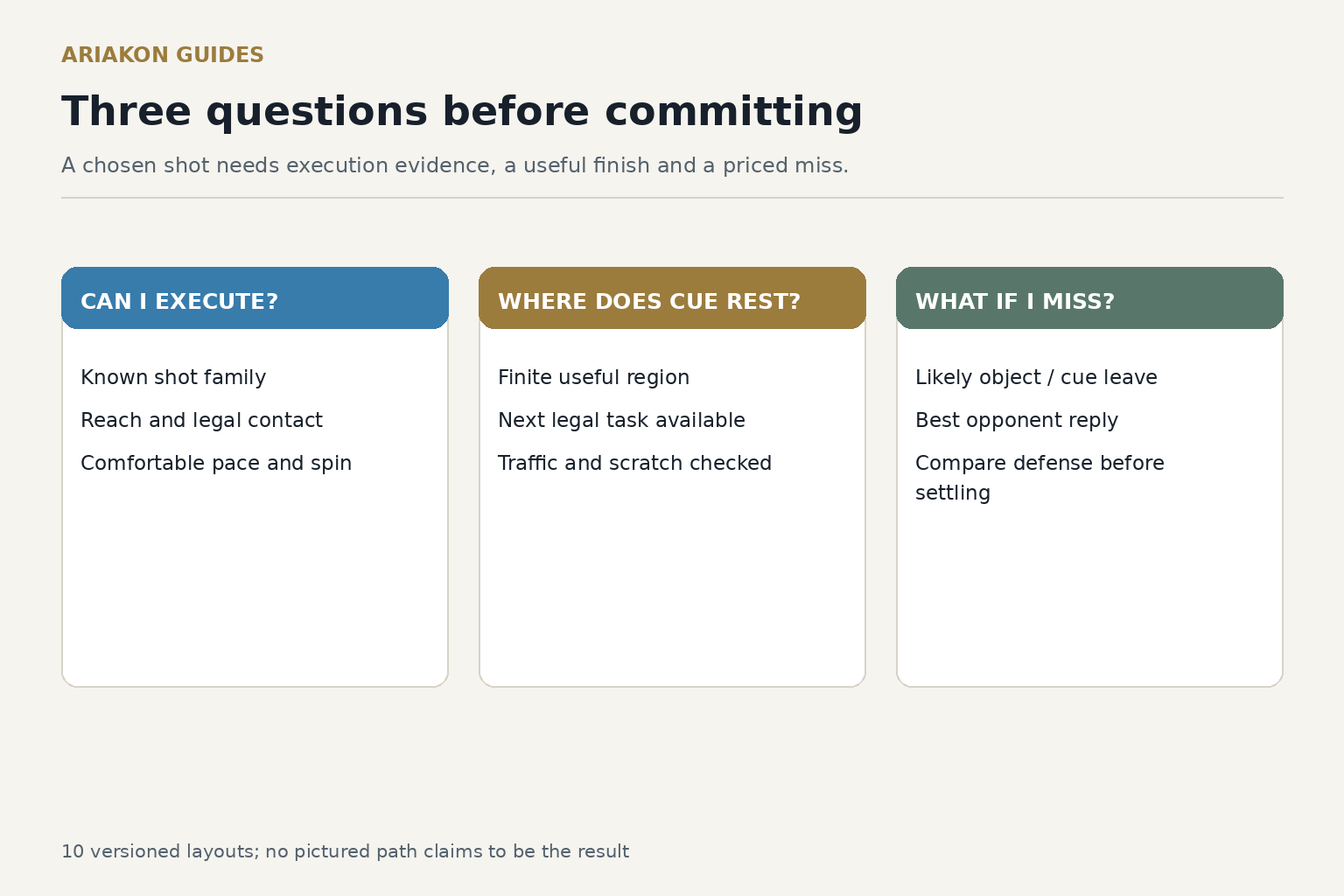
Question one: what can I execute now?
Name the shot, pocket and required contact before getting down. Judge the cut angle, distance, bridge access, speed and spin against shots you have actually practiced.
A shot is not high percentage because it looks easy from a distance. If the position requires an unfamiliar power stroke or extreme spin, include that execution demand in the decision.
Question two: where must the cue ball finish?
Define a position zone rather than one perfect point. Prefer natural cue-ball routes with fewer rails and less sidespin when they leave a useful angle on the next ball.
If every successful version of the shot sends the cue ball into traffic, toward a scratch or onto the wrong side of the next ball, a different pocket or a defensive choice may be stronger.
Question three: what happens when I miss?
Trace the likely object-ball miss and cue-ball finish. A difficult shot that leaves both balls open can lose the rack immediately. A slightly less ambitious route may preserve distance, cover or a difficult reply.
This is not permission to play timidly. It is a way to compare expected results. When the reward is large and the miss is survivable, offense can still be the correct percentage choice.
Use a simple practice score
- Before each layout, write O for offense, D for defense or T for a two-way attempt.
- Record whether the chosen shot was executed, not only whether a ball fell.
- For each actual attempt, score 0 for known foul or failure of the called primary result,1 for that result,2 for it plus the predeclared finite cue-center zone. Keep the actual opponent reply separate. Ten known attempts permit 20 points; unknown required evidence leaves the nested score unscored.
- After ten layouts, review decisions that produced an easy reply for the imaginary opponent.
- Repeat the same layouts and compare the second set without changing the scoring.
Make the decision before your stance
Finish the comparison while standing. Once you select the shot, commit to its line, speed and cue-ball target. Reopening the debate during the final stroke encourages steering.
If new information appears when you get down, stand up and restart. A clear reset costs less time than delivering a stroke while caught between two plans.
Sources and further reading
References support the specific factual information above. The practical checklists are Ariakon editorial guidance.