
Strategy · 3 min read
Ask Three Questions Before Every Nine-Ball Shot
Nine-ball gives every shot a clear legal starting point—the lowest-numbered ball—but it does not choose the right pocket, cue-ball route or risk for you. Three questions keep the whole rack in view without requiring a long calculation before every stroke.
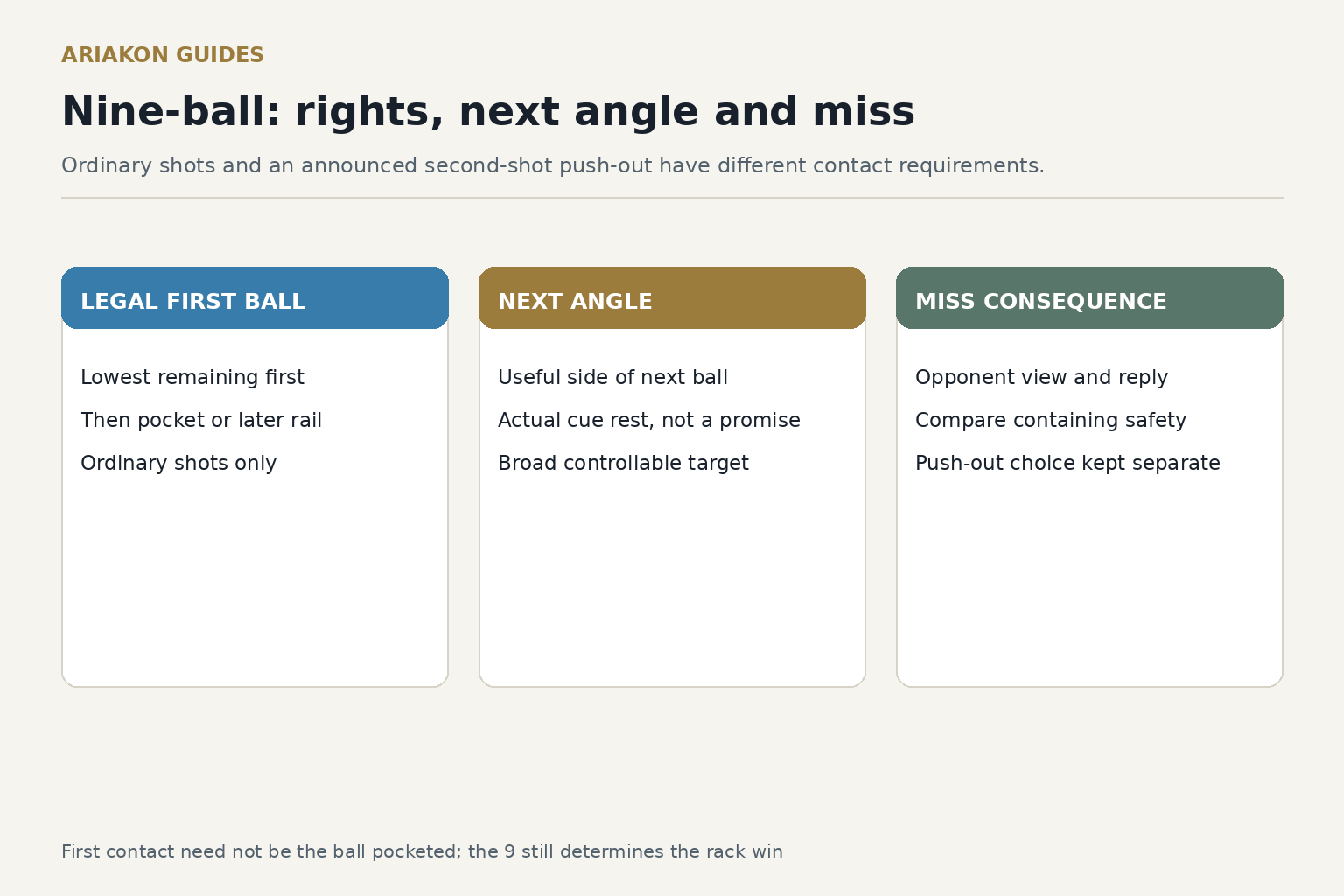
Question one: what is the legal first contact?
Under current WPA nine-ball rules, the cue ball must contact the lowest-numbered ball first on ordinary shots. Identify that ball before considering combinations, caroms, safeties or a direct pocket.
A legal first contact does not require the lowest ball to be pocketed. That creates offensive and defensive options, but the no-rail-after-contact and other standard foul rules still apply.
Question two: what angle do I need next?
Work from the next ball backward. Choose a useful side of that ball, then select a cue-ball route with a wide landing zone. Position is more reliable when the cue ball travels into the line of the next shot instead of crossing a narrow window.
Do not chase perfect straightness automatically. A modest angle often gives you more natural movement toward the following ball.
Question three: what table do I leave?
Trace the likely miss. If both the object ball and cue ball remain open, a difficult offensive attempt may give away the rack. Consider a safety, a two-way shot or a route that sends one ball toward cover.
Inspect separation and available blockers as explicit defensive outcomes. The best defensive choice controls both balls rather than merely hiding the cue ball by chance.
Treat the push-out as a separate decision
Current WPA rules allow the player taking the second shot after a legal break to announce a push-out. The usual wrong-ball-first and no-rail-after-contact requirements are suspended for that shot, and the opponent then chooses who shoots next.
A good push-out is not simply an escape from a hard shot. Place the table where your opponent faces a real decision and where you understand the likely reply if the shot is handed back.
Practice the questions with short patterns
- Use an ordinary midrack nine-ball practice layout with 1,2,3 and ball in hand, not a break or push-out. Record all three centers and a legal initial cue placement before starting.
- For an exact example use the three-ball pattern in the linked stop-pattern guide: the first cue center C(2.014845,1.398578),1 at(3.280465,1.948675) to real upper-right(8,4),2 at(3.569231,2.966154),3 at(1.75,1.4), on its illustrative 100-by 50 inch bed and 0..8 by 0..4 grid. Confirm actual ball size and jaws; remove aids before shooting.
- Take five reset first shots only. Before each, state first legal ball, intended finish disk radius 0.36 about G1(3.115385,1.876923), next legal 2 route and likely miss consequence. Do not play the later balls inside this baseline.
- Score 0 known foul/miss,1 legal 1 pot,2 pot plus known finish in disk. Five fully known strikes have ceiling 10. Unknown required finish keeps the known pot separately and nested score unscored. A good finish does not certify a playable next ball without checking the actual line.
- After the five-shot record, play three separate three-ball innings from the same cue placement, stopping each at its first miss/foul. At most 9 additional strikes and 9 legal-pot outcomes; keep those counts separate. Do not add a fourth ball or declare reliable patterns from an unobserved opening.
Use exact three-ball contact-center planning for the complete geometry rather than an assumed simultaneous route in a picture.
Sources and further reading
References support the specific factual information above. The practical checklists are Ariakon editorial guidance.